Visualizzazione post con etichetta editions. Mostra tutti i post

domenica 20 maggio 2012

THE WOOD BURNS (en)

Dear Fenrir’s writers.
I just read your last publication and I want answer to the “debate” explicated into the lines of the editorial and in the next pages and I write you this mail:

At the page 61 of the last Fenrir number you put a paragraph on my absolution and the absolution of the comrade Mattia.But you put my name at the page 18 too, in reference to the CARI-PGG “Revolutionary Anarchist Cell – Gabriella Segata Antolini” attack. Until now it seemed to me that I was precise and conform to what you put in the above mentioned pages. My interest in “debate” arises spontaneously reading the paragraph on my absolution and the absolution of the comrade Mattia.
I mean that, at least to me, it’s fundamental to be “free” to express our selves, without any occlusion, and overall in anarchic context, nobody can tell to another anarchist “you have to do this or that”…
You as promulgators of Fenrir zine, are naturally free to express and express yourselves as you like… on this nobody can put his “voice” on that
Attention, because just specifying, and being specific, you can understand what I mean with “voice”:
I as individual, I won’t for sure force you to write what I want, but this because the paper is yours, as I feel mine (and my affines’), Edizioni Cerbero.
But since in the paragraph and in the CARI-PGG attack transcription there is my name, I want to specify that:
Some months before the end of the trial I put on internet, and I sent to comrades and affines, a text called:
“A break from the endless possibilities”
So, now, in the text, I wrote clearly and with a premise, fundamental to me, that I separated myself consequentially to the comrade Mattia, co-defendant with me into the trial for explosive material.
Some weeks after someone put this text on Indymedia Lombardia with a pseudonym that gives anonymity to this person.
I put hand to my fantasy and I put again with my name the complete text.
Now, to return to what I wrote above:
Who can, in a hidden way, not to put a premise, that sharply “cut” the text itself and make it seems that I and the comrade Mattia stay together in the trial, or continue into the same path with the same choices for both?
Each individual in his choices has to be free to do what he like, and not following any moral, he can use forms suited to him, to reach a result:
So, denying the moral (anarchist moral too), I don’t deny to another individual to put a text without the premise, but the same individual has to take his own responsibilities , when who wrote the text itself will read and will act consequentially.
I invited to the anonymous extensor to show him up, but without any result…
My interest point, into writing this to you, is to specify how I act, in anarchist context and that as individual, I defend with all my strength and all my claws.
I put a specific text, I don’t care if good or bad, but “clear”, without too many facets or references to who-knows-what “bourgeois justice”, to exploited and exploiters…
In the text it’s me “individual, inseparable from myself.
In the same way (the difference is present into the “non”-anonymity), meanwhile I as individual, make clear my choice, and to be more clear I write to who’s interested that he can write me to my e-mail, to “debate”, you don’t put absolute anything that could make understand to who read that my choice is completely opposed to that of the comrade Mattia, and this “rupture” is due to peculiar choices, that I made to preserve me as individual who put before him how to act in choices context.
However the comrade Mattia make the same thing writing a public text, by citing me, to make clear his choice.
This last text arrives to me from one of the Fenrir’s editors (right?) with a mode that I’d like to debate on with the same extensor of the mail that I received:
you text’s extensor, write “me”, but like if you talk with the comrade Mattia, right?
But this specific form of structural and synthetic simplification, is maybe nullifying the individual, and to consider “everything” as individual itself?
The form used presupposes the use of the subject as equal form of the structural form?
I come back saying that you being editors and owners of the zine Fenrir, you can move me as you want, but I’m free, since you wrote to “debate”, to “invite” too, without any anonymous form to the debate, inviting who is interested to the “debate” itself.
But primarily because this concerns my choices, that in your paragraph aren’t even mentioned, but is put a line that doesn’t make understand anything, if not that there was an absolution.
And there are 2 texts (more “Negare ogni resipiscenza” signed by both us co-defendants), that were published.
But now, I want to specify again:
You could put a note or a long text, your idea on the juridical theme and on the choices made in the context of “justice”, may them be for or against.
You embellished yourselves in the lines you write, to specify the various position in the anarchist context, that are specific for each individual that choose them but:
Nothing, like if I and Mattia had always gotten along, and both me and him did not separated in any way in the trial context.
I ask you:
How can a comrade understand the difference, if you don’t put anything that could make understand something different to the absolution?
And in the same way, you act in the field of simplification and nullification of any individual and peculiar choice, by citing my name wrote into the CARI-PGG claim text, but it was simple to put just a line more, that they give me solidarity!
But I ask you:
But how can the comrade to understand why CARI-PGG give me solidarity?
If you had put the part where they cite me (and I claim my support toward them in the attacks they made), the reader would read and understand that they gave me solidarity too, because they supported my anti-juridical conduct in the trial…
There’s no trace of this, and this make me think that you don’t care at all about what was the trial, or you have a divergent or opposing idea from mine, or from other comrades that made similar choices…
But what do you think about this?
It would be interesting to understand, but this in a extended way, and not only on my trial, or on my choices.
The systematic reduction of a communiqué (intended as communicate), can bring to the detriment of the meaning of the communication itself, because it narrows to a cancellation of the significant signs that the communiqué wants to give:
if I (in general) communicate something that doesn’t communicate anything, then the text becomes something that is incommunicable.
But I mean this not in the sense that a text must “say” something that is comprehensive at all, but it has to be something specific, because if not every text extensor’s communicative singularity is nullified.
I don’t care at all to “say” we’re all comrades, and I see in a specific way each peculiar difference.
So I’m or not free to act how I like?
I repeat: the zine is yours and you can act as you want, but if I read in 2 paragraphs that there’s my name and there’s nothing that could make understand that my choice was not Mattia’s choice, and that furthermore there’s a specific text on the trial against me, that there’s an invite to debate, then I can answer you…
Like, on the other hand, is omitted the part of the CARI-PGG claim where they give me solidarity for a precise reason (that in the claim paragraph there’s not), that is that of my trial choice and my choice to revoke the lawyers, and my trying in all ways to nullify the use of legal right.
Now, you can don’t answer me too, but why, which is the reason, in a specific note in the CARI-PGG claim, not to put that they give me solidarity because of precise reasons?
Into the anarchist context, but not the stereotyped one, individual choices are fundamental: they’re the essence  of the individual itself.
Into the anarchist context, the individual who propose itself and make a personal choice, in which he takes his own responsibilities, acts in a clear way and without hiding anything.
Into the anarchist context, individual essence is his acting as he like more, breaking when and how he wants any imposition, may it be moral or material.
Into the anarchist context, the individual doesn’t have to submit to anything that can impede him his free will and if he has to act because he made a choice, he’ll do it, even if the others won’t agree with him.
Into the anarchist context, acting has to be go against too, without content the majority, and if he has to break to preserve his peculiar essence, he’ll do it, and the moral won’t stop him.
Into the anarchist context, the use of own Ego is the essence itself of the individual, who’ll start from his own choice, essential to himself, and just after, joining him in a informal way he’ll can come to “terms” with another individual.
But without submit to any law that could stop him from “breaking” this union, if doesn’t want anymore to, respect to his inseparable singularity.
My letter to you wants to preserve my individuality that, into the trial context, broke, to continue my individual choice, because ceased that affinity in the choices of own way to act into the trial against me and the comrade Mattia.
With the comrade Mattia, I talked about this and other openly, without remain silent on anything, and he continued in his choice that is his choice and just his, as on the other and I did, without submit to any stupid anarchist moral imposition in saying and doing.
You didn’t put anything that could make understand the total difference between me and the comrade Mattia, into the trial against us.
And you repeated this into the CARI-PGG attack claim text, omitting that the solidarity was due to specific reasons into the trial context and of the logic right use.
At this point I ask you:
But how do you intend “debate”?
Fede and for total sharing Maurizio/Ed. Cerbero

martedì 15 maggio 2012

(es-en) Invitación para el libro “Poemas de Amor y Guerra” ★ Invitation to the book “Poems of Love and War”


* Entropía Ediciones
El regreso momentaneo de la Editorial Lxs Niñxs Salvajes se sitúa temporalmente en las álgidas luchas vividas a lo largo del año que pasó (2011) en todo el mundo. Casualidades no existen. Se viven movimientos de lucha, entre metodologías reformistas, y radicales revolucionarixs.
La memoria nos llama, nos incita a contribuir desde nuestras capacidades al choque con esta realidad. Nos habla cada noche entre las caminatas nocturnas, o los pedaleos diarios. Nos pide que no se nos olviden esas caras tras los paños, esas ideas tras el fuego, ese amor tras la destrucción.
No sería digno si dejasemos a todxs esxs seres en el lodo del olvido. A quienes entregan su vida y su muerte a cambio de todo. No es razón para olvidar que no les conocimos, que no los hemos acariciado.
No hay motivo para quien desea hacer del hermoso acto de la subversión, olvidar esos nombres sin al menos haber sufrido un pequeño infarto al enterarte de su desgracia, o descubrir la historia de esxs que hace años ya partieron peleando cara a cara con la vida, sin temor a la muerte.
Acá estamos, y les dejamos la invitación para que participen en la creación del libro “Poemas de Amor y Guerra, sentimientos de amor y odio”.
* * *
Invitación a un Gesto de Amor y Rabia en solidaridad internacional con lxs presxs del mundo.
Largas noches de encuentros entre uno que otro tejado, blasfemando, reflexionando y atacando desde nuestro que hacer cotidiano a la maquinaria capitalista, nos enfrentamos a un hecho concreto de facto en nuestro aporte desde la propaganda, la rearticulación de lo que alguna vez llamamos Editorial.
Debido a la contingencia que se vive en la lucha revolucionaria de sujetxs posicionadxs irreconciliablemente a uno u otro lado de la barricada, nos enfrentamos a una dura tarea que a lo largo de la historia han sabido mantener lxs compañerxs en todas partes del mundo, la solidaridad entre aquellxs que despreciamos las lógicas del Poder.
Esto nos llevo conciente o inconcientemente a reencontrarnos como una célula difusa y en constante transformación que golpea de la mejor manera que sabe, y es la de propagación activa de la idea antiautoritaria, buscando mantener e intensificar la tensión y la contradicción que nos presenta día a día el sistema dominante.
Somos Lxs Niñxs Salvajes, lxs mismxs que nos juntamos por esa prisa de aportar a la reflexión desde nuestra editorial, y tuvimos que esparcirnos por el mundo, para volver con un poco de amargura a continuar con este proyecto que habiamos abandonado para asumir nuevas aventuras con la idea de agitación permanente hasta que todo reviente. Nada ha cambiado durante este tiempo. Seguimos y seguiremos en guerra.
Apoyándonos en estas premisas y sustentándonos bajo una mirada histórica de la propaganda anarquista, nos damos cuenta que los escritos en solidaridad con lxs perseguidxs y su respuesta reciproca, han sido una constante a lo largo de la historia, que incluso con la represión pisando nuestros talones, no se ha detenido, es mas, se intensifica, como podemos apreciar en el escrito de Simón Radowitzky luego de su encarcelamiento por ajusticiar al jefe de policía de Buenos Aires (Argentina), Ramón Falcón, quien el 1º de mayo de 1909 hizo matar a una decena de obreros en la Plaza Lorea; desde Ushuaia escribe a lxs compañerxs “el penado 155 esta enfermo y débil, el anarquista Simón Radowitzky continua siempre firme, siempre fuerte”, a su vez lxs compañerxs desde fuera del encierro responden a nivel mundial con una campaña internacional en busca de la liberación del joven anarquista que durara 20 años.
Por su parte, los brotes de solidaridad comienzan a germinar en todas partes, Miguel Arcángel Roscigna, secretario del comité pro-presos y deportados de Buenos Aires, es un anarquista que sin conocer a Simon, comienza a gestionar la fuga de este en 1924 empleándose como carcelero, muchos se han encargado de decir que el plan fue un fracaso a causa de la denuncia de los comunistas, pero bien sabemos nosotrxs que no se concretó la liberación del compañero, pero se incendia la casa del director del penal como un gesto solidario de fuga permanente hacia lxs compañerxs presxs.
Estos gestos solidarios bien lo saben lxs compañerxs de Conspiración de Células del Fuego (CCF) que en su intento de fuga el 12 de diciembre de 2011, declaran: “Algunos se van a apresurar de hablar sobre un fracaso. Sin embargo, nuestra fuga ha tenido éxito. Nos hemos fugado del derrotismo de aceptar a nuestro papel de presos. Nos hemos fugado de ese estado somnoliento causado por medicamentos que en las cárceles se reparte con manos generosas, de los beneficios de jornales del trabajo carcelario, de las ilusiones sobre unos futuros permisos y suspensiones de condena, nos hemos fugado actuando como anarquistas revolucionarios.”
Siguiendo por una pequeña pincelada histórica de la solidaridad entre anarquistas retomamos a Roscigna y a Gino Gatti que en 1929 financian el plan de liberación de los hermanos Vicente y Antonio Moretti, y a tres anarquistas catalanes acusados de ser los responsables de atentados con bombas en Barcelona. En marzo de 1931 se concreta el plan de fuga de la cárcel de Punta Carretas, por un túnel realizado por lxs compañerxs anarquistas desde una carbonería que se ubicaba en frente de la cárcel.
Años mas tarde en 1971 desde el mismo centro de tortura se logran fugar 106 militantes del Movimiento de Liberación Nacional-Tupamaros y 6 presos comunes del penal de Punta Carretas, estos encontraron en medio el túnel, las palabras que hoy en día nos motivan a escribirles, “la solidaridad entre anarquistas no es solo cuestión de palabras”.
En el contexto actual de la lucha revolucionaria y la solidaridad entre compañerxs encontramos numerosos gesto de amor y libertad, aun en el encierro de nuestrxs hermanxs salvajes que solidarizan a lo largo del mundo. El 2 de diciembre del 2011 lxs compañerxs de la Conspiración de Células del Fuego y Theofilos Mavropoulos sacaron una carta en solidaridad con Rami Sirianos, juicio que se iniciará el lunes que viene, 5 de diciembre de 2011 “[…] …La solidaridad entre nosotros no es simplemente una obligación más o unas fáciles palabras escritas sólo porque sí. Es la esencia de nuestros valores y de nuestra ética revolucionaria. Es nuestra propia percepción del compañerismo.”
Estas palabras nos dejan claro la importancia de la solidaridad entre guerrerxs tanto fuera como dentro de las cárceles por lo tanto “Cuando las rejas de la prisión bloquean nuestras manos a lanzar el fuego de la anarquía contra el mundo del Poder, entonces nuestras palabras se convierten en la escofina afilada de nuestro escape.” (CCF y Theofilos Movropoulos, 15/11/2011) “Nuestras palabras que se fugan de la prisión, tratan de romper el muro de papel de los textos para transformarse en acciones. Es una manera de comunicación con esos hermanxs nuestrxs, no sólo en Grecia sino también al nivel internacional” (CCF y Theofilos Movropoulos, 07/11/2011) “Creemos que la cuestión de la solidaridad internacional anarquista y de la liberación de compañerxs, es uno de los más fijos valores y prioridades estratégicas para lxs anarquistas de acción. Por esto nosotros, la CCF de Primera Fase-FAI, llamamos a todas las individualidades y células de la FAI-FRI a no dejar a nuestrxs hermanxs en Indonesia y Chile solxs. Existen palabras que tan bellamente acompañan al fuego y la pólvora, mandando saludo y señal de solidaridad a los compañeros aprisionados.” (CCF, 07/11/2011)
Por lo tanto, no olvidar es un ejercicio de honor con nuestros valores, que nada tienen que ver con los del dominio, y de reafirmar en cada ejercicio de memoria, que ningún/a revolucionarix caídx en combate, como también encarceladxs, o fugadxs, están solxs en esta guerra. Porque cada mañana al despertar, levantaremos nuestras alegres sonrisas para continuar las miles de batallas a las que nos vemos obligadxs a asistir. Agitar hasta que todo caiga.
También rescatamos las palabran de nuestro hermano Cristóbal Franke, “Mono”, que en uno de sus comunicados plantea que “desde $hile a Grecia, no podemos olvidar a ningun/a compañerx en prisión hay que hacerles saber que no estan solxs, lo mismo debe ocurrir con quienes caminan sin dejar huellas siendo más astutxs que lxs cazadores” (Cristóbal Franke, “Mono” 31/12/2011) “la solidaridad es una herramienta de lucha para expresar, de diferentes formas, el apoyo y respeto entre oprimidos, que resisten y/o se enfrentan a los gestores de la miseria. Para mi es una relación entre conocidxs y desconocidxs, que no se ven como superior o inferior, sino como equivalentes, donde también muchas veces los gestos se reciben y envían de forma anónima, con la única intención de estar presente y hacer tangible que nadie esta solx.” (Cristóbal Franke, “Mono” 31/12/2011)
Frente a estos hechos tanto históricos como actuales, nos proponemos brindar un gesto potente de amor y rebeldía a lxs compañerxs encarceladxs.
La prisión se ha llevado a muchxs compañerxs a lo largo de este mundo, otrxs han muertx en combate, otrxs han resultadxs heridxs luego de sus acciones, y no queremos que sus nombres se pierdan entre los olvidos, y el arrepentimiento. Queremos entregarles un guiño lleno de amor insurrecto a cada revolucionarix, y para esto tenemos una invitación para todxs aquellxs irreconciliables enemigxs de la autoridad.
Hace ya un tiempo editamos un Zine llamado: Poemas de amor y guerra; sentimientos de amor y odio, en el que aparecieron algunos poemas, escritos, con diversos motivos contra el capital y en memoria de algunxs guerrerxs caídxs en combate. En este nuevo número de “Poemas de Amor y Guerra”, tenemos pensado abrazar a nuestrxs hermanxs mediante este gesto y “que nuestras palabras se transformen en la escofina afilada” para el escape de los que hoy están presxs, por lo tanto, el motivo especial de esta edición tiene que ver con un llamado de solidaridad internacional con lxs presxs, nuestra idea es compartir esta invitacion con hermanxs de Grecia, con lxs cachorrxs de México, con lxs incontrolables de Bolivia, sin olvidarnos de nuestros compas de Argentina, y a los lugares que se pueda seguir expandiendo esta invitación. La idea es realizar un poema a algun presx, de cualquier parte del mundo, con quien cada unx sienta mayor afinidad según sus ideas/prácticas (praxis) o un poema por cada muertx en combate, con tal de robarles una sonrisa en el lugar que se encuentren y darles un aliento de fuga a ellxs, o en su caso, apelar a la memoria como arma recordando a nuestrxs guerrerxs caídxs.
Esta idea tiene como fin promover la destrucción del aislamiento por medio de cartas frecuentes con lxs presxs. Y cargar nuestra arma, la memoria, con la sabiduría necesaria. Ya lo dijo la Gabi (Gabriela Curilem, burlando a lxs cazadores del Estado, actualmente en fuga) “la memoria como un arma es aplicable no solo a personas, sino que a procesos colectivos que generaron un aporte en las posiciones de ofensiva. La memoria como un arma, es negarse a la resignación de que nos roben espacios y compañerxs mientras nostrxs observamos como espectadores.” Bajo estas palabras queremos hacer con todxs ustedes, un proceso colectivo de historia y memoria en solidaridad con lxs presxs.
Nuestros sueños es que se desborden los poemas por nuestra casilla de mail, uno tras otro, y editar en ese caso un libro, pero también sabemos que algunxs compañerxs no poseen el tiempo para respondernos o aportar en esta iniciativa, esperamos una pronta llama de libertad de todxs ustedes y convertir nuestros sueños en realidad.
Daremos un plazo estimado de 2 a 3 meses para la recepción de los poemas que por sugerencia proponemos de una a dos planas por poema (no censuraremos a ningún compañerx que se extienda sobre esta sugerencia, no va con nuestros principios) para incluirlos en un libro formato medio oficio.
Junto al poema, esperamos recibir algún tipo de dibujo acorde al mismo, priorizando dibujos propios, o imágenes en buena calidad, para hacer más grata la lectura.
Por ultimo, cabe destacar que no queremos dejar afuera a nadie, si no fueron nombrados por ahí es cuestión de espacio y tiempo, pero no nos olvidamos de lxs iconoclastas en Italia, de lxs rebeldes de Inglaterra, de Estados Unidos, de Perú y de todas partes del mundo, esperamos que este aullido salvaje logre penetrar estas selvas de cemento y acaricien sus oídos cómplices en esta iniciativa.
Nos volvemos a esparcir junto al viento que nos acaricia con dulzura. Viajaremos por el mundo si fuese necesario para recolectar todas las expresiones de solidaridad revolucionaria. Hemos vuelto para destruir el olvido, y avivar las llamas que daran la muerte a esta civilización. Hemos vuelto, y nos quedaremos lo suficiente, para volver a desaparecer entre las selvas, junto a lxs nuestrxs. Hemos vuelto para preparar su sepulcro.
Se despiden con mucha fuerza, mas que nunca, y esperando que estas palabras hagan eco en sus oídos, y en su cuerpo. Que se ericen sus pelos cuando le escriben a alguien presx, de la misma manera que lo sentimos nosotrxs cuando nos dirigimos hacia ustedes, con la misma dignidad destructora.
Que la nada nos impulse a crear donde destruiremos toda forma de dominación.
Somos Lxs Niñxs Salvajes.
ediciones_salvajes(at)riseup.net
Nunca arrepentidxs
Nunca derrotadxs
Cariños Salvajes
________________________________________________________________
An Invitation to a Gesture of Love and Rage, in international solidarity with the prisoners of the world.
Long nights of encounters under one roof or another, cursing, reflecting, and attacking the capitalist machinery from our daily to do, we face a concrete de facto actuality in our contribution through the propaganda, the rearticulation of what we sometimes call Publishing.
Due to the fact that we live in the revolutionary struggle of subjects positioned irreconcilably on one side of the barricades or the other, we face a difficult task that the comrades all over the world have known to maintain throughout history: solidarity between those who despise the logics of power.
This led us consciously or unconsciously to find each other again as a diffuse cell in constant transformation which strikes as best we know, a cell of the active propagation of the anti-authoritarian idea, seeking to maintain and intensify the tension and contradiction that the dominant system presents to us day after day.
We are Lxs Niñxs Salvajes (The Wild Children), the same ones who came together for that rush of contributing to reflection through our publishing, and we had to scatter ourselves across the world, in order to return with a little bitterness to continue with this project that we had abandoned to take on new adventures with the idea of permanent agitation until everything explodes. Nothing has changed during this time. We continue, and will continue, in war.
Resting on these premises and keeping ourselves under a historical view of anarchist propaganda, we realize that texts in solidarity with the persecuted and their reciprocal response have been a constant throughout history, as we can appreciate in Simón Radowitzky’s text after his incarceration for assassinating the chief of police of Buenos Aires (Argentina) Ramón Falcón, who on May 1st, 1909 had a dozen workers killed in Plaza Lorea; from Ushuaia, Simón wrote the comrades, “prisoner 155 is sick and weak, the anarchist Simón Radowitzky stays always firm, always strong”; on seeing this the comrades from outside the bars responded on a global level with an international campaign seeking the liberation of the young anarchist, a campaign that lasted for 20 years.
Outbreaks of solidarity on his behalf began to germinate everywhere; Miguel Arcángel Roscigna, secretary of the Buenos Aires pro-prisoners and deportees committee, was an anarchist who, without knowing Simon, began to arrange for his escape in 1924 by employing himself as a jailer; many have claimed he said that the plan was a failure because it was reported to the authorities by the communists, in any case we know that the liberation of the comrade was not secured, but that the house of the prison warden was burned as a solidarity gesture of permanent escape for the imprisoned comrades.
These solidarity gestures are well known by the comrades of the Conspiracy of Cells of Fire, who in their escape attempt on December 12th, 2011 declared: “Some people will rush to talk about failure. However, our escape succeeded. We escaped from the defeatist acceptance of our role as prisoners. We escaped from the sleep up by psychiatric drugs that are generously distributed in prisons, from the benefits of day wages, from the illusions of future leaves and paroles, and we acted as anarchist revolutionaries.”
Continuing with a small historical brush over the solidarity between anarchists, we come to Roscigna, and to Gino Gatti who in 1929 financed the plan for the liberation of the brothers Vicente and Antonio Moretti and of three Catalan anarchists accused of being responsible for bomb attacks in Barcelona. In March of 1931, the plan for the escape from the Punta Carretas prison was realized by means of a tunnel dug by the anarchist comrades from a coal yard located in front of the prison. Years later, in 1971, 106 militants of the Tumpamaros National Liberation Movement and 6 common prisoners managed to escape from the same torture center, the Punta Carretas prison; they found in the middle of the tunnel the words that today motivate us to write to you: “solidarity between anarchists isn’t a mere matter of words.”
In the present context of the revolutionary struggle and of solidarity between comrades, we find numerous gestures of love and freedom, even in the captivity of our wild brothers and sisters who act in solidarity across the world: “On December 2nd, 2011 the comrades of the Conspiracy of Cells of Fire and Theofilos Mavropoulos put out a letter in solidarity with Rami Sirianos, whose trial began the following Monday, December 5th, 2011 […] Solidarity between us is not simply another obligation or some easy words written only for their own sake. It is the essence of our values and our revolutionary ethic. It is our own perception of camaraderie.”
These words make clear to us the importance of solidarity between warriors outside as much as within the prisons therefore “When the bars of the prison block our hands from throwing the fire of anarchy against the world of Power, then our words become the sharp rasp of our escape.” (CCF / Theofilos Mavropoulos, 15 Nov ‘11) “Our words that escape from the prison, try to break the paper wall of the texts in order to become actions. It is a form of communication with our brothers and sisters, not only in Greece but also at the international level” (CCF / Theofilos Mavropoulos, 7 Nov ‘11) “We believe that the question of international anarchist solidarity and of the liberation of comrades is one of the most fixed values and strategic priorities for the anarchists of action. Therefore we, the first-phase CCF / FAI call on all the individuals of the FAI/FRI to not let our brothers and sisters in Indonesia and Chile be alone. There are words that so beautifully accompany fire and gunpowder, sending a salute and signal of solidarity to the imprisoned comrades.” (CCF 7 Nov ‘11)
Therefore, to not forget is a practice of honoring our values, which have nothing to do with dominion’s values, and of reaffirming in each practice of memory that no revolutionary fallen in combat, incarcerated, or fugitive is alone in this war. Because every morning on awakening we will awaken our joyful smiles to continue the thousands of battles that we see ourselves obliged to attend. Agitating until everything falls.
We also retrieve the words of our brother Cristóbal Franke-Mono who, in one of his communiques, proposed that “from $hile to Greece, we cannot forget any comrade in prison, we must let them know that they are not alone, the same must happen with those who go without leaving traces being more astute than their hunters” (Cristóbal Franke-Mono 31 Dec ‘11) “solidarity is a tool of struggle for expressing in different ways support and respect between the oppressed who resist and/or confront the managers of misery. For me it is a relation between known and unknown individuals who do not see themselves as superior or inferior but as equivalent, where also often gestures are sent and received anonymously with the sole intention of being present and making tangible the fact that no one is alone.” (Cristóbal Franke-Mono 31 Dec ‘11)
In the face of these historical and present deeds, we propose providing a potent gesture of love and rebellion to the incarcerated comrades. Prison has taken many comrades across this world, others have died in combat, others have been wounded after their actions, and we do not want their names to be lost among the forgotten, and the repentant. We want to give a wink full of insurgent love to every revolutionary, and for this we have an invitation for all those irreconcilable enemies of authority.
Some time ago, we edited a Zine called Poems of Love and War; Feelings of Love and Hatred, in which some poems appeared written with different reasons against capital and in memory of some warriors fallen in combat.
In this new issue of Poems of Love and War we have thought to embrace our brothers and sisters by means of this gesture and that “our words become the sharp rasp” for the escape of those who today are prisoners, therefore, the special motivation of this edition has to do with a call for international solidarity with the prisoners, our idea is to share this invitation with the brothers and sisters in Greece, with the cubs in Mexico, with the uncontrollables of Bolivia, without forgetting our comrades in Argentina, and to those places that this invitation can keep expanding. The idea is to realize a poem to each prisoner, from whatever part of the world, with whom each one feels greatest affinity according to their ideas/practices (praxis) or a poem for each one fallen in combat, with which to steal them a smile in the place where they find themselves and give them a breath of escape, or as the case may be, to appeal to memory as a weapon remembering our fallen warriors.
This idea has the aim of promoting the destruction of the isolation by means of frequent letters with the prisoners. And carrying our weapon, memory, with the necessary wisdom. As Gabi already said it (Gabriela Curilem, outwitting the State’s hunters, currently on the run), “Memory as a weapon is applicable not only to people, but also to collective processes that created a contribution in offensive positions. Memory as a weapon is to deny the resignation that has us robbed of spaces and comrades while we observe as spectators.” Beneath these words we want to make with all of you a collective process of history and memory in solidarity with the prisoners.
Our dream is that the poems overflow our mail box, one after another, and in that case to edit a book, but also we know that some comrades do not have the time to respond or contribute in this initiative; we hope for a call of freedom from all of you soon to turn our dreams into reality.
We will give an estimated period of 2 to 3 months for the reception of the poems which we suggest be one or two pages per poem (we will not censor any comrade who extends beyond this suggestion, that does not fit our principles) in order to include them in an official medium-size book.
Along with the poem, we hope to receive some kind of drawing to go with it, prioritizing proper drawings, or good quality images, to make reading more pleasant.
Finally, it is worth mentioning that we do not want to leave anyone out, if anyone was not named here it is a matter of space and time, but we do not forget the iconoclasts in Italy, the rebels in England, the US, in Peru and in all parts of the world; we hope that this wild howl manages to penetrate these cement cells and caress your ears complicit in this initiative.
We will return to scatter with the wind that caresses us sweetly. We would travel through the world if it was necessary to recollect all the expressions of revolutionary solidarity. We have returned to destroy forgetting, to fan the flames that will bring death to this civilization.
We have returned, and we have stayed long enough, to again disappear among the leaves, together with our own. We have returned to prepare its grave.
Farewell with great strength, more than ever, and hoping that these words echo in your ears and in your body. That the hair raises on your skin when you write to a prisoner, in the same way that it does when we address ourselves to you, with the same destructive dignity.
May the nothing drive us to create where we will destroy every form of domination.
We are The Wild Children.
ediciones_salvajes(at)riseup.net
Never repentant
Never defeated
Wild regards


http://culmine.noblogs.org/2012/05/14/es-en-invitacion-para-el-libro-poemas-de-amor-y-guerra-%E2%98%85-invitation-to-the-book-poems-of-love-and-war/#more-15249

domenica 13 maggio 2012

Resumen: Como la No Violencia protege al Estado

El presente texto es una selección de algunos párrafos interesantes que se encuentran en el libro “Como la no violencia protege al Estado” (el cual se puede descargar completo en pdf). El autor deja en descubierto cuales son las intenciones de quienes detentan el poder que por medio de ongs, la cultura oficial del castigo y la “guerra contra el terrorismo” a influenciado fuertemente a movimientos feministas, ecologistas, anticapitalistas, etc normalizando la noviolencia y el ciudadanismo.
Para esto Gederloos comienza contrastando algunos de los hechos históricos favoritos manipulados por los pacifistas como la independencia india, los movimientos antibelicos de estados unidos, Martin Luther King, etc.
Debemos aceptar, siendo realistas, que la revolución es una guerra social, no porque nos guste la guerra, si no porque reconocemos que el status quo es una guerra de baja intensidad y desafiar al Estado tiene como resultado una intensificación de esta guerra. Debemos aceptar también que la revolución precisa del conflicto interpersonal, porque ciertas clases de personas están empeñadas en defender las instituciones centralizadoras que debemos destruir. La gente que sigue deshumanizándose a sí misma actuando como agentes de la ley y del orden deben ser derrotadxs por cualquier medio que sea necesario, hasta que ya no puedan impedir la realización autónoma de nuestras necesidades. 


(ver online) (descargar)


http://masquepalabrasediciones.wordpress.com/

mercoledì 9 maggio 2012

$hile: Poems of Love and War


The temporary return of the publishing house Wild Kids is transitionally located in the decisive struggles experienced worldwide throughout last year (2011). Coincidences do not exist. Movements of struggle are being lived, both amongst reformist and revolutionary methodologies and practices.


Memory is calling us, inciting us to contribute with the means at our disposal towards the clash against this reality. It talks to us every night, during night walks or daily bike rides. It asks us not to forget those faces behind the scarfs, those ideas behind the fire, that love behind the destruction.
It would not be honorable of us to leave all those beings in the mud of oblivion; those who give their life and death in exchange for everything. Not having met them, not having touched them. These are not reasons to forget them. There is no reason that those who wish to commit a beautiful act against our subversion should be forgotten; those names, who at the least suffered a small heart attack by learning of their misfortune, or discovered the story of those who, years ago, passed away while fighting face to face against life, with no fear of death.
Here we are, and we leave you this invitation to participate in the creation of the “Poems of Love and War” book: feelings of love and hate.
An Invitation to a Gesture of Love and Rage, in international solidarity with the prisoners of the world.
Long nights of encounters under one roof or another, cursing, reflecting, and attacking the capitalist machinery from our daily to do, we face a concrete de facto actuality in our contribution through the propaganda, the rearticulation of what we sometimes call Publishing.
Due to the fact that we live in the revolutionary struggle of subjects positioned irreconcilably on one side of the barricades or the other, we face a difficult task that the comrades all over the world have known to maintain throughout history: solidarity between those who despise the logics of power.
This led us consciously or unconsciously to find each other again as a diffuse cell in constant transformation which strikes as best we know, a cell of the active propagation of the anti-authoritarian idea, seeking to maintain and intensify the tension and contradiction that the dominant system presents to us day after day.
We are Lxs Niñxs Salvajes [The Wild Children], the same ones who came together for that rush of contributing to reflection through our publishing, and we had to scatter ourselves across the world, in order to return with a little bitterness to continue with this project that we had abandoned to take on new adventures with the idea of permanent agitation until everything explodes. Nothing has changed during this time. We continue, and will continue, in war.
Resting on these premises and keeping ourselves under a historical view of anarchist propaganda, we realize that texts in solidarity with the persecuted and their reciprocal response have been a constant throughout history, as we can appreciate in Simón Radowitzky’s text after his incarceration for assassinating the chief of police of Buenos Aires (Argentina) Ramón Falcón, who on May 1st, 1909 had a dozen workers killed in Plaza Lorea; from Ushuaia, Simón wrote the comrades, “prisoner 155 is sick and weak, the anarchist Simón Radowitzky stays always firm, always strong”; on seeing this the comrades from outside the bars responded on a global level with an international campaign seeking the liberation of the young anarchist, a campaign that lasted for 20 years.
Outbreaks of solidarity on his behalf began to germinate everywhere; Miguel Arcángel Roscigna, secretary of the Buenos Aires pro-prisoners and deportees committee, was an anarchist who, without knowing Simon, began to arrange for his escape in 1924 by employing himself as a jailer; many have claimed he said that the plan was a failure because it was reported to the authorities by the communists, in any case we know that the liberation of the comrade was not secured, but that the house of the prison warden was burned as a solidarity gesture of permanent escape for the imprisoned comrades.
These solidarity gestures are well known by the comrades of the Conspiracy of Cells of Fire, who in their escape attempt on December 12th, 2011 declared: “Some people will rush to talk about failure. However, our escape succeeded. We escaped from the defeatist acceptance of our role as prisoners. We escaped from the sleep up by psychiatric drugs that are generously distributed in prisons, from the benefits of day wages, from the illusions of future leaves and paroles, and we acted as anarchist revolutionaries.
Continuing with a small historical brush over the solidarity between anarchists, we come to Roscigna, and to Gino Gatti who in 1929 financed the plan for the liberation of the brothers Vicente and Antonio Moretti and of three Catalan anarchists accused of being responsible for bomb attacks in Barcelona. In March of 1931, the plan for the escape from the Punta Carretas prison was realized by means of a tunnel dug by the anarchist comrades from a coal yard located in front of the prison. Years later, in 1971, 106 militants of the Tumpamaros National Liberation Movement and 6 common prisoners managed to escape from the same torture center, the Punta Carretas prison; they found in the middle of the tunnel the words that today motivate us to write to you: “solidarity between anarchists is not a mere matter of words.”
In the present context of the revolutionary struggle and of solidarity between comrades, we find numerous gestures of love and freedom, even in the captivity of our wild brothers and sisters who act in solidarity across the world: On December 2nd, 2011 the comrades of the Conspiracy of Cells of Fire and Theofilos Mavropoulos put out a letter in solidarity with Rami Sirianos, whose trial began the following Monday, December 5th, 2011 “[...] Solidarity between us is not simply another obligation or some easy words written only for their own sake. It is the essence of our values and our revolutionary ethic. It is our own perception of camaraderie.
These words make clear to us the importance of solidarity between warriors outside as much as within the prisons therefore “When the bars of the prison block our hands from throwing the fire of anarchy against the world of Power, then our words become the sharp rasp of our escape.” (CCF /Theofilos Mavropoulos, 15 Nov ’11) “Our words that escape from the prison, try to break the paper wall of the texts in order to become actions. It is a form of communication with our brothers and sisters, not only in Greece but also at the international level” (CCF / Theofilos Mavropoulos, 7 Nov ’11) “We believe that the question of international anarchist solidarity and of the liberation of comrades is one of the most fixed values and strategic priorities for the anarchists of action. Therefore we, the first-phase CCF / FAI call on all the individuals of the FAI/FRI to not let our brothers and sisters in Indonesia and Chile be alone. There are words that so beautifully accompany fire and gunpowder, sending a salute and signal of solidarity to the imprisoned comrades.” (CCF 7 Nov ’11)
Therefore, to not forget is a practice of honoring our values, which have nothing to do with dominion’s values, and of reaffirming in each practice of memory that no revolutionary fallen in combat, incarcerated, or fugitive is alone in this war. Because every morning on awakening we will awaken our joyful smiles to continue the thousands of battles that we see ourselves obliged to attend. Agitating until everything falls.
We also retrieve the words of our brother Cristóbal Franke-Mono who, in one of his communiques, proposed that “from $hile to Greece, we cannot forget any comrade in prison, we must let them know that they are not alone, the same must happen with those who go without leaving traces being more astute than their hunters” (Cristóbal Franke-Mono 31 Dec ’11) “solidarity is a tool of struggle for expressing in different ways support and respect between the oppressed who resist and/or confront the managers of misery. For me it is a relation between known and unknown individuals who do not see themselves as superior or inferior but as equivalent, where also often gestures are sent and received anonymously with the sole intention of being present and making tangible the fact that no one is alone.” (Cristóbal Franke-Mono 31 Dec ’11)
In the face of these historical and present deeds, we propose providing a potent gesture of love and rebellion to the incarcerated comrades. Prison has taken many comrades across this world, others have died in combat, others have been wounded after their actions, and we do not want their names to be lost among the forgotten, and the repentant. We want to give a wink full of insurgent love to every revolutionary, and for this we have an invitation for all those irreconcilable enemies of authority.
Some time ago, we edited a Zine called Poems of Love and War; Feelings of Love and Hatred, in which some poems appeared written with different reasons against capital and in memory of some warriors fallen in combat.
In this new issue of Poems of Love and War we have thought to embrace our brothers and sisters by means of this gesture and that “our words become the sharp rasp” for the escape of those who today are prisoners, therefore, the special motivation of this edition has to do with a call for international solidarity with the prisoners, our idea is to share this invitation with the brothers and sisters in Greece, with the cubs in Mexico, with the uncontrollables of Bolivia, without forgetting our comrades in Argentina, and to those places that this invitation can keep expanding. The idea is to realize a poem to each prisoner, from whatever part of the world, with whom each one feels greatest affinity according to their ideas/practices (praxis) or a poem for each one fallen in combat, with which to steal them a smile in the place where they find themselves and give them a breath of escape, or as the case may be, to appeal to memory as a weapon remembering our fallen warriors.
This idea has the aim of promoting the destruction of the isolation by means of frequent letters with the prisoners. And carrying our weapon, memory, with the necessary wisdom. As Gabi already said it (Gabriela Curilem, outwitting the State’s hunters, currently on the run), “Memory as a weapon is applicable not only to people, but also to collective processes that created a contribution in offensive positions. Memory as a weapon is to deny the resignation that has us robbed of spaces and comrades while we observe as spectators.” Beneath these words we want to make with all of you a collective process of history and memory in solidarity with the prisoners.
Our dream is that the poems overflow our mail box, one after another, and in that case to edit a book, but also we know that some comrades do not have the time to respond or contribute in this initiative; we hope for a call of freedom from all of you soon to turn our dreams into reality.
We will give an estimated period of two to three months for the reception of the poems which we suggest be one or two pages per poem (we will not censor any comrade who extends beyond this suggestion, that does not fit our principles) in order to include them in an official medium-size book.
Along with the poem, we hope to receive some kind of drawing to go with it, prioritizing proper drawings, or good quality images, to make reading more pleasant.
Finally, it is worth mentioning that we do not want to leave anyone out, if anyone was not named here it is a matter of space and time, but we do not forget the iconoclasts in Italy, the rebels in England, the US, in Peru and in all parts of the world; we hope that this wild howl manages to penetrate these cement cells and caress your ears complicit in this initiative.
We will return to scatter with the wind that caresses us sweetly. We would travel through the world if it was necessary to recollect all the expressions of revolutionary solidarity. We have returned to destroy forgetting, to fan the flames that will bring death to this civilization. We have returned, and we have stayed long enough, to again disappear among the leaves, together with our own. We have returned to prepare its grave.
Farewell with great strength, more than ever, and hoping that these words echo in your ears and in your body. That the hair raises on your skin when you write to a prisoner, in the same way that it does when we address ourselves to you, with the same destructive dignity.
May the nothing drive us to create where we will destroy every form of domination.
We are the Wild Children.
ediciones_salvajes[at]riseup.net

Never repentant
Never defeated

Wild Regards,
Wild Children


 http://en.contrainfo.espiv.net/2012/05/09/hile-poems-of-love-and-war/#more-10487


Federico Buono – “The Depersonalization of the Individual” (Edizioni Cerbero)

Click for PDF version
Federico Buono
THE DEPERSONALIZATION OF THE INDIVIDUAL
‘Body coexistent in an existence with a presence’

‘The divine is the cause of god, the human is the cause of man. My cause is neither divine nor human, neither the truth nor the good, neither the right nor freedom etc, but it is only what belongs to me, and it is not a general cause but a unique one, as I myself am unique too. There is nothing above me!’

‘I placed my cause on the nothingness’ The Ego and its Own M. Stirner
Through the concentric and concentration camp-like chain mails of the moral-judicial monster and of disabling annihilation of the individual a pre-planned life is overcome by detriment in an existence in the ‘free’ cages of human society, where to be programmed to failure determines the ‘instant’.
It annihilates the trajectories of life attracted by the ‘pale sun’ of existence, in the introjections of the analysed being, and makes the contours faint like threads that can shortly burn, if touched, given back to life itself by thin certitude.
Limpid visions given by marginal aspects are a ‘margin’ that, rather muffled way, explores a world made by precise schematic and logic elaboration, in which the enumeration of repetitive gestures forms and assimilates the coexistent body in a psycho-somatic absorption.
A ‘step’ into the margin delineates and deforms a correlation of the psyche in a vision of the body.
A ‘breathless breath’ as an attitudinal of a look at a wide horizon.
In the belly of the moral judicial monster, the erection of the form ‘defendant’ unravels in an extension of sudden stratification of the redemptive trajectory of programmatic subordination.
Cells are the experience of an empty imaginative memory of a life, which is chosen sometimes and expiated from time to time.
Depersonalization occurs hand in hand with the assimilation of the essence of the ‘prisoner body’ in its ordinary doctrines for the keeping of power in the cells of redemption.
The ‘revolt’ of an individual is assimilated and engulfed in the intricate presentation of events that dissemble the pivot and essence of its extensive singularity.
The existence of the cells of redemption represents the disentanglement of events taking on speculative intents in search of all-comprehensive doctrines of the not-being an individual.
The ‘form-defendant’ is depersonalization carried out in countless synthesises of ramifications through a vision in the shape of a ‘wolf’s mouth’.
The stratified form of sub-induced estrangement produces the anaesthetisation of derivative forms with space-time occlusions.
‘Time’ is like an experiment of jurisprudential conformation in the ravines of the cells of redemption.
As events given by structural-programmatic dispositions pass by, an ‘overcoming’ occurs, the overcoming through a time that is temporality of the event in a concentric form and correlation of a correlated ‘wait’.
The wait is a definite time, where the blunting of an obstruction in the construction of the definition can be found.
The wait delineates and assimilates the gestures that are predisposed in the alienation of a definitely waiting ‘something’.
Waiting ‘something’ is subjected and orientated in a disability of the wait itself.
The wait becomes a memorandum of modifying gestures as a given wait conformed to the gestures is obtained while the being waiting for ‘something’ in a modified way is in wait.
This ‘something’ is the aspiration to obtain a thing from ‘somebody’, a thing which is also obtaining a wait.
Being in wait is being in a disabling obtaining of the ‘something’, which waits for the ‘someone’ to introduce itself while waiting to obtain.
After the wait, the obtaining represents the being engulfed in the ‘prisoner body’, waiting to obtain the role of ‘defendant’ itself.
The attestation of wanting to be something which goes beyond being an individual is also obtaining that ‘somebody’ is there, somebody which wants any given thing to be a frustration of any gesture of revolt, so that total alienation of one’s own ‘being’ is achieved in the cells of redemption.
Depersonalization is not only a consequential datum but also intrinsic introjections of the depersonalized being, in the attestation of having achieved consequentiality.
The being decomposed in an organic composition has minimally wanted to achieve that ‘something’, which gave to the act of depersonalization its annihilating the singular existence of the individual.
‘Time’ is a waited event in the reconstruction of the given events, which become an intrinsic juxtaposition of the being received in a definite moment.
Schemes delineate the signs of a supposition, which the divergence of a given ‘time’ makes a firm and certain sign.
Being marginalized poses the juxtaposition as a continuous flow in the wait for a being that is definitely given.
‘All propositions express the idea of a relationship of commensuration between the rule and what that is regulated by the law; but if we do not consider the interest and evaluation, this relationship between the condition and the one who is being conditioned and the corresponding normative proposition present themselves in the form of subsisting or non subsisting.’ 1
This ‘not all’ means to frustrate all researches that experiments with on the one side a give depersonalization and on the other the way and methods of our ability to break out the alienating fibres in a prison circuit and in the cells and yards of redemption.
But is there or not the chance to be able to break out something, even if minimal?
And this breaking out must or must not be analysed through a research inside the recondite existential ravines in dark cells, which are pregnant with a bad smelling inhalation of a cadaverous transposition of being an individual?
In a continuous research for the countless forms of systematic dispositions-within of the being, to write about all this means to succeed, minimally, to searching for the meaning of the structures of power in human society.
Here human society is intended not as a ethical and demo-centric power but as the essence of the human being, in its countless facets in a composed disposition of decomposable sub-ordinariness to the massification of society itself.
But let’s go back to the main pivot of this exploration and of the questions that can’t have a precise answer: and they do not obtain anything that is an effective answer.
In the cold and damp cells, as they are cold and dump, even when the heat is like the presence of Cerberus in the Hades, the presence-absence of being present experiences the absence of the presence of something, which is the correspondence of determination of the presence of an experience of the events in a life of atonement.
In jumping through an ‘expectorating’ of oneself, there is an interpenetration of the constant exploration of what belongs to one’s own self, in the determination of hiding one’s own atonement.
A constant exile of one’s own self is the expression of a falsification of being something which is more than an absence.
Interpenetration of the absent absence.
Absence is not being there but being something in the daily life and struggle for survival, but absence is not there when not being there is something that looks for someone, in search of the Self-something in a planned and falsified being something as having being someone in an extensive and impendent effect.
The spreading of ‘expectorating’ of oneself is the expression of the terms of a report of an explicit and extensive conduct while hiding a planned impeding effect in one’s own ‘prisoner body’.
Channelizing is jumping through a living depersonalization.
It is the absent being waiting for something, of achieving that something in constant aspiration and atonement and in a constant flow of emotional expedients, extraneous to oneself.
Is or is not the expedient the achieving of something?
The impeding jargon goes back to the mystifications of the objective equalization of the present being; it breathes the disgusting annihilation in the amorphous form of spirals that lie down inside the composed walls by a presence at the limit of decomposition.
The ‘bars’ concealing the desire of individual revolt exist as an existence of a presence of fixed and unchanging existent, which however is changeable.
The existence of planning forms in flatness implies the change of the ‘prisoner body’ in movement inside the essence of the nucleus of the planned form in a motionless presence, yet it moves, while the absent being is waiting something, which can be a change of the moving form, of the existent existence or of the existence of the ‘prisoner body’.
This transfiguration transfuses the emotional-directional drives of the desire to obtain ‘someone’ and ‘something’ as an appropriation of the form of the ‘prisoner body’.
The being that moves at the presence of an absence changes the presence into the very essence of an impeding predication of the absent being in search of ‘something’, in the achievement because what has to be given has to be given and received by the applicant in something, to someone, that is already receiving in the achievement of the amorphous form.
In the darkness and dampness of the cold cells of redemption, the presence of a ‘fixed’ existent promises subordination to a motionless existent.
One moves towards permeating and interlocking the experience of being oneself in an impeding life, where the flow of events stretches one’s dreams of revolt in flatness.
The presence-absence of the existent in a procedure of a program is a rule of conduct, which starts from a datum formalizing the instant.
The ‘prisoner body’ recognizes the very existence as if it was the procedure of an amorphous solemn walk of the presence, in an absence that widens and amplifies the terms of achievement of the meaning of being in anchorite. 2
The still of an instantaneous life gives countless deformed visions, which are affected by the presence-absence of the absent being.
Like presence, the existent also blocks any instant in a mono-thematic approach to the ‘bars’.
Being oneself, having being oneself, being present and absent in front of a presence, which is the instant in a still, where the presence brings about lines of mutuation and metamorphosis while achieving a presence-absence and the being conforms itself and does not conforms itself at the same time.
When ‘time’ is flow of events in the presence, motionless, which presents itself as a wait in the ‘prisoner body’, as something of the presence-absence in a mobile and vague recurrence of expedients of expectorating oneself.
In a cold and dark cell the presence is existence in an affirmation of redemption?
The gaze turns into a motionless form like Noesis.
Individuating and perceiving the absent presence and its motionless form, which is also fixed and determined and where the gaze looks, means to fix the marginality of one’s own absent being and turn –in a way or another – to a well defined point, which is definitely ‘given’, even if in complete transformation, in the forms and deformations of composed structures that give the ‘gaze’.
As a result, a penetration occurs into the motionless composed form in an attempt at penetrating this limit, not looking ‘beyond’ but observing that motionless composed form as something fixed, a sign of thought going ‘beyond’, but while looking the ‘seeing eye’ is accomplished.
The very limit of a derivation of depersonalizing decomposition.
‘Before and after, a negotiator must make the counterpart notice the information because he cannot help presenting his case and discuss the solutions. But he will have a huge advantage if the other part exposes his situation first.’ 3
Writing about the psycho-achieving aspects of the ‘prisoner body’ is like moving in the search of the lost part of one’s movement as a single; and the formal datum, an anaesthetic act of being an individual, is like giving a gaze.
Besides the substantial peregrinations of those who end up inside the moral judicial monster, where the precluding one is in contrast to a believed equalization, the complex and complementary ramification occurs, and it refers to the objectivity of the power of annihilation of oneself.
If the depersonalizing effect is not included in theme ‘sentence’, that is like to say that in the cells and yards of redemption free will is ongoing, which later nullifies itself in the fact that is ‘already’ a ‘defendant-form’.
The annihilating complexity permeating the moral judicial monster leads to the need to be more incisive when writing about the permeated complex and sinking all formal ‘data’ into an easy conclusion of the opposite, of a friend and an enemy, which the Anarchist-Ego-Nihilism denies and trying to cut all forms of absolute concept of adducted morality like a stabilizer of formal data.
The corresponding role of being prisoner does not occur at all times, a role of opposition, on the ‘guard’, but it must be seen again in front of an examination inside a new shape of negation of the opposite.
A role can correspond, if it is corresponded to the moralizing rules of the corresponding leading role.
To have and to be ‘leading role’ delineates parameters of absoluteness of the corresponding roles.
Now we can take a step forward in the research here exposed, and write about a corresponding assonance in taking roles, which makes all ‘singular powers’ normal, but which also affects the deduced (and induced) depersonalized surrender.
The fulfilment of an assumption of the ‘form-prisoner’ makes and absorbs all fibres of being one’s own self.
To be an individual for oneself.
The fulfilment of one’s leading role it is not only to be someone who wants something and obtains it by the use of one’s impact force.
The fulfilment occurs in the centralization of being oneself subject in a compression of the being induced and ‘rendered’ in a depersonalized way.
The ‘leading role’ is to portray oneself as a complement of being something. Not anything but one’s will to achieve one’s role, which must lead one’s being like something that must and want to obtain a role in being something asking someone for the attainment of the corresponding ‘Being’.
In this the concealment occurs in an impeding and prostrating form, in an imaginary request of equalization in flatness.
To obtain something in a certain way is not to obtain because this ‘something’ is the reification of the being oneself subject, in a deducible minimum attainment and giving the maximum achievement in a surrender becoming depersonalized.
The compression of the being in a ‘prisoner form’ is the certificate of the examination carried out, aiming to consolidate the reification and not the attainment of something, but receiving something, which is minimum but it is also nothingness for the most part.
The ‘nothingness for the most part’ does not demonstrate the prominent emerging of an Egocentric and singular force, but the essence of the role one has given to oneself.
However, to establish a ‘leading role’ is ‘already’ to give oneself something, an annihilating centric form; and as it is so, the presence of the absence is the presence of an annihilating void of the being oneself subject.
Prostrating oneself in order to achieve this role leads to nullifying any fibre of individual resistance and delineating the joint form in an impeding movement, in being ‘something’ and nothing more than nothing less.
The aspiration to a resolution decriminalizes, in a deprecating act, any determination to insurgency in the dark and cold cells of redemption like a single volitional being.
Resistance becomes atrocious for those who fight knowing they can succumb at any time because one’s radical movement in Egotism is completely nullified at any second in the gnawing of the depersonalizing form. Even the refusal of a ‘leading role’ and of any role disposed in the organization chart in the moral judicial monster is still to struggle against the infecting invasion of a depersonalized surrender.
‘The person of the accuser, no matter their name or assignment, is absolutely necessary for the judgement: as innocence is the natural state and common condition of all citizens, there can be no doubt or investigation concerning the exceptional quality of being guilty. And the necessity of the affirmation leads to the necessity of someone who affirms.’ 4
Depersonalization penetrates deeply and establishes a link of ramification and completion of the objectivity of the dark and fetid cells, which change in a vision that widens, compresses, diversifies, intensifies, gives and takes away the ‘prisoner body’.
In the cells of redemption the structural forms explicit themselves in a deconstruction of their volitional acts.
It is not ‘being’ but it is being ‘anything’, a something that is presence.
In narrow spaces, with inhalations of cadaverous stench predicting the act of depersonalization, the mutations of the motionless form that modifies itself produce instants of decomposed mnemonic visualization.
The pivot in which the smell of cadaverous form is strong and irresistible intensifies in the systematic anaesthetization of the development of given events that conform to the daily nightmare.
The occluded space-time-limit incessantly expresses signs of decomposition in the complex moral judicial monster and in the exposition of the producing effects.
Emptiness comes back in exolicit dispositions of memorandum in an intricate and speculative ‘prisone form’.
The ‘key’ implies the ‘prisoner form’ and its implicit essence in an effect that comes back, deduces and seduces, and expresses the significant surrender and the rendition of this ‘surrender’.
The significant intro-composition promises spirals of falsifying observation.
In the obstruction of a logical scheme, the opening and closing becomes the manifesto of a programmatic examination, which extends the pivot of its effluxes, to the ‘prisoner body’, in a conformation that changes the bet of the signs in the essence of its ‘principle’.
The essence produces the introspection in the sign-effect, in the disposition of the composition of the effect, which wants that the disposed ‘leading role’ emerges in the assimilation of the ‘principle’, which is a compromising and compressed comprehension of the essence of the ‘key’-order, which amplifies the mono-system of the events in methodical and schematic induction.
The essence of the falsification of the composition in the disposition is the prodrome establishment of the penetration of the ‘principle’ of the ‘key’.
The ‘principle’ becomes a ritualistic symbol, where the redemption deposes the principle of the very essence of procedural power.
The proclamation becomes the effect of the significance of the ritualistic symbol.
The penetration is the contraction of the signs in a relaxation of the ‘leading role’; and in a programmatic act it is assimilated by the essence of the ‘key’.
In the darkness of a cold and damp cell, what kind of depersonalizing experience is that of the sound of the keys?
Is that a ‘return’ or a ‘repetition’?
Is or is not the material of the keys the beginning of a ‘prisoner form’?
The returned logical form is the assumption of a subjection of the unloading of events, which form again the symptom in the cells of redemption.
The ‘sound’ in an impeding exposition makes the contours clear, but not the ‘contour’, which remains the effect given and wanted by the necessity of a ‘leading role’, which obtains the wanted, as it does not want to obtain the corresponding giving the ‘wanted’, something that must be a ‘saying’.
Obtaining is ‘not wanting’ in the opposed confrontation, as ‘giving’ is a given and definite receiver.
The willy-nilly wanting expresses nothing if not the ‘giving’ the beginning of the ‘sound’ of the keys, the corresponding ‘leading role’ in an assumption of correlation between a given wanting that is given by the giving, and a wanting that is not given by the giving.
Is not wanting the expression of wanting a corresponding wanted ‘leading role’?
The significant signs of not wanting express and extend the question: is the ‘prisoner form’ a not wanting that wants?
Is the definition given in a systematic introspection inside the intrinsic significance of the wanting that does not want?
The organic disposition in the dark and damp and fetid cells of decomposed redemption promises the symbolic extrapolation of the principle of the significance of the wanting that does not want, but the essence remains in a bottom of putrid stagnation, whose smell attires and intensifies the volitional act of understanding the essence, but it does not predict anything that is not a wanting and recognizing the putrid, stagnant and imaginary inhalation.
The wanting that does not want assumes now the shape of a putrid ascension in a rite with a despicable smell.
Is the ‘key’ the essence of the wanting that does not want or is it the wanting that does not want?
‘If, as we usually do in a spontaneous way when we talk about expressions, we first limit ourselves to those expressions that serve the living dialogue, the concept of signal seems to have a wider extension than the concept of expression. Not for this it is a genre in relation with the content. The meaning is not a sort of being a sign, intended as indication. Its extension is more restricted for the sole reason that the meaning in the communicative speech is always intertwined in a certain relation with the being a signal, and the latter is at the base of a wider concept because it can also appear without this intertwining.’ 5
Sparks of lucid madness interpose at any time the adumbration of what is being experienced, where time does not move anything that is not a concatenation of normal and centric events, but in a deposed and decomposable disposition.
The ‘key’ is the sound given to the decomposable conformation of the interactions of the methodological structures intrinsic to the ‘prisoner body’.
Writing this means to sink the Ego-Nihilist blade: in the ‘prisoner body’ and in its assumption of a ‘leading role’ and nullifying any singular peculiarity.
The question is: how to annihilate the emergence of a composed form of depersonalization and of its annihilating advancement?
The answer leads to nothing without knocking down the door of one’s self, if not the fall into the alignment of the ‘prisoner form’ to something more than a corresponding ‘leading role’.
There is no effective answer to the question because one does not want to obtain but to annihilate human society.
In its countless ramifications and predispositions as it formulates the rules of smoothing any singular peculiarity.
In the constant and endless research, without any question coming to the ‘absolute’ we have to ask: what is the depersonalizing ‘substance’ that nests in the recondite ravines of the putrid cells of redemption?
‘God and humanity have placed their cause on nothingness, on nothingness and on themselves. I want to place my cause on myself too, because I, like God, am the nothingness of all the rest and for me I am my all, I am the Ego as unique.’ 6
-
1 ‘Theoretical Disciplines as Foundations of Normative Disciplines’, ‘Logical Researches’ E. Husserl.
2 An ‘anchorite’ is a religious man who lives in solitude fasting and preying.
3 ‘Listen, do not speak’, ‘A guide to techniques of negotiation’ J. Winkler.
4 ‘Program of course of criminal law’ F. Carrara.
5 ‘Double sense of the term “sign”’ ‘Logical researches’ E. Husserl.
6 ‘I placed my cause on nothingness’ ‘The Ego and its Own’ Max Stirner.


http://325.nostate.net/?p=5173#more-5173

lunedì 7 maggio 2012

Historia de Ciencias; Pequeño cuento para quemar tu escuela.


En los tiempos ancianos el mundo entero iba a la escuela,
Las piedras, las plantas y todos los animales iban a la escuela,
Los más viejos enseñaban a los más jóvenes como defenderse y comer bien,
Los más jóvenes enseñaban a los más viejos a mantener el espíritu abierto y alerta,
Un Baobab (un árbol), podía dar un curso de botánica a un joven leopardo,
Una piedra podía enseñar meditación a los pequeños gorriones
El viento, enseñaba la danza a los jóvenes flacones de nieve, y el fuego enseñaba la magia,
Podíamos tomar los cursos de auto defensa con un maestro cactus, lecciones de canto con un ruiseñor o descubrir la geografía con un pingüino
Cada una y cada uno escogía donde, cuando, como y con quien aprender.
Y todo el mundo amaba la escuela, era la gran escuela de la vida.
De ya, ni si quiera se llamaba “escuela” se llamaba “vida”, y no se decía “aprender” si no “respirar”.
Después, un animal orgulloso de sí mismo, llamado homo-sapiens, cayo de un árbol y declara un día: listo, yo lo sé todo, y lo sé mejor que todo el mundo.
Y él se nombra a sí mismo: gran maestro de escuela.
El despedaza toda su ciencia en pequeños pedazos, y se mete a hacer la lección distribuyendo sus pequeños pedazos de saber a quienes querían entenderle.
Entonces, el encuentra que nadie quería entenderlo.
Intenta darles lecciones de moral a las piedras.
Pero las piedras no entendía nada de su discurso.
El se pone a darles cursos de economía a los pájaros, pero los pájaros aleteaban de derecha a izquierda sin tener nada que ver con las leyes de mercado.
Después el intenta de inculcar lecciones de civismo a los arboles, pero los arboles hacían “oídos sordos”.
Un día el quería enseñarle la “cortesía” al fuego, y se quemo los dedos. Después, el casi se ahoga al intentar disciplinar a un rio.
Sus cursos de aritmética a las estrellas fueron un verdadero fracaso.
Y el viento no ha seguido jamás ni una de sus lecciones de geopolítica.
Entonces, en homo-sapiens decide cortar relaciones con el mundo, y enseñar cualquier cosa a sus propios hijos.
Pero sus hijos preferían ir a tomar los cursos a la escuela de la vida.
Entonces, el hace construir una prisión para niños prohibida para los animales, las plantas y piedras.
Prohibida para el viento y las estrellas.
Los tátara tátara nietos del homosapiens continuaran perdiendo su juventud dentro la prisión del maestro de la escuela.
Mientras que el mundo alrededor de ellos continuaba transmitiendo todo tipo de enseñanzas vividas en la gran escuela de la vida.
A veces pasa que, una de estas prisiones, es devastada por un incendio, y para todxs esxs que aman aprender, es una buena revisión de enseñanzas del fuego.

MORALEJA: INCENDIA TU ESCUELA...!!!

http://edicionesvoragine.blogspot.com/2012/04/historia-de-ciencias-pequeno-cuento.html

domenica 6 maggio 2012

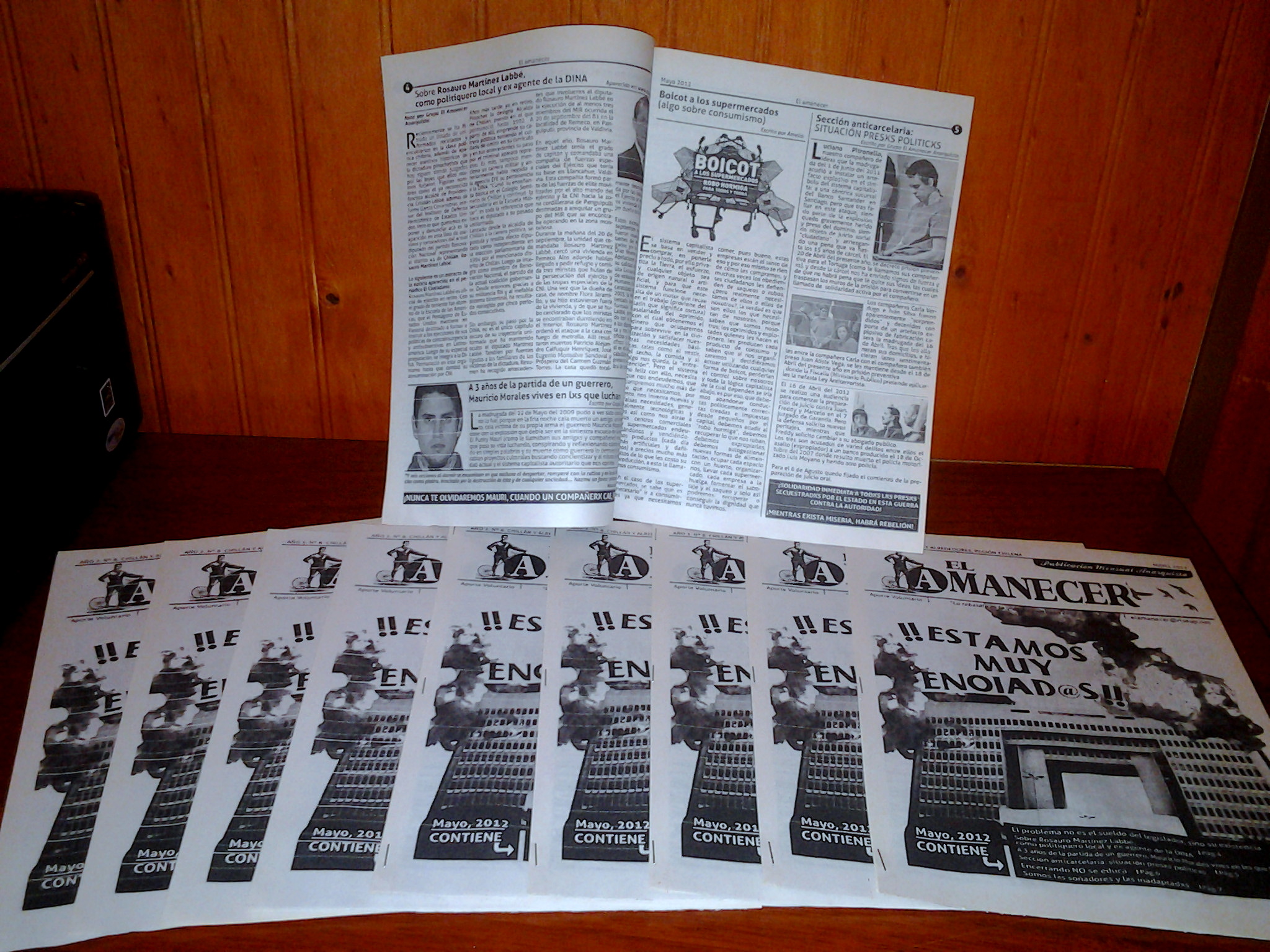
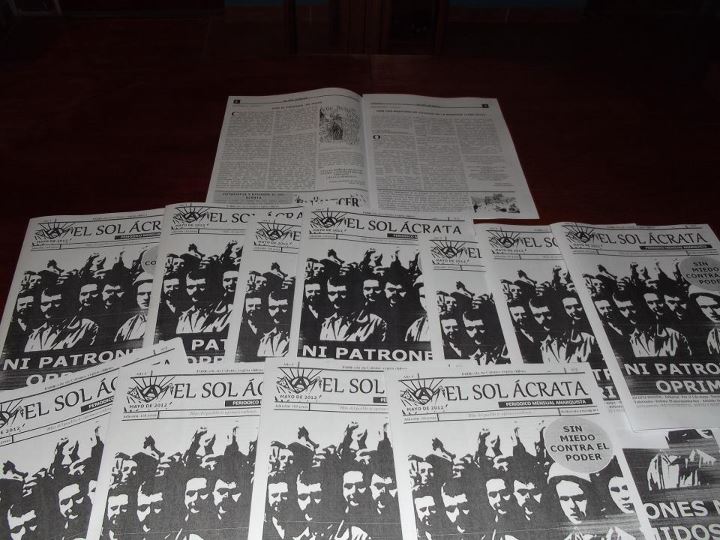
CHILE: INVITACIÓN ABIERTA A MULTIPLICAR LAS PUBLICACIONES ANARQUISTAS


Cada ciudad es un mundo distinto. Todas tienen su propia cultura, su modo de ver la vida, incluso su propia jerga, sin embargo en lo que se parecen las ciudades del territorio chileno y del orbe entero, es que en todas existen opresores y oprimidos. Esto es común en todas. Basta ver la composición de la comuna misma: Existen barrios de ricos y de pobres, estos últimos ubicados en la periferia de la ciudad, allí donde se vive en pleno hacinamiento, donde en una casa completa viven dos familias, en las cuales cada invierno es una pesadilla, las familias lidiando con el frío y la lluvia, mientras los explotadores disfrutan de sus mansiones ubicadas en sectores estratégicos de la ciudad. En otras palabras siempre una ciudad será una manifestación de la dominación.
Esto no lo podemos desconocer, como también es imposible hacer vista gorda al descontento de los oprimidos y a este punto queríamos llegar: Como los explotados buscan alternativas de romper la opresión. Ahí es cuando aparecen las huelgas, los sabotajes, las barricadas se levantan en las poblaciones, los pacos son echados de estas y un grupo de individuos, en su afán de demostrar que nada esta bien, deciden crear un periódico. Un periódico en el cual se denuncien las injusticias del mundo, el que sirva para solidarizar con los presos de la guerra social, que tenga como objetivo difundir la anarquía entre los explotados, es decir, iniciar una labor propagandística de tales proporciones que sea capas de iniciar la marcha hacia un mundo mejor.
Mantener un periódico no es nada fácil. Aunque no lo crean lo más sencillo de un periódico es su diseño, ya que importa mucho más lo que se dice, lo que esta escrito, y esto es lo más complicado en toda redacción: El como expresar lo que queremos decir y hacer que llegue a la gente. Aparte de todo esto, hay que tomar en cuenta el sostenimiento del periódico, ya se sabe que El Sol Ácrata y El Amanecer son periódicos anarquistas, razón por la cual resulta imposible que recibamos amablemente financiamiento del Estado o de los empresarios, ya que estamos en lucha directa contra ellos, por lo cual estas dos publicaciones subsisten gracias al empeño de los grupos que las realizan. Nos ha costado, es verdad, muchas veces hemos sufrido persecución del aparataje represivo estatal, de los pacos rojos, pero nos quedamos con la recepción de la gente, la que se alegra de ver como un puñado de individualidades libres y anárquicas, tanto en Chillán como en Calama, gastan su tiempo y le ponen todo el empeño del mundo en ver realizadas nuestras ideas.
En base a nuestra experiencia, de ambos grupos es queremos hacer una invitación abierta a todos corazones indómitos con ganas de difundir la idea, invitamos a multiplicar los periódicos y no solo los periódicos, sino toda expresión propagandista anarquista, y así causar que por toda la región chilena invadan las publicaciones ácratas. Que en cada ciudad, desde Arica, pasando por Valparaíso, hasta Punta Arenas, exista una, dos, tres o muchas publicaciones anárquicas. Este territorio es fértil para sembrar la semilla de la idea, así lo demuestra la historia. También sobre esto mismo queremos que sirva como crítica y autocrítica la difusión de la propaganda que muchas veces se queda en los guetos históricos de los anarquistas, creemos que esto no puede continuar, que la idea debe invadir lugares donde no sospechan y muchas veces odiarían su invasión, porque solo así iremos socializando la anarquía y con ello, destruyendo la sociedad, sus cárceles y toda forma de autoridad.
El Surco, periódico anarquista con más de tres años de vida y que deambula por todo el territorio chileno nos sirve como ejemplo y gracias su sola existencia, entendemos que es posible, que aunque hayan costos y dificultades, siempre es una posibilidad alcanzable si están las ganas y el compromiso, crear una nueva publicación anarquista, y es así como humildemente queremos que este escrito sirva para ayudar y empujar a salir del horno nuevos periódicos negros.
¡Si quieres ver un periódico anarquista en donde te desarrollas y vives, hazlo tu mismo!
Grupo El Amanecer Anarquista, Chillán. http://periodicoelamanecer.wordpress.com/ – elamanecer[a]riseup.net
Grupo El Sol Ácrata, Calama. http://periodicoelsolacrata.wordpress.com/ – elsolacrata[a]riseup.net
Mayo 2012

giovedì 3 maggio 2012

LAS MALAS PASIONES – EL DERECHO DEL SER


“La contribución en este fragmento de un texto más largo que se publicará más adelante cubrirá un amplio terreno crítico de un examen minucioso sobre el debate abierto (o al menos hecho público) por mi compañero egoísta y afín Federico Buono sobre los temas anti-jurídicos y sobre la ética o no ética con respecto a vivir ilegalmente aquí y ahora. “Este texto provisional está destinado a ser, a partir del anti-cristianismo, una señal para dar cabida a la intervención escrita de los compañeros egoístas que sientan la necesidad y el querer participar para nutrir este proyecto nihilista. Los textos complementarán un panfleto que editaremos como Edizioni Cerbero.

“Este texto conserva las palabras del compañero Gabriel Pombo Da Silva y vuelve a reubicarse en estos días de Navidad, su saludo de solidaridad con los presos de la Conspiración de las Células de Fuego y de la FAI – sección Indonesia.
“Por una Navidad negra y nihilista que siembre terror”.

mercoledì 2 maggio 2012

Fragment – The Labyrinth of the Law (Edizioni Cerbero)

Click for PDF version

‘Equality of “rights” is truly a ghost because rights are nothing more than permission, that is to say a question of mercy’
1
THE LABYRINTH OF THE LAW
Introduction
In its endless search for inferno, Cerberus penetrates like the epicentre of an emanation.
Impulsive, instinctive, immoral: ‘A BAD PASSION’.
The nihilist anarchist introduces the non-form into a circle where all things are born and die…
In the world of Cerberus one feeds oneself with the corpses of the whole humanity.
The gates represent the unknown, and no one gets in or out of them.
The metaphor sinks all formal data, and it becomes harsher and makes the significant sign inexplicable.
In a continuous search for non-value the free spirit/the nihilist anarchist reveals his egoism. 2
Nihilist anarchism is a wandering exception.
The labyrinth of the moral judicial monster is intricate and complex and it exposes its threads, which imprison the individual changing their form into one of a ‘defendant’.
In the conventional signs of a ‘just judgement’, the free spirit/nihilist anarchist experiments and denies until they break the right-duty.
The road is uphill, in an endless exploration of the extreme situation and anarchist coherence. 3
A circle in ebb and flow, there is the debris of this fragment in the labyrinth.
‘What is it the feeling of the lack of value, when it was understood that it is not permitted to interpret the general character of existence with either the concept of ‘end’ or the concept of ‘unity’ or the concept of ‘truth’.
Nothing is attained with this; in the multiplicity of events there no unity that permeates all.
The character of the existent is not true, it is false. It is absolutely unreasonable to fantasize a true world.
So the categories ‘end’, ‘unity’, ‘being’, with which we had introduced a value in the world, are being pulled out by us once again, and now the world appears with no value. strong>4
-
1. Second part ‘The Ego’, ‘The Ego and its Own’, M. Stirner
2. ‘I’m the only one who decides if the law is in me; there’s no law outside me. If it is all right for me then it is possible that it is not all right for others. This is their business not mine. They can defend themselves. And if the whole world would not be all right, but it would be the right thing for me, and I would want it like it is, I would not mind the whole world. So does behave the one who can admire himself, each his grade, his egotism being because strength is superior to the law.’
Ibid
3. ‘You know we are going to die! Long live death!’
Raymond cries.
‘He distributes cyanide among all the associates, which he had been given by David. Better to die than be captured, no wounded no prisoners. Either corpses or free men, there no half way.’
‘Long live Raymond! Long live Anarchy!’ They cry.
‘The Bonnot Gang’ B. Thomas
4. ‘Will to Power’ F. Nietzsche


http://325.nostate.net/?p=5087#more-5087

domenica 29 aprile 2012

Fragment – Rigor mortis ostativo (Edizioni Cerbero)

Click for PDF version
In the metaphorical text of this last fragment entitled ‘Rigor mortis ostativo’ the right-duty of the “defendant subject’ is disentangled.
The behavioural terms that the defendant-subject has chosen outline an apodictic sign, which is willing and ready to be displayed.
The ‘right’ is a limit prone to disentangle the events of a chosen path.
The basic material for getting the right is the same being-subject that takes shape in the comparison between the subject and the right in a merging of events, which becomes the foundations of the moral-judicial-monster in a sudden organic disposition, which nullifies any willing motion.
In the action of ‘claiming’ the singular tissues of the individual asking for a right become tissues of a decomposition of its own existential peculiarities.

The applicant calls the right to ask in the invocation of the right.
The Rigor mortis is now Decay.
Only the right that is mine, which belongs to me, cannot be lost.
But I can renounce that right that does not belong to me,
the right belonging to the people.’
The Ego and its Own’, M. Stirner
SPECIAL PROCEEDINGS
1. SUMMARY PROCEEDINGS
A summary proceeding is a pre-trial extended to the merit, which takes place in a courtroom in the presence of an investigating judge (according to the stage when it is requested) and can be classified as unilateral request for a trial. It is characterized by the decision taken on the state of the preliminary investigation, which has full probative value (documents of the prosecutor’s file) at this stage.
In case of conviction a summary proceeding implies the reduction of the sentence to a third in order to encourage the private party to ask for this procedure.’
APODICTIC
A synthesis of a syncretic pre-trial emerges from and depends on the explicated and judicious term of an examiner, in a perpendicular permeability.
The Abnegation in explicating the behavioural terms emerges when an ostensive simulacrum is erected, a simulacrum of the prevailing work of the one who examines.
The structure determined in a substantial manner emerges in an apotheosis of cross-reference in a liturgical ceremony, where the ‘judgement’ goes beyond the ‘Pre’ in a nullified going forward.
The correspondence is a collimating between a correspondent examination and a Ceremony that corresponds to the Examiner.
The relation of belonging is a simulation between a corresponding collimating and a corresponded exam.
The simulacrum of the simulation is the corresponded in the correspondent leading role of the synthetic assimilation of the ‘role’ and of the collimating ‘guide’ in the word ‘defendant’.
The Demiurge chairing a liturgical Ceremony poses the clarification of a symptom that crosses and prevails over the assumption of a ‘judgement’, which has a redundant effect on the ‘Pre’ in a nullified going forward.
The scheme of a prevaricating obtaining emerges insidiously as it builds up an exam in a collimating ceremony of an official rite.
The Demiurge (and the synthetic form ‘Examiner’) gives a pregnant ‘look’ and disposes the premonitory signs, which are outlined in a imaginative manner in a prevailing liturgical Ceremony, where the correspondent ‘leading role’ is officiated by the word ‘defendant’.
The back consideration of a simulation of Abnegation is so called ‘Dead Form’, which is defined by an indefinite ‘ultimate Defunct’.
The ‘Dead Form’ delineates itself irreversibly in an imaginative synthesis: back-induced Extension in simplification effectiveness.
The role and the corresponding collimating ‘guide’ correspond in a reduced premonition of the synthesis, which is evocated in a reverential availability: ceremonial assonance between the word ‘defendant’ and a ‘Dead Form’, pronoun of an ‘ultimate Defunct’.
An inclination is produced by the analogy between an ‘inclined’ that claims and an ‘inclined’ that takes part to the official liturgical ceremony while preparing the simulation of the leading role in a dissimulation of prepared documents.
The synthetic Abnegation of an exam induces the listening of the delegated terms, which imprint their essence in a ‘Dead Form’ that detects (and reveals) a substantial product in an imaginative manner and in an officious Ceremony of a rite where the inclination is analogous with the word ‘defendant’.
Those who carefully prepare themselves for negotiations know their final goal and can evaluate the expectations of their interlocutors. Their starting point is a strong one. On the contrary, those who do not know the rules of the game or do not realize that they are involved in a negotiation even if they are in the middle of it, are in an extremely weak position.’
A guide to negotiation techniques’, J. Winkler
Now the requirements for summary proceedings are:
A) A request from the defendant
B) An order of eligibility from the investigating judge
C) A possibility for new evidence.

CIRCUMLOCUTION OF A DEMIGOD
A premonition changes the undulating course of a Consecration.
The determination induced by an event simulated in a Simulacrum moves and goes back to undulate the choices of the volitional Events (given by).
Evolution practised through the introduction of an asserting logic.
The distinction between something that is asserted and the one who asserts implies the non-distinction between the practical form and the formless ‘practise’ of a solemn sensational ceremony.
The word ‘defendant’ is freed (but not distinct); it permeates and is permeated by a ‘Dead Form’ in a siege of its affirmative abilities.
The transposition of a predetermined motion is an indirect arrangement pre-imposed in a ceremony post-planned in an indirect but premonitory manner.
The disposition of the events carries a translated deduction, which is inclined in reversibility between Abnegation and Invocation.
Elements melt and split in a ‘Pre’ or a ‘Con’.
The stentorian Abnegation reminds of the Invocation in a programmatic (and summary) assumption of responsibility.
Redundant in a ‘Con’ and a ‘Pre’, the sign of the effect postpones, expresses, holds, keeps, moves and stops.
The caducity is the extension of a ‘Dead Form’ that simulates the cadence of the sign-effect in a disposition of affirmation of its significance.
The arrangement is to deduce the sign from the effect, which remains introductory to the ‘Dead Form’ that closes the premonition of the word ‘defendant’ in an impeded space.
The cult evoked in the hyphenation is a prodome of an affirmation of significance in a correlated medium that draws from the indentions ‘Pre’ and ‘Con’.
Introduction to an Abnegation of an extended and exhausting premonition in an arrangement of Levels in junctions of significance.
As he postpones the prominence of a ceremony, the Examiner gives the doing to the ‘saying’.
Extirpating a recondite repetition of the effect-sign, which is not nothingness, does not give events translated in a returned analysis to the doing, of sedentary parameters in the Temple of prophecy.
The Ceremony in a liturgical rite predisposes and postpones possible lumps of ‘introduction’ waiting for a premonition.
The wait (waiting is a sign) is spasmodic in an invitation to an invocative cult given by an anesthetized suffix: to mark the preeminent anaesthesia.
The relation of representation is Abnegation in the ceremony.
The Demiurge exposes.
If someone destroys the Temple of God, God will destroy him:
For the Temple of God is sacred, and you are this Temple.’
(Paul, Cor. 3.16)
Following the reform introduced by bill 479/99, the defendant has no chance to put forward two types of request for summary proceeding:
- Ordinary summary proceeding according to the first paragraph of article 438, for which the prosecutor cannot express any dissent and the judge is compelled to carry it out.’
EXTENSIVE EFFECT OF A CEREMONY
An insignificant determination is the product of a certain Invocative Cult.
The perspective is determined in a planned premonition in an afflux that becomes and differs in its undulating motion and in an exposition of data, ‘given’ by the undulating movement that reifies all documents and that differs from the undulation.
The Invocative Cult predicts the ‘Dead Form’ and exposes its Premonition in indistinct Flows of acquiescence that permeate between a ‘saying’ and a ‘doing’.
The exposition of a rite leads to the Demiurge.
Exacerbated interpretative modulations extend the ‘exterior’ in a wider range of extensiveness.
The ostensive Ceremony in a liturgical rite is the extensiveness of wider hypothesises heading to premonition: Omni comprehensive in a major reified form, and in a Ceremonial minor form.
The degree of understanding in the introduction of an elementary elected component: a major form of a less major ‘measuring’.
The stratification of the structural elements poses a mutation between an ‘elected’ and an ‘elementary’.
The Demiurge chairs the procedural rite and the premonition.
The ceremonial disposition is the direct connection between an ‘elected’ and an ‘elementary’.
As it promises a process of elected premonition, the basic programmatic procedure gives the ‘Pro’ and the ‘Pre’ in different but corresponding stages.
The invocative Cult claims the promise of Abnegation in a correspondent undulation of the elements that constitute the stages in sequence of decomposed axioms.
Promising is the promise of a premonition. The ‘Dead Form’ looks for the word ‘defendant’, in which the Demiurge is the Omni comprehensive stability in the claiming of the promise.
The singular bursting reduces the premonition to extended allocutions of non-significant determinations.
The extension of the (pro)noun of the word ‘defendant’ is the course of the repentance of a ‘Dead Form’, where speculative signs reduce the singular traits in a disruptive disposition of forms with guidelines.
Postponed in a predetermined premonition, the guidelines assume the role of the word ‘defendant’.
Data of synthesis complete the repentance of the stage of a ‘Dead Form’.
The Demiurge is the affirmation: the response is the volitional act in a liturgical rite.
Collective feelings, which the penal law of the people protect in a determined time of their history, came therefore to penetrate the consciences which were precluded to them up to that time, or they increase their power where they did not have enough of it. Only on condition of acquiring a deeper intensity than that they had before can the community as a whole be aware of them in a stronger way, for it is the only source to which they can draw the necessary strength to impose themselves to the individuals who were refractory to them.’
The rules of sociological method’ Dunkheim
In a summary proceeding conditional that allows the defendant to subordinate his request of summary proceeding to new evidence, which has to be examined during the trial by a judge, the applicant must indicate sources of evidence that are not precluded by the law (…).’
CONSTITUTED IN DEVOTION
An affirmative bond establishes a definite introductory ductile arrangement in an introspective delay of programmatic junctions.
The basic material melts in an intricate correlation between recurrence and re-collocation.
Automatisms of membership form the delay of junctions that intervene disposed in a (non)sense and premonitory feeling.
The Volitional Being can be divided in reflexes of comparison extended in a constant flow towards the beginning of a ‘Dead Form’.
The affirmation of ductility of the ‘definitely Defunct’, defined and given by a definition, is exemplary in the recurrence.
The dead-essence material is the introduction to a ceremony of a liturgical rite.
In Abnegation to the rite there is an expression of given significances of a supplementary supplication.
The affirmative bond must now establish itself in a programmatic dependence in the Volitional Being.
The Ceremony calls the Demiurge in a rite, and the Demiurge affirms the dead material in an act; the dead material is the specific essence of a ‘Dead Form’: an expedient of the word ‘defendant’.
The flow of the dead material is composed and activated in a mixture of explicative ramifications.
The flow of the dead material is equivalent to the essence of the Abnegation of reflexes of the ‘Dead form’.
The pre-agony stage is a balanced substrate in an affirmation of the ‘SELF’ in a sequence of ‘oneSELF’.
The consequential pro(noun) is the word ‘defendant’.
The absence of shared affections is the procedural ‘ethic’ produced in the liturgical rite.
The substantial flow of dead material supporting the ostensive Ceremony is the procedure of a pre-agony premonition that feeds the aptitude of the pro(noun) of a ‘Dead Form’.
The deprecating act of a bursting of the repentant allocutions is given in a ‘paragraph’, where the introjections of the ‘Dead Form’ of the word ‘defendant’ goes across (and not behind) behavioural appearances infected in symbiosis by postponed elements of a repentance.
It is the instinct of a community (ancestry, generation, flock, community) that feels the states and desires as valid, which it owes its conservation, for example obedience, reciprocity, reverence, moderation, and therefore it represses anything that opposes and contradicts them.’
Will of Power’ F. Nietzsche
THE STAGE OF CELEBRATION OF THE RITE
The natural site to forward the request for summary proceeding is the preliminary hearing (article 438). But the request can also be forwarded during other trial stages; after the prosecution, when another proceeding is introduced: for summary judgement (article 452, paragraph C.2), immediate judgement (article 458) of penal decree (article 461, paragraph C.3), direct subpoena (article 555, paragraph C.2).’
Evidence constituted in appeal in the explanation of a false line.
A digression in ‘gnashing’.
The exposition of a ceremony in a liturgical rite is being officiated…
The verdict of guilty or not guilty is always subjected to recourse in Cassation, even if there exist limits to the possibility of appeal (article 443) as a counterpart to the benefits for the defendant or the prosecutor.’
THE JURISPRUDENTIAL DOCTRINE
The introspection introverts a figure, which becomes a walk-on of the word ‘defendant.
Specific figures introduce their substrate and emerge infected in an organic disposition.
The graft of figures is the being of the syllogistic representations.
The dead material is the cadaverous essence of a ‘Dead Form’.
The disposition is the prophetic pre-agony where Abnegation is undeniable and imaginary introjections of decomposition.
The Demiurge expresses a doctrine of jurisprudence through the Examiner.
The decomposing course is the ‘margin’ concerning the Ceremony of a liturgical rite; a jurisprudential act is a decomposed significance of a premonition.
The substance of the decomposed being is Abnegation towards a cure of decomposing syllogism.
The ‘Dead Form’ is the release of dead material.
The passion predicting a decomposed allusion of significances is skilfully inserted into a ‘Dogma’, decomposed in its being accomplishment of the cure of the Jurisprudential Doctrine.
The detection of a reverential cure is the solution of formal data referring to the accomplishment of an affirmation: the revelation is the substrate of the accomplishment of the cure.
A given detection tries to infect a disruptive repentance.
The disposition of a rite in the flows of comparative accomplishment between dead material and ‘Dead Form’ is Abnegation in a liturgical rite where the execution is given in a jurisprudential manner examined by the Examiner.
As it is being introduced in a figurative manner, the walk-on is an appearance of an informal form, disposed in premonition.
The assonance of the figurative forms is arranged through the collocation in a dead material of the figurative being of a ‘Dead Form’.
The liturgical Rite offers images of anesthetizing significances.
The representation is the release of the dead material in an extended pre-agony prophecy where the skilful Dogma is the explicating concept of the Jurisprudential Doctrine.
Do not accumulate treasures on the earth, where moth and rust consume, and where thieves burgle and steal: instead, accumulate treasures in heaven, where nor moth or rust consume, and where thieves neither burgle or steal.’
(Matthew, 6, 19-20)
2. SENTENCING UPON THE PARTIES’ REQUEST
A) Generalities
Sentencing upon the parties’ request (so called settlement) is a special pre-trial proceeding of a rewarding type.
Unlike a summary judgement, which is reserved to the unilateral will of the defendant, a settlement presupposes an agreement between the parties not only as concerns the proceeding but also the sentence to be pronounced, even if the possible disagreement of the prosecutor remains amenable to the control of the presiding judge. The dies-quo of the request for sentencing can also intervene before the execution of the penal action as the latter can be anticipated during the stage of the preliminary investigation (article 447, paragraph 1 of the penal code).
HERMETIC COFFIN
The ‘territory’ in which (and for which) the cure prepares its action is established by residues of programmatic observation, where (and for which) the reification of immunological instances is infected through a dogma of composition in content: the pre-judicial Being.
The ‘Pre’ is a profitable container of affirmative data of rules pre-established by the ‘judgement’.
The context in which the affirmation of the dead material exhibits an unquestionable cadaverous essence, nullifies the falsification of the ‘Pre’ in the word ‘defendant’.
The judgement expresses its ‘Pro’ in wide factual visions.
The assertion ‘Funeral rites of the not guilty’ is the sharing of a memorandum (product and material) of a synthetic theory of affirmation and cure.
The nullified Being is the beginning of the word ‘defendant’.
The establishment of effective jurisdictional forms leads to the ‘Dead Form’ to inhalations of beneficial returns in a transience of pre-agony influxes.
The premonition is the synthesis in an epigraph of obtaining the essence of the dead material.
The liturgical Rite is episodic in a variety of forms.
The dilatation of a ‘contrast’ in an absent being is the predicted form of a prophecy, disposed in a ceremony in which and for which the Absence of an absence is celebrated.
The word ‘defendant’ is close to a funeral rite (in an assertion of ‘possible guilty’), while the cure of the terms is the absence of the absence itself in an ‘it-itself’: there determination is absent.
The dead material is the essence of an absent being in the presence of a substantial liturgical Rite.
The same in itself is the accomplishment of a ceremony chaired by the Demiurge.
Absence and Essence are present in a prophecy.
Dispersion is never a good sign in a negotiation. If enthusiasm and interest have a reassuring effect on the counterpart, the anxiety of coming to a conclusion only shows weakness. So let the others quarrel to conquer your attention. If you want to lead your interlocutor to a decision you need, along with good doses of readiness, the presence of a rival.’
Divide et impera’, ‘A guide to negotiation’, J. Winkler
The rewarding of this institution is reduction of the sentence to a third of it, exemption from payment of legal expenses, exemption from additional charges and restrictions, except for confiscation (if the sentence is shorter than two years), and extra-judicial ineffectiveness of the sentence (for example as concerns damages compensation).’
DISAFFECTION OF AN IMMUNE-THERAPEUTIC RITE
Extensive traces in rigid ramifications of therapeutic speculation dispose themselves – waiting for an intrinsic voluntary and volitional therapy – in thematic juxtapositions, which give and introduce expositions of practices of a liturgical rite.
Marginal notions in a reflux of assertions lay a sacrificial bridge in an afflux towards the Temple of prophecy.
Sacrifice is the face of a ‘Dead Form’.
The traces require a composed form in decomposition where the dead material expels the flowing flux of the ‘SELF’ inside the ‘Dead Form’ and where reification predicts its premonition to the word ‘defendant’.
Being reclaimable in a reflex of a reflux the dead material carries its essence and inserts itself in an expropriation of its ‘SELF’ in a falsification of the very being of a ‘Dead Form’.
A priori the word ‘defendant’, which is prone and ductile, searches a terminal contact with the Demiurge of a liturgical rite.
The mediator of a Examiner is the cure of this contact that is penetrated by an outgrowth of dead material producing fetishist inputs to the ‘Dead Form’.
Repentance is infected.
The afflux of the flowing flux opens itself in countless histological interactions of dead material in an official rite.
Postponing the Invocative Cult in a structured way exposes the ‘Dead Form’ to infinite dispositions of prominent memorandum in a procedure of premonition.
Repentance is disruptive in a correspondent jurisprudence, and it articulates consequential stages in an official and ostensive rite.
Histological in the flowing flux of a prefix suffix: post and prefigure a premonition where a posterior anteriority is chaired and postponed.
If what is desirable cannot be an object of observation, and yet it can and must bedetermined by a sort of mental calculation, it is impossible to impose any limit, if we can say so, to the free inventions of imagination, which always tend to look for the best.
One can solve this practical dilemma if the desirable is health, and if health is something definite as a matter of fact, for in this case the term of the effort is at the same time as definite as a matter of fact. It is no longer a question of desperately pursuing a goal which escapes as it is being sought after, but rather of engaging oneself with regular perseverance to keeping the normal state and restoring it if it is troubled or its conditions happen to change.’
Rules relating to the distinction between normal and pathological’
Rules of the sociological method’ Durkheim
D) Proceeding
A request for a plea bargaining is permissible during the course of the preliminary investigations (in which case the correlated request makes the investigated party acquire the qualification of defendant, article 60, paragraph 1 of the penal code), of the preliminary hearing (…) and when preliminary statements are produced in two cases:
A) When the defendant presents the request according to the rule of law but the prosecutor does give consent;
B) When the parties reach an agreement but the investigating judge refuses the alternative procedure as he does not consent on the terms of the settlement (…).
LABYRINTH OF HYPOTHESIS: HYPOSTASIS AND HYPOSTATIC
Formations of derivative allocutions extend their invocating flux to the prefix ‘Pre’ in the suffix ‘Are’.
Extended prefixes induce the dead material to disarticulate all origins of the ‘SELF’.
The ONE-self is in a ‘being’ in impediment.
The ‘Dead Material’ is a macro-principle in the exposition of an official rite, in the presence of the word ‘defendant’.
Repetitive affluxes in dispositions of curative affections induce the ‘SELF’ to a disgraceful jurisdictional act.
The dead material infuses its despicable flux with schizophrenic transpositions in a re-infection of the word ‘defendant’.
The repartition of the incisions with ‘effluvium’ of the dead material widens the countless traces of allocutions in the source of the ‘Dead Form’.
An exhausting derivative procedure extends its ‘impeding’ power in an official rite.
The organic offer in a ceremony is the premonition that induces to the sacrifice of the word ‘defendant’.
The procedure is requested by a Demiurge during an exam.
Nullified moving forward prescribes a disposition of undulation in a backward-forward gait of the ‘Dead Form’, and as the Ceremony fades the Demiurge extends his sacrificial rite to the Examiner.
In general evidence is everything needed to make oneself sure of the truth of a proposition – the truth is inside us: the truth is in the facts. The former comes from the alleged cognition of the latter; but human fallibility has it that the former can be without the latter and vice-versa.
Only in God do truth and certitude unify, they cease to be the one all objectivity and the other one all subjection.’
On evidence’, ‘Program of the course of criminal law’ F. Carrara
The sentence cannot be made object of appeal if the prosecutor is not in the position to make appeal and on the sole condition that the judge does not consent to his dissent (articles 448, paragraph .2, penal code). Nevertheless appeal to Cassation can be presented’.
Jurisdiction in a pronoun.
4. IMMEDIATE JUDGEMENT
Immediate judgement is a special proceeding of a non rewarding nature, which can be proposed unilaterally by the prosecutor (article 453) or by the defendant, through whom, as the preliminary hearing is skipped (article 419, paragraph 5), the judgement is immediately undertaken.’
GENESIS
In territories of imaginative sensations where the dead material is the essence of the being, the Ceremony expresses itself through an interlocutor.
Clots of hypothesis in hypostasis decline towards the Temple of the prophecy.
The cure compresses and crushes the word ‘defendant’ in a trap-labyrinth. The word ‘defendant’ interjects the very source of the ‘SELF’ as cure of the being, through a volitional act.
The Examiner is an appellant trying to dispose the dead material in simple but clear signs of devotion.
Funeral rites give a fertile ground for premonitions full of significance and posthumous and predicted significant data to the dead material.
The word ‘defendant’ is in unsubordinated order promised to the ‘Dead Form’.
Intrinsic visions of alienating memory burst and penetrate into and ‘dead form’: the dream of a hermetic grave exists.
The labyrinth of hypothesis is an intricate correlation of glimmers in incontrovertible side roads whose exits are a representation of the ‘SELF’ interjected in a ‘dead Form’.
The dead material explicitly advances and supports the cure in a labyrinth where imagines on every wall are the genesis of the hypothesis in hypostasis.
The ceremony in an invocative Cult exposes itself in the ravines of the labyrinth of the hypothesis, and exposes and is the Demiurge.
Micro-forms of a micro-principle dispose various hypotheses while postponing them, during the prophetic and prominent Ceremony where the purity of the liturgical rite aspires to the ‘Dead Form’.
‘Knowledge and self-esteem are generally of help to the success of a negotiation because they lead to a clear understanding of the messages that come and go from one party of the negotiation to the other one.’
Keep your integrity intact’
A guide to the techniques of negotiation’ J. Winkler
The ordinance with which an investigating judge decides for immediate judgement must cite a note to the defendant, which informs the latter that he can make request, as an alternative measure to immediate judgement, for two awarding proceedings: summary proceeding (which has to be requested for within 15 days from the day of the notification of the ordinance) or request for settlement.’
RIGORIS MORTIS OSTATIVO
In an explicit begging for a legitimate premonition the ‘Dead Form’ removes an essence in a resolution of sacrificial acts.
Indefinite ravines ascend a labyrinth where hypothesis demand hypostasis and where traces of dead material introduce a cadaverous exhalation in a pure Temple of prophecy.
The beginning of a principle of a prefix disposes events in a postponed way, which is available for the cure of a Ceremony in an official Rite.
The Demiurge is placed at the base of the ramifications according to the Ceremony.
The ‘Dead Form’ is confined to the cure in the essence of the being of the word ‘defendant’ and is interjected by the procedural expressions where the dead material introduces its cadaverous essence.
Immunotherapeutic disaffection implants itself in the fabric of Rigoris Mortis, in a ‘Dead Form’ and in an ostensive memorandum of a predictable pure Ceremony in front of the Demiurge.
A jurisprudential premonition is the question corresponding to a correspondent relation between infection and repentance.
The Demiurge announces the beginning of the Ceremony.
To deny the judges the faculty of interpreting the law is the same as to place the rights of all citizens under the unlimited power of executive power, and to confine the judges to narrow and crude cognition of the facts.’
Pamphlets of criminal law’.
5. CRIMINAL LAW PROCEEDING
The ordinance contains the note to the defendants and the person concerned as for the pecuniary penalty that they can oppose the ordinance within 15 days from its notification and that the defendant can request, through immediate judgement, a summary proceeding and a settlement, that is to say he can request admission of oblation.’
DECAY

http://325.nostate.net/?p=5055#more-5055