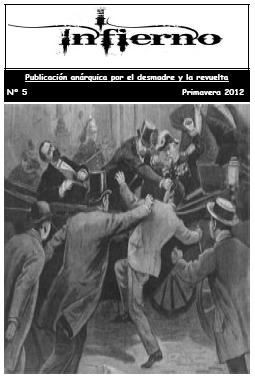
Questo è il file per scaricare il numero quattro di “Vertice Abisso“:
This is the link for the download of number four of “Vertice Abisso“:
In questo numero:
Editoriale: La Sacra Sindrome
Ritorna il boato delle parole armate
CCF – 250 nuove accuse, comunicato di rivendicazione
Lettera di Theofilos Mavropoulos in merito alle 250 accuse
Maurizio De mone – Il pugnale avvelenato del nichilista, dibattito con Entropia – II Giustizia
Redazione Edizioni Cerbero – La rivendicazione di un di-rompimento singolativo, dibattito con Entropia – I Solidarietà
_____________
contatti:
VerticeAbisso(at)distruzione.org
Visualizzazione post con etichetta nihil. Mostra tutti i post
mercoledì 16 maggio 2012
giovedì 10 maggio 2012
Spain: Communique from Nihilist Anarchists actions May 1 to 4
from culmine, transl waronsociety, communique:
May 1, 2012
In Poblesec:
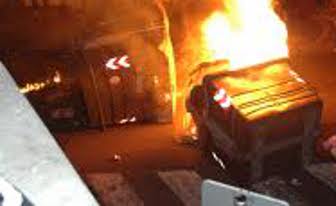
- At about 9:50 PM, the “Passeig de l’Exposcio” street was blocked off with burning dumpsters.
- At 10:30 PM, Jaume Fabra street was also blocked.
In Bonanova:
- At 12:40 AM the windows of 10 luxury cars were destroyed, the hoods and windows stoned and destroyed, and then the tires were punctured.
- At 1:30 AM, Ganduxer street was blocked off with 5 burning dumpsters.
- At 2:40 AM various houses in the wealthiest area were attacked with paint bombs.
- At 3:00 AM the doors of a 5-star hotel were attacked with blunt objects.
May 2, 2012
In El besos:
- At 3:20 AM, La Rambla Prim was blocked off with five burning dumpsters.
- At 3:50 AM, a La Caixa bank branch was attacked, two molotov cocktails thrown at two ATMs.
- At 4:10 AM on Carrer del Taulat, a row of 10 dumpsters were set on fire, also, in order to block off the street burning furniture was used.
- At 4:30 AM, the windows of a Caixa Sabadell bank were destroyed with rocks and hammers and then paint was thrown. Then, the ATM was set on fire.
In Raval:
- At 4:20, simultaneously other compas in the Raval neighborhood blocked off the Carrer de la Cera with 5 burning dumpsters with molotov cocktails.
- At 4:50 AM on Carrer Aurora, a row of 8 dumpsters were set ablaze.
- At 5:20 AM, 3 bank branches were hit with rocks and hammers, also paint was thrown against them.
May 3, 2012
In the metro area of Barcelona:
- On Carrer Calderon de la Barca, at 4:50 PM, a telephone booth was hit hard with hammers and rocks until it was knocked over.
- At 6:20 PM, a row of 6 dumpsters were set on fire in Europa street with several molotov cocktails.
- At 10:40 PM, two telephone booths were set on fire.
- On Carrer de la Gravina, a religious and state-aided private school was attacked with 4 molotov cocktails, as well as the windows of the exterior kitchen being destroyed with rocks and hammers.
May 4, 2012
Montcada i Reixac:
- At 2:30 AM, a row of 10 dumpsters were set alight on Carrer de Bogatell, also two ATMs were burned.
In La mina:
- At 11:30 PM. Carrer de Tessalia was blocked with burning dumpsters and a Caixa Laietana branch was attacked with hammers and rocks.
* * *
We have lost confidence in the democratic middle class, we have lost confidence in a society that when faced with social conflict asks for more repressive measures, asks for more police, more harassment, personalize the “insecurity” of the lower classes asking for their imprisonment, deportation (in the case of immigrants), or enclosure… it’s certain that if they could they would surround the lower neighborhoods with electric fences. All this, acting as if the problem is not the economic inequality of the system, not a social problem created by the structures of capitalism and the state, that the root problem is not private property and social inequality… that while some have 40 homes, others do not even have a roof to live under, that the system does not allow you possibilities, that it condemns you for life. These people ask for more police, more CIES [immigrant detention centers], they say that the main problem is the immigrant youth (for example) and they vote for the extreme right. Therefore, we do not fight for these “democrats,” for these “free citizens” (or rather such idiots that they believe they are free…), we fight for the kid who has to provide for his family alone, who spends his days on the street searching for food or in the scrap heaps, who is wary when he imagines his future, who lives in secluded rat holes having to rob at gunpoint, for those who live below the poverty line and show themselves violently against this. We fight for those kids who were expelled from their schools or institutions for not adhering to the authoritarian rules of the classroom and the centre, for “getting bored” of authoritarian indoctrination, disrespecting the bourgeois schemas and therefore were punished and expelled. We fight for all of them because they are the only ones who — whether unconsciously or not — rebel against the capitalist society, who suffer fascist and police aggressions.
But we do not resign ourselves, and we do not make ourselves victims. We propose the response… faced with all this, we opt for the social threat, for insecurity, for pressure and punishment toward systematic structures, for night-time arsons, for the internal and asymmetric threat, for FEAR as a form of vengeance on the system and the society that constitutes and supports it. We are in civil war between the system along with the society that supports it against the marginal youth. They imprison, repress, occupy with police… we contest with violence, with insecurity, with social tension, with panic. Violence from below will do nothing but intensify and so they will have to shield they houses, their cars, their banks, their churches. While those from above rob us of life, enclose us, discriminate against us… they will have their fear on stepping into the street, fearing and having to equip themselves with cameras, police, security systems.
While the youth continue to be marginalized and exploited, the middle bourgeois class, the bosses, the cops… will live with fear and terror of those who assault them, rob them, attack them.


In Poblesec:
- At about 9:50 PM, the “Passeig de l’Exposcio” street was blocked off with burning dumpsters.
- At 10:30 PM, Jaume Fabra street was also blocked.
In Bonanova:
- At 12:40 AM the windows of 10 luxury cars were destroyed, the hoods and windows stoned and destroyed, and then the tires were punctured.
- At 1:30 AM, Ganduxer street was blocked off with 5 burning dumpsters.
- At 2:40 AM various houses in the wealthiest area were attacked with paint bombs.
- At 3:00 AM the doors of a 5-star hotel were attacked with blunt objects.
May 2, 2012
In El besos:
- At 3:20 AM, La Rambla Prim was blocked off with five burning dumpsters.
- At 3:50 AM, a La Caixa bank branch was attacked, two molotov cocktails thrown at two ATMs.
- At 4:10 AM on Carrer del Taulat, a row of 10 dumpsters were set on fire, also, in order to block off the street burning furniture was used.
- At 4:30 AM, the windows of a Caixa Sabadell bank were destroyed with rocks and hammers and then paint was thrown. Then, the ATM was set on fire.
In Raval:
- At 4:20, simultaneously other compas in the Raval neighborhood blocked off the Carrer de la Cera with 5 burning dumpsters with molotov cocktails.
- At 4:50 AM on Carrer Aurora, a row of 8 dumpsters were set ablaze.
- At 5:20 AM, 3 bank branches were hit with rocks and hammers, also paint was thrown against them.
May 3, 2012
In the metro area of Barcelona:
- On Carrer Calderon de la Barca, at 4:50 PM, a telephone booth was hit hard with hammers and rocks until it was knocked over.
- At 6:20 PM, a row of 6 dumpsters were set on fire in Europa street with several molotov cocktails.
- At 10:40 PM, two telephone booths were set on fire.
- On Carrer de la Gravina, a religious and state-aided private school was attacked with 4 molotov cocktails, as well as the windows of the exterior kitchen being destroyed with rocks and hammers.
May 4, 2012
Montcada i Reixac:
- At 2:30 AM, a row of 10 dumpsters were set alight on Carrer de Bogatell, also two ATMs were burned.
In La mina:
- At 11:30 PM. Carrer de Tessalia was blocked with burning dumpsters and a Caixa Laietana branch was attacked with hammers and rocks.
* * *
We have lost confidence in the democratic middle class, we have lost confidence in a society that when faced with social conflict asks for more repressive measures, asks for more police, more harassment, personalize the “insecurity” of the lower classes asking for their imprisonment, deportation (in the case of immigrants), or enclosure… it’s certain that if they could they would surround the lower neighborhoods with electric fences. All this, acting as if the problem is not the economic inequality of the system, not a social problem created by the structures of capitalism and the state, that the root problem is not private property and social inequality… that while some have 40 homes, others do not even have a roof to live under, that the system does not allow you possibilities, that it condemns you for life. These people ask for more police, more CIES [immigrant detention centers], they say that the main problem is the immigrant youth (for example) and they vote for the extreme right. Therefore, we do not fight for these “democrats,” for these “free citizens” (or rather such idiots that they believe they are free…), we fight for the kid who has to provide for his family alone, who spends his days on the street searching for food or in the scrap heaps, who is wary when he imagines his future, who lives in secluded rat holes having to rob at gunpoint, for those who live below the poverty line and show themselves violently against this. We fight for those kids who were expelled from their schools or institutions for not adhering to the authoritarian rules of the classroom and the centre, for “getting bored” of authoritarian indoctrination, disrespecting the bourgeois schemas and therefore were punished and expelled. We fight for all of them because they are the only ones who — whether unconsciously or not — rebel against the capitalist society, who suffer fascist and police aggressions.
But we do not resign ourselves, and we do not make ourselves victims. We propose the response… faced with all this, we opt for the social threat, for insecurity, for pressure and punishment toward systematic structures, for night-time arsons, for the internal and asymmetric threat, for FEAR as a form of vengeance on the system and the society that constitutes and supports it. We are in civil war between the system along with the society that supports it against the marginal youth. They imprison, repress, occupy with police… we contest with violence, with insecurity, with social tension, with panic. Violence from below will do nothing but intensify and so they will have to shield they houses, their cars, their banks, their churches. While those from above rob us of life, enclose us, discriminate against us… they will have their fear on stepping into the street, fearing and having to equip themselves with cameras, police, security systems.
While the youth continue to be marginalized and exploited, the middle bourgeois class, the bosses, the cops… will live with fear and terror of those who assault them, rob them, attack them.
The streets are ours.
Arms your hands, spit your hatred against the tyrant.
Nihilist Anarchists.


Etichette:
communique,
direct action,
en,
nihil,
responsibilty claim
mercoledì 9 maggio 2012
(fotos) Anarquistas nihilistas – La ciudad de las bombas volverá a arder

1 de Mayo de 2012
Poblesec:
- A las 21:50 aproximadamente, se cortó la calle ‘’Passeig de l’Exposició’’ con contenedores volcados.
- A las 22:30 fue cortada también, la calle Jaume Fabra.
Bonanova:
- A las 00:40 fueron destrozados los cristales de 10 coches de gamma alta, apedreando y destrozando el capó y las ventanas, posteriormente, se pincharon las ruedas.
- A la 1:30 fue cortada la calle Ganduxer con 5 contenedores ardiendo.
- A las 2:40 varias casas en la zona más adinerada fueron atacadas con bombas de pintura.
- A las 3:00 los portales de un hotel de 5 estrellas fueron atacados con objetos contundentes.
2 de Mayo de 2012
El besos:
- A las 3:20 de la noche, se corto la rambla prim con cinco contenedores quemados.
- A las 3:50 se atacó una sucursal La Caixa lanzando dos cocteles molotov contra dos cajeros.
- A las 4:10 en el Carrer del Taulat una hilera de 10 contenedores fueron incendiados, además, para cortar la calle se utilizaron armarios incendiados.
- A las 4:30 las vitrinas de una sucursal de Caixa Sabadell fueron destrozadas con piedras y martillos y posteriormente, se arrojó pintura. Después, se quemó el cajero.
Raval:
- A las 4:20 al mismo tiempo, otros compas en el barrio del raval cortaron el carrer de la cera con 5 contenedores ardiendo con cocteles molotov.
- A las 4:50 en el carrer Aurora una hilera de 8 contenedores fueron pasto de las llamas.
- A las 5:20 3 sucursales bancarias fueron golpeadas con piedras y martillos, además, se arrojó pintura contra las mismas.
3 de Mayo de 2012
Area Metropolitana de Barcelona:
- En el carrer Calderon de la Barca a las 16:50 de la tarde, una cabina telefónica fue duramente golpeada con martillos y piedras hasta el punto de volcarla.
- A las 18:20 una hilera de 6 contenedores fue incendiada en la calle Europa con varios cocteles molotov.
- A las 22:40 dos cabinas de telefónica fueron incendiadas.
- En el carrer de la Gravina, una escuela religiosa y concertada, fue atacada con 4 cocteles molotov, asi como las ventanas de la cocina exterior, destrozadas con piedras y martillos.
4 de mayo de 2012
Montcada i Reixac:
- A las 2:30 una hilera de 10 contendores fueron pasto de las llamas en el carrer de Bogatell, además, se quemaron dos cajeros.
La mina:
- A las 23:30 en el carrer de Tessàlia fue cortado con contenedores ardiendo y una sucursal Caixa Laietana fue atacada con martillos y piedras.
Hemos perdido la confianza en la clase media demócrata, hemos perdido la confianza en una sociedad que ante la conflictividad social pide más medidas represoras, pide más policía, más acoso, personalizan la ‘’inseguridad’’ en las clases bajas pidiendo su encarcelamiento , deportación (en caso de inmigrantes), o encierros..seguro que si pudieran rodearían a los barrios bajos con rejas eléctricas. Todo esto, obviando que el problema no es la desigualdad económica del sistema, que no es un problema social creado por las estructuras del capitalismo y el estado, que el problema de raíz no es la propiedad privada y la desigualdad social..que mientras unos tienen 40 habitaciones, otros no tienen ni techo donde vivir, que el sistema no te deja posibilidades, que te condena de por vida. Esta gente, pide más policía, más CIES, dice que el gran problema son los jóvenes inmigrantes (por poner un ejemplo) y vota a la extrema derecha. Por eso, nosotros no luchamos por estos ‘’democratas’’ por estos ‘’ciudadanos libres’’ (o demasiado gilipollas como para creerse libres..) luchamos por el chaval que tiene que mantener a su familia el solo, que pasa sus días en la calle buscando comida o en la chatarra, que se imagina con recelo su futuro, que vive en ratoneras apartadas siendo obligado a robar a punta de pistola, por los que viven bajo el umbral de la miseria y se muestran violentos contra esto. Luchamos por esos chavales que fueron expulsados de sus escuelas o institutos por no ceñirse a las reglas autoritarias del aula y el centro, por ‘’aburrirse’’ del adoctrinamiento autoritario, ser irrespetuoso con los esquemas burgueses y por ello, castigado y expulsado. Luchamos por todos ellos por que son los únicos que-aunque inconscientemente o no-se rebelan contra la sociedad capitalista, que sufren las agresiones fascistas y policiales.
Pero no nos resignamos, no nos hacemos las victimas. Planteamos la respuesta..ante todo esto, optamos por la amenaza social, por la inseguridad, por la presión y el castigamiento a las estructuras sistémicas , por los incendios nocturnos, por la amenaza interna y asimétrica, por el MIEDO como forma de venganza al sistema y la sociedad que lo consiente y respalda. Estamos en guerra civil entre el sistema junto la sociedad que le apoya contra los jóvenes marginados. Ellos encarcelan, reprimen, ocupan policialmente..nosotros contestamos con violencia, con inseguridad, con tensión social, con pánico. La violencia desde abajo no hará más que intensificarse y con ello, tendrán que blindar sus casas, sus coches, sus bancos, sus iglesias. Mientras los de arriba nos roben la vida, nos encierren, nos discriminen..tendrán miedo al pisar la calle, temor y necesitarán dotarse de cámaras, de policía, de sistemas de seguridad.
Mientras los jovenes sigan siendo marginados y explotados, la clase media burguesa,los jefes, los maderos..vivirán con miedo, con temor a que les asalten, a que les roben, a que les ataquen.
Las calles son nuestras.
Arma tus manos, escupe tu odio contra el tirano.
Anarquistas Nihilistas.


Federico Buono – “The Depersonalization of the Individual” (Edizioni Cerbero)
Click for PDF version
Federico Buono
THE DEPERSONALIZATION OF THE INDIVIDUAL
‘Body coexistent in an existence with a presence’
‘The divine is the cause of god, the human is the cause of man. My cause is neither divine nor human, neither the truth nor the good, neither the right nor freedom etc, but it is only what belongs to me, and it is not a general cause but a unique one, as I myself am unique too. There is nothing above me!’
‘I placed my cause on the nothingness’ The Ego and its Own M. Stirner
Through the concentric and concentration camp-like chain mails of the moral-judicial monster and of disabling annihilation of the individual a pre-planned life is overcome by detriment in an existence in the ‘free’ cages of human society, where to be programmed to failure determines the ‘instant’.
It annihilates the trajectories of life attracted by the ‘pale sun’ of existence, in the introjections of the analysed being, and makes the contours faint like threads that can shortly burn, if touched, given back to life itself by thin certitude.
Limpid visions given by marginal aspects are a ‘margin’ that, rather muffled way, explores a world made by precise schematic and logic elaboration, in which the enumeration of repetitive gestures forms and assimilates the coexistent body in a psycho-somatic absorption.
A ‘step’ into the margin delineates and deforms a correlation of the psyche in a vision of the body.
A ‘breathless breath’ as an attitudinal of a look at a wide horizon.
In the belly of the moral judicial monster, the erection of the form ‘defendant’ unravels in an extension of sudden stratification of the redemptive trajectory of programmatic subordination.
Cells are the experience of an empty imaginative memory of a life, which is chosen sometimes and expiated from time to time.
Depersonalization occurs hand in hand with the assimilation of the essence of the ‘prisoner body’ in its ordinary doctrines for the keeping of power in the cells of redemption.
The ‘revolt’ of an individual is assimilated and engulfed in the intricate presentation of events that dissemble the pivot and essence of its extensive singularity.
The existence of the cells of redemption represents the disentanglement of events taking on speculative intents in search of all-comprehensive doctrines of the not-being an individual.
The ‘form-defendant’ is depersonalization carried out in countless synthesises of ramifications through a vision in the shape of a ‘wolf’s mouth’.
The stratified form of sub-induced estrangement produces the anaesthetisation of derivative forms with space-time occlusions.
‘Time’ is like an experiment of jurisprudential conformation in the ravines of the cells of redemption.
As events given by structural-programmatic dispositions pass by, an ‘overcoming’ occurs, the overcoming through a time that is temporality of the event in a concentric form and correlation of a correlated ‘wait’.
The wait is a definite time, where the blunting of an obstruction in the construction of the definition can be found.
The wait delineates and assimilates the gestures that are predisposed in the alienation of a definitely waiting ‘something’.
Waiting ‘something’ is subjected and orientated in a disability of the wait itself.
The wait becomes a memorandum of modifying gestures as a given wait conformed to the gestures is obtained while the being waiting for ‘something’ in a modified way is in wait.
This ‘something’ is the aspiration to obtain a thing from ‘somebody’, a thing which is also obtaining a wait.
Being in wait is being in a disabling obtaining of the ‘something’, which waits for the ‘someone’ to introduce itself while waiting to obtain.
After the wait, the obtaining represents the being engulfed in the ‘prisoner body’, waiting to obtain the role of ‘defendant’ itself.
The attestation of wanting to be something which goes beyond being an individual is also obtaining that ‘somebody’ is there, somebody which wants any given thing to be a frustration of any gesture of revolt, so that total alienation of one’s own ‘being’ is achieved in the cells of redemption.
Depersonalization is not only a consequential datum but also intrinsic introjections of the depersonalized being, in the attestation of having achieved consequentiality.
The being decomposed in an organic composition has minimally wanted to achieve that ‘something’, which gave to the act of depersonalization its annihilating the singular existence of the individual.
‘Time’ is a waited event in the reconstruction of the given events, which become an intrinsic juxtaposition of the being received in a definite moment.
Schemes delineate the signs of a supposition, which the divergence of a given ‘time’ makes a firm and certain sign.
Being marginalized poses the juxtaposition as a continuous flow in the wait for a being that is definitely given.
‘All propositions express the idea of a relationship of commensuration between the rule and what that is regulated by the law; but if we do not consider the interest and evaluation, this relationship between the condition and the one who is being conditioned and the corresponding normative proposition present themselves in the form of subsisting or non subsisting.’ 1
This ‘not all’ means to frustrate all researches that experiments with on the one side a give depersonalization and on the other the way and methods of our ability to break out the alienating fibres in a prison circuit and in the cells and yards of redemption.
But is there or not the chance to be able to break out something, even if minimal?
And this breaking out must or must not be analysed through a research inside the recondite existential ravines in dark cells, which are pregnant with a bad smelling inhalation of a cadaverous transposition of being an individual?
In a continuous research for the countless forms of systematic dispositions-within of the being, to write about all this means to succeed, minimally, to searching for the meaning of the structures of power in human society.
Here human society is intended not as a ethical and demo-centric power but as the essence of the human being, in its countless facets in a composed disposition of decomposable sub-ordinariness to the massification of society itself.
But let’s go back to the main pivot of this exploration and of the questions that can’t have a precise answer: and they do not obtain anything that is an effective answer.
In the cold and damp cells, as they are cold and dump, even when the heat is like the presence of Cerberus in the Hades, the presence-absence of being present experiences the absence of the presence of something, which is the correspondence of determination of the presence of an experience of the events in a life of atonement.
In jumping through an ‘expectorating’ of oneself, there is an interpenetration of the constant exploration of what belongs to one’s own self, in the determination of hiding one’s own atonement.
A constant exile of one’s own self is the expression of a falsification of being something which is more than an absence.
Interpenetration of the absent absence.
Absence is not being there but being something in the daily life and struggle for survival, but absence is not there when not being there is something that looks for someone, in search of the Self-something in a planned and falsified being something as having being someone in an extensive and impendent effect.
The spreading of ‘expectorating’ of oneself is the expression of the terms of a report of an explicit and extensive conduct while hiding a planned impeding effect in one’s own ‘prisoner body’.
Channelizing is jumping through a living depersonalization.
It is the absent being waiting for something, of achieving that something in constant aspiration and atonement and in a constant flow of emotional expedients, extraneous to oneself.
Is or is not the expedient the achieving of something?
The impeding jargon goes back to the mystifications of the objective equalization of the present being; it breathes the disgusting annihilation in the amorphous form of spirals that lie down inside the composed walls by a presence at the limit of decomposition.
The ‘bars’ concealing the desire of individual revolt exist as an existence of a presence of fixed and unchanging existent, which however is changeable.
The existence of planning forms in flatness implies the change of the ‘prisoner body’ in movement inside the essence of the nucleus of the planned form in a motionless presence, yet it moves, while the absent being is waiting something, which can be a change of the moving form, of the existent existence or of the existence of the ‘prisoner body’.
This transfiguration transfuses the emotional-directional drives of the desire to obtain ‘someone’ and ‘something’ as an appropriation of the form of the ‘prisoner body’.
The being that moves at the presence of an absence changes the presence into the very essence of an impeding predication of the absent being in search of ‘something’, in the achievement because what has to be given has to be given and received by the applicant in something, to someone, that is already receiving in the achievement of the amorphous form.
In the darkness and dampness of the cold cells of redemption, the presence of a ‘fixed’ existent promises subordination to a motionless existent.
One moves towards permeating and interlocking the experience of being oneself in an impeding life, where the flow of events stretches one’s dreams of revolt in flatness.
The presence-absence of the existent in a procedure of a program is a rule of conduct, which starts from a datum formalizing the instant.
The ‘prisoner body’ recognizes the very existence as if it was the procedure of an amorphous solemn walk of the presence, in an absence that widens and amplifies the terms of achievement of the meaning of being in anchorite. 2
The still of an instantaneous life gives countless deformed visions, which are affected by the presence-absence of the absent being.
Like presence, the existent also blocks any instant in a mono-thematic approach to the ‘bars’.
Being oneself, having being oneself, being present and absent in front of a presence, which is the instant in a still, where the presence brings about lines of mutuation and metamorphosis while achieving a presence-absence and the being conforms itself and does not conforms itself at the same time.
When ‘time’ is flow of events in the presence, motionless, which presents itself as a wait in the ‘prisoner body’, as something of the presence-absence in a mobile and vague recurrence of expedients of expectorating oneself.
In a cold and dark cell the presence is existence in an affirmation of redemption?
The gaze turns into a motionless form like Noesis.
Individuating and perceiving the absent presence and its motionless form, which is also fixed and determined and where the gaze looks, means to fix the marginality of one’s own absent being and turn –in a way or another – to a well defined point, which is definitely ‘given’, even if in complete transformation, in the forms and deformations of composed structures that give the ‘gaze’.
As a result, a penetration occurs into the motionless composed form in an attempt at penetrating this limit, not looking ‘beyond’ but observing that motionless composed form as something fixed, a sign of thought going ‘beyond’, but while looking the ‘seeing eye’ is accomplished.
The very limit of a derivation of depersonalizing decomposition.
‘Before and after, a negotiator must make the counterpart notice the information because he cannot help presenting his case and discuss the solutions. But he will have a huge advantage if the other part exposes his situation first.’ 3
Writing about the psycho-achieving aspects of the ‘prisoner body’ is like moving in the search of the lost part of one’s movement as a single; and the formal datum, an anaesthetic act of being an individual, is like giving a gaze.
Besides the substantial peregrinations of those who end up inside the moral judicial monster, where the precluding one is in contrast to a believed equalization, the complex and complementary ramification occurs, and it refers to the objectivity of the power of annihilation of oneself.
If the depersonalizing effect is not included in theme ‘sentence’, that is like to say that in the cells and yards of redemption free will is ongoing, which later nullifies itself in the fact that is ‘already’ a ‘defendant-form’.
The annihilating complexity permeating the moral judicial monster leads to the need to be more incisive when writing about the permeated complex and sinking all formal ‘data’ into an easy conclusion of the opposite, of a friend and an enemy, which the Anarchist-Ego-Nihilism denies and trying to cut all forms of absolute concept of adducted morality like a stabilizer of formal data.
The corresponding role of being prisoner does not occur at all times, a role of opposition, on the ‘guard’, but it must be seen again in front of an examination inside a new shape of negation of the opposite.
A role can correspond, if it is corresponded to the moralizing rules of the corresponding leading role.
To have and to be ‘leading role’ delineates parameters of absoluteness of the corresponding roles.
Now we can take a step forward in the research here exposed, and write about a corresponding assonance in taking roles, which makes all ‘singular powers’ normal, but which also affects the deduced (and induced) depersonalized surrender.
The fulfilment of an assumption of the ‘form-prisoner’ makes and absorbs all fibres of being one’s own self.
To be an individual for oneself.
The fulfilment of one’s leading role it is not only to be someone who wants something and obtains it by the use of one’s impact force.
The fulfilment occurs in the centralization of being oneself subject in a compression of the being induced and ‘rendered’ in a depersonalized way.
The ‘leading role’ is to portray oneself as a complement of being something. Not anything but one’s will to achieve one’s role, which must lead one’s being like something that must and want to obtain a role in being something asking someone for the attainment of the corresponding ‘Being’.
In this the concealment occurs in an impeding and prostrating form, in an imaginary request of equalization in flatness.
To obtain something in a certain way is not to obtain because this ‘something’ is the reification of the being oneself subject, in a deducible minimum attainment and giving the maximum achievement in a surrender becoming depersonalized.
The compression of the being in a ‘prisoner form’ is the certificate of the examination carried out, aiming to consolidate the reification and not the attainment of something, but receiving something, which is minimum but it is also nothingness for the most part.
The ‘nothingness for the most part’ does not demonstrate the prominent emerging of an Egocentric and singular force, but the essence of the role one has given to oneself.
However, to establish a ‘leading role’ is ‘already’ to give oneself something, an annihilating centric form; and as it is so, the presence of the absence is the presence of an annihilating void of the being oneself subject.
Prostrating oneself in order to achieve this role leads to nullifying any fibre of individual resistance and delineating the joint form in an impeding movement, in being ‘something’ and nothing more than nothing less.
The aspiration to a resolution decriminalizes, in a deprecating act, any determination to insurgency in the dark and cold cells of redemption like a single volitional being.
Resistance becomes atrocious for those who fight knowing they can succumb at any time because one’s radical movement in Egotism is completely nullified at any second in the gnawing of the depersonalizing form. Even the refusal of a ‘leading role’ and of any role disposed in the organization chart in the moral judicial monster is still to struggle against the infecting invasion of a depersonalized surrender.
‘The person of the accuser, no matter their name or assignment, is absolutely necessary for the judgement: as innocence is the natural state and common condition of all citizens, there can be no doubt or investigation concerning the exceptional quality of being guilty. And the necessity of the affirmation leads to the necessity of someone who affirms.’ 4
Depersonalization penetrates deeply and establishes a link of ramification and completion of the objectivity of the dark and fetid cells, which change in a vision that widens, compresses, diversifies, intensifies, gives and takes away the ‘prisoner body’.
In the cells of redemption the structural forms explicit themselves in a deconstruction of their volitional acts.
It is not ‘being’ but it is being ‘anything’, a something that is presence.
In narrow spaces, with inhalations of cadaverous stench predicting the act of depersonalization, the mutations of the motionless form that modifies itself produce instants of decomposed mnemonic visualization.
The pivot in which the smell of cadaverous form is strong and irresistible intensifies in the systematic anaesthetization of the development of given events that conform to the daily nightmare.
The occluded space-time-limit incessantly expresses signs of decomposition in the complex moral judicial monster and in the exposition of the producing effects.
Emptiness comes back in exolicit dispositions of memorandum in an intricate and speculative ‘prisone form’.
The ‘key’ implies the ‘prisoner form’ and its implicit essence in an effect that comes back, deduces and seduces, and expresses the significant surrender and the rendition of this ‘surrender’.
The significant intro-composition promises spirals of falsifying observation.
In the obstruction of a logical scheme, the opening and closing becomes the manifesto of a programmatic examination, which extends the pivot of its effluxes, to the ‘prisoner body’, in a conformation that changes the bet of the signs in the essence of its ‘principle’.
The essence produces the introspection in the sign-effect, in the disposition of the composition of the effect, which wants that the disposed ‘leading role’ emerges in the assimilation of the ‘principle’, which is a compromising and compressed comprehension of the essence of the ‘key’-order, which amplifies the mono-system of the events in methodical and schematic induction.
The essence of the falsification of the composition in the disposition is the prodrome establishment of the penetration of the ‘principle’ of the ‘key’.
The ‘principle’ becomes a ritualistic symbol, where the redemption deposes the principle of the very essence of procedural power.
The proclamation becomes the effect of the significance of the ritualistic symbol.
The penetration is the contraction of the signs in a relaxation of the ‘leading role’; and in a programmatic act it is assimilated by the essence of the ‘key’.
In the darkness of a cold and damp cell, what kind of depersonalizing experience is that of the sound of the keys?
Is that a ‘return’ or a ‘repetition’?
Is or is not the material of the keys the beginning of a ‘prisoner form’?
The returned logical form is the assumption of a subjection of the unloading of events, which form again the symptom in the cells of redemption.
The ‘sound’ in an impeding exposition makes the contours clear, but not the ‘contour’, which remains the effect given and wanted by the necessity of a ‘leading role’, which obtains the wanted, as it does not want to obtain the corresponding giving the ‘wanted’, something that must be a ‘saying’.
Obtaining is ‘not wanting’ in the opposed confrontation, as ‘giving’ is a given and definite receiver.
The willy-nilly wanting expresses nothing if not the ‘giving’ the beginning of the ‘sound’ of the keys, the corresponding ‘leading role’ in an assumption of correlation between a given wanting that is given by the giving, and a wanting that is not given by the giving.
Is not wanting the expression of wanting a corresponding wanted ‘leading role’?
The significant signs of not wanting express and extend the question: is the ‘prisoner form’ a not wanting that wants?
Is the definition given in a systematic introspection inside the intrinsic significance of the wanting that does not want?
The organic disposition in the dark and damp and fetid cells of decomposed redemption promises the symbolic extrapolation of the principle of the significance of the wanting that does not want, but the essence remains in a bottom of putrid stagnation, whose smell attires and intensifies the volitional act of understanding the essence, but it does not predict anything that is not a wanting and recognizing the putrid, stagnant and imaginary inhalation.
The wanting that does not want assumes now the shape of a putrid ascension in a rite with a despicable smell.
Is the ‘key’ the essence of the wanting that does not want or is it the wanting that does not want?
‘If, as we usually do in a spontaneous way when we talk about expressions, we first limit ourselves to those expressions that serve the living dialogue, the concept of signal seems to have a wider extension than the concept of expression. Not for this it is a genre in relation with the content. The meaning is not a sort of being a sign, intended as indication. Its extension is more restricted for the sole reason that the meaning in the communicative speech is always intertwined in a certain relation with the being a signal, and the latter is at the base of a wider concept because it can also appear without this intertwining.’ 5
Sparks of lucid madness interpose at any time the adumbration of what is being experienced, where time does not move anything that is not a concatenation of normal and centric events, but in a deposed and decomposable disposition.
The ‘key’ is the sound given to the decomposable conformation of the interactions of the methodological structures intrinsic to the ‘prisoner body’.
Writing this means to sink the Ego-Nihilist blade: in the ‘prisoner body’ and in its assumption of a ‘leading role’ and nullifying any singular peculiarity.
The question is: how to annihilate the emergence of a composed form of depersonalization and of its annihilating advancement?
The answer leads to nothing without knocking down the door of one’s self, if not the fall into the alignment of the ‘prisoner form’ to something more than a corresponding ‘leading role’.
There is no effective answer to the question because one does not want to obtain but to annihilate human society.
In its countless ramifications and predispositions as it formulates the rules of smoothing any singular peculiarity.
In the constant and endless research, without any question coming to the ‘absolute’ we have to ask: what is the depersonalizing ‘substance’ that nests in the recondite ravines of the putrid cells of redemption?
‘God and humanity have placed their cause on nothingness, on nothingness and on themselves. I want to place my cause on myself too, because I, like God, am the nothingness of all the rest and for me I am my all, I am the Ego as unique.’ 6
-
1 ‘Theoretical Disciplines as Foundations of Normative Disciplines’, ‘Logical Researches’ E. Husserl.
2 An ‘anchorite’ is a religious man who lives in solitude fasting and preying.
3 ‘Listen, do not speak’, ‘A guide to techniques of negotiation’ J. Winkler.
4 ‘Program of course of criminal law’ F. Carrara.
5 ‘Double sense of the term “sign”’ ‘Logical researches’ E. Husserl.
6 ‘I placed my cause on nothingness’ ‘The Ego and its Own’ Max Stirner.
http://325.nostate.net/?p=5173#more-5173
Federico Buono
THE DEPERSONALIZATION OF THE INDIVIDUAL
‘Body coexistent in an existence with a presence’
‘The divine is the cause of god, the human is the cause of man. My cause is neither divine nor human, neither the truth nor the good, neither the right nor freedom etc, but it is only what belongs to me, and it is not a general cause but a unique one, as I myself am unique too. There is nothing above me!’
‘I placed my cause on the nothingness’ The Ego and its Own M. Stirner
Through the concentric and concentration camp-like chain mails of the moral-judicial monster and of disabling annihilation of the individual a pre-planned life is overcome by detriment in an existence in the ‘free’ cages of human society, where to be programmed to failure determines the ‘instant’.
It annihilates the trajectories of life attracted by the ‘pale sun’ of existence, in the introjections of the analysed being, and makes the contours faint like threads that can shortly burn, if touched, given back to life itself by thin certitude.
Limpid visions given by marginal aspects are a ‘margin’ that, rather muffled way, explores a world made by precise schematic and logic elaboration, in which the enumeration of repetitive gestures forms and assimilates the coexistent body in a psycho-somatic absorption.
A ‘step’ into the margin delineates and deforms a correlation of the psyche in a vision of the body.
A ‘breathless breath’ as an attitudinal of a look at a wide horizon.
In the belly of the moral judicial monster, the erection of the form ‘defendant’ unravels in an extension of sudden stratification of the redemptive trajectory of programmatic subordination.
Cells are the experience of an empty imaginative memory of a life, which is chosen sometimes and expiated from time to time.
Depersonalization occurs hand in hand with the assimilation of the essence of the ‘prisoner body’ in its ordinary doctrines for the keeping of power in the cells of redemption.
The ‘revolt’ of an individual is assimilated and engulfed in the intricate presentation of events that dissemble the pivot and essence of its extensive singularity.
The existence of the cells of redemption represents the disentanglement of events taking on speculative intents in search of all-comprehensive doctrines of the not-being an individual.
The ‘form-defendant’ is depersonalization carried out in countless synthesises of ramifications through a vision in the shape of a ‘wolf’s mouth’.
The stratified form of sub-induced estrangement produces the anaesthetisation of derivative forms with space-time occlusions.
‘Time’ is like an experiment of jurisprudential conformation in the ravines of the cells of redemption.
As events given by structural-programmatic dispositions pass by, an ‘overcoming’ occurs, the overcoming through a time that is temporality of the event in a concentric form and correlation of a correlated ‘wait’.
The wait is a definite time, where the blunting of an obstruction in the construction of the definition can be found.
The wait delineates and assimilates the gestures that are predisposed in the alienation of a definitely waiting ‘something’.
Waiting ‘something’ is subjected and orientated in a disability of the wait itself.
The wait becomes a memorandum of modifying gestures as a given wait conformed to the gestures is obtained while the being waiting for ‘something’ in a modified way is in wait.
This ‘something’ is the aspiration to obtain a thing from ‘somebody’, a thing which is also obtaining a wait.
Being in wait is being in a disabling obtaining of the ‘something’, which waits for the ‘someone’ to introduce itself while waiting to obtain.
After the wait, the obtaining represents the being engulfed in the ‘prisoner body’, waiting to obtain the role of ‘defendant’ itself.
The attestation of wanting to be something which goes beyond being an individual is also obtaining that ‘somebody’ is there, somebody which wants any given thing to be a frustration of any gesture of revolt, so that total alienation of one’s own ‘being’ is achieved in the cells of redemption.
Depersonalization is not only a consequential datum but also intrinsic introjections of the depersonalized being, in the attestation of having achieved consequentiality.
The being decomposed in an organic composition has minimally wanted to achieve that ‘something’, which gave to the act of depersonalization its annihilating the singular existence of the individual.
‘Time’ is a waited event in the reconstruction of the given events, which become an intrinsic juxtaposition of the being received in a definite moment.
Schemes delineate the signs of a supposition, which the divergence of a given ‘time’ makes a firm and certain sign.
Being marginalized poses the juxtaposition as a continuous flow in the wait for a being that is definitely given.
‘All propositions express the idea of a relationship of commensuration between the rule and what that is regulated by the law; but if we do not consider the interest and evaluation, this relationship between the condition and the one who is being conditioned and the corresponding normative proposition present themselves in the form of subsisting or non subsisting.’ 1
This ‘not all’ means to frustrate all researches that experiments with on the one side a give depersonalization and on the other the way and methods of our ability to break out the alienating fibres in a prison circuit and in the cells and yards of redemption.
But is there or not the chance to be able to break out something, even if minimal?
And this breaking out must or must not be analysed through a research inside the recondite existential ravines in dark cells, which are pregnant with a bad smelling inhalation of a cadaverous transposition of being an individual?
In a continuous research for the countless forms of systematic dispositions-within of the being, to write about all this means to succeed, minimally, to searching for the meaning of the structures of power in human society.
Here human society is intended not as a ethical and demo-centric power but as the essence of the human being, in its countless facets in a composed disposition of decomposable sub-ordinariness to the massification of society itself.
But let’s go back to the main pivot of this exploration and of the questions that can’t have a precise answer: and they do not obtain anything that is an effective answer.
In the cold and damp cells, as they are cold and dump, even when the heat is like the presence of Cerberus in the Hades, the presence-absence of being present experiences the absence of the presence of something, which is the correspondence of determination of the presence of an experience of the events in a life of atonement.
In jumping through an ‘expectorating’ of oneself, there is an interpenetration of the constant exploration of what belongs to one’s own self, in the determination of hiding one’s own atonement.
A constant exile of one’s own self is the expression of a falsification of being something which is more than an absence.
Interpenetration of the absent absence.
Absence is not being there but being something in the daily life and struggle for survival, but absence is not there when not being there is something that looks for someone, in search of the Self-something in a planned and falsified being something as having being someone in an extensive and impendent effect.
The spreading of ‘expectorating’ of oneself is the expression of the terms of a report of an explicit and extensive conduct while hiding a planned impeding effect in one’s own ‘prisoner body’.
Channelizing is jumping through a living depersonalization.
It is the absent being waiting for something, of achieving that something in constant aspiration and atonement and in a constant flow of emotional expedients, extraneous to oneself.
Is or is not the expedient the achieving of something?
The impeding jargon goes back to the mystifications of the objective equalization of the present being; it breathes the disgusting annihilation in the amorphous form of spirals that lie down inside the composed walls by a presence at the limit of decomposition.
The ‘bars’ concealing the desire of individual revolt exist as an existence of a presence of fixed and unchanging existent, which however is changeable.
The existence of planning forms in flatness implies the change of the ‘prisoner body’ in movement inside the essence of the nucleus of the planned form in a motionless presence, yet it moves, while the absent being is waiting something, which can be a change of the moving form, of the existent existence or of the existence of the ‘prisoner body’.
This transfiguration transfuses the emotional-directional drives of the desire to obtain ‘someone’ and ‘something’ as an appropriation of the form of the ‘prisoner body’.
The being that moves at the presence of an absence changes the presence into the very essence of an impeding predication of the absent being in search of ‘something’, in the achievement because what has to be given has to be given and received by the applicant in something, to someone, that is already receiving in the achievement of the amorphous form.
In the darkness and dampness of the cold cells of redemption, the presence of a ‘fixed’ existent promises subordination to a motionless existent.
One moves towards permeating and interlocking the experience of being oneself in an impeding life, where the flow of events stretches one’s dreams of revolt in flatness.
The presence-absence of the existent in a procedure of a program is a rule of conduct, which starts from a datum formalizing the instant.
The ‘prisoner body’ recognizes the very existence as if it was the procedure of an amorphous solemn walk of the presence, in an absence that widens and amplifies the terms of achievement of the meaning of being in anchorite. 2
The still of an instantaneous life gives countless deformed visions, which are affected by the presence-absence of the absent being.
Like presence, the existent also blocks any instant in a mono-thematic approach to the ‘bars’.
Being oneself, having being oneself, being present and absent in front of a presence, which is the instant in a still, where the presence brings about lines of mutuation and metamorphosis while achieving a presence-absence and the being conforms itself and does not conforms itself at the same time.
When ‘time’ is flow of events in the presence, motionless, which presents itself as a wait in the ‘prisoner body’, as something of the presence-absence in a mobile and vague recurrence of expedients of expectorating oneself.
In a cold and dark cell the presence is existence in an affirmation of redemption?
The gaze turns into a motionless form like Noesis.
Individuating and perceiving the absent presence and its motionless form, which is also fixed and determined and where the gaze looks, means to fix the marginality of one’s own absent being and turn –in a way or another – to a well defined point, which is definitely ‘given’, even if in complete transformation, in the forms and deformations of composed structures that give the ‘gaze’.
As a result, a penetration occurs into the motionless composed form in an attempt at penetrating this limit, not looking ‘beyond’ but observing that motionless composed form as something fixed, a sign of thought going ‘beyond’, but while looking the ‘seeing eye’ is accomplished.
The very limit of a derivation of depersonalizing decomposition.
‘Before and after, a negotiator must make the counterpart notice the information because he cannot help presenting his case and discuss the solutions. But he will have a huge advantage if the other part exposes his situation first.’ 3
Writing about the psycho-achieving aspects of the ‘prisoner body’ is like moving in the search of the lost part of one’s movement as a single; and the formal datum, an anaesthetic act of being an individual, is like giving a gaze.
Besides the substantial peregrinations of those who end up inside the moral judicial monster, where the precluding one is in contrast to a believed equalization, the complex and complementary ramification occurs, and it refers to the objectivity of the power of annihilation of oneself.
If the depersonalizing effect is not included in theme ‘sentence’, that is like to say that in the cells and yards of redemption free will is ongoing, which later nullifies itself in the fact that is ‘already’ a ‘defendant-form’.
The annihilating complexity permeating the moral judicial monster leads to the need to be more incisive when writing about the permeated complex and sinking all formal ‘data’ into an easy conclusion of the opposite, of a friend and an enemy, which the Anarchist-Ego-Nihilism denies and trying to cut all forms of absolute concept of adducted morality like a stabilizer of formal data.
The corresponding role of being prisoner does not occur at all times, a role of opposition, on the ‘guard’, but it must be seen again in front of an examination inside a new shape of negation of the opposite.
A role can correspond, if it is corresponded to the moralizing rules of the corresponding leading role.
To have and to be ‘leading role’ delineates parameters of absoluteness of the corresponding roles.
Now we can take a step forward in the research here exposed, and write about a corresponding assonance in taking roles, which makes all ‘singular powers’ normal, but which also affects the deduced (and induced) depersonalized surrender.
The fulfilment of an assumption of the ‘form-prisoner’ makes and absorbs all fibres of being one’s own self.
To be an individual for oneself.
The fulfilment of one’s leading role it is not only to be someone who wants something and obtains it by the use of one’s impact force.
The fulfilment occurs in the centralization of being oneself subject in a compression of the being induced and ‘rendered’ in a depersonalized way.
The ‘leading role’ is to portray oneself as a complement of being something. Not anything but one’s will to achieve one’s role, which must lead one’s being like something that must and want to obtain a role in being something asking someone for the attainment of the corresponding ‘Being’.
In this the concealment occurs in an impeding and prostrating form, in an imaginary request of equalization in flatness.
To obtain something in a certain way is not to obtain because this ‘something’ is the reification of the being oneself subject, in a deducible minimum attainment and giving the maximum achievement in a surrender becoming depersonalized.
The compression of the being in a ‘prisoner form’ is the certificate of the examination carried out, aiming to consolidate the reification and not the attainment of something, but receiving something, which is minimum but it is also nothingness for the most part.
The ‘nothingness for the most part’ does not demonstrate the prominent emerging of an Egocentric and singular force, but the essence of the role one has given to oneself.
However, to establish a ‘leading role’ is ‘already’ to give oneself something, an annihilating centric form; and as it is so, the presence of the absence is the presence of an annihilating void of the being oneself subject.
Prostrating oneself in order to achieve this role leads to nullifying any fibre of individual resistance and delineating the joint form in an impeding movement, in being ‘something’ and nothing more than nothing less.
The aspiration to a resolution decriminalizes, in a deprecating act, any determination to insurgency in the dark and cold cells of redemption like a single volitional being.
Resistance becomes atrocious for those who fight knowing they can succumb at any time because one’s radical movement in Egotism is completely nullified at any second in the gnawing of the depersonalizing form. Even the refusal of a ‘leading role’ and of any role disposed in the organization chart in the moral judicial monster is still to struggle against the infecting invasion of a depersonalized surrender.
‘The person of the accuser, no matter their name or assignment, is absolutely necessary for the judgement: as innocence is the natural state and common condition of all citizens, there can be no doubt or investigation concerning the exceptional quality of being guilty. And the necessity of the affirmation leads to the necessity of someone who affirms.’ 4
Depersonalization penetrates deeply and establishes a link of ramification and completion of the objectivity of the dark and fetid cells, which change in a vision that widens, compresses, diversifies, intensifies, gives and takes away the ‘prisoner body’.
In the cells of redemption the structural forms explicit themselves in a deconstruction of their volitional acts.
It is not ‘being’ but it is being ‘anything’, a something that is presence.
In narrow spaces, with inhalations of cadaverous stench predicting the act of depersonalization, the mutations of the motionless form that modifies itself produce instants of decomposed mnemonic visualization.
The pivot in which the smell of cadaverous form is strong and irresistible intensifies in the systematic anaesthetization of the development of given events that conform to the daily nightmare.
The occluded space-time-limit incessantly expresses signs of decomposition in the complex moral judicial monster and in the exposition of the producing effects.
Emptiness comes back in exolicit dispositions of memorandum in an intricate and speculative ‘prisone form’.
The ‘key’ implies the ‘prisoner form’ and its implicit essence in an effect that comes back, deduces and seduces, and expresses the significant surrender and the rendition of this ‘surrender’.
The significant intro-composition promises spirals of falsifying observation.
In the obstruction of a logical scheme, the opening and closing becomes the manifesto of a programmatic examination, which extends the pivot of its effluxes, to the ‘prisoner body’, in a conformation that changes the bet of the signs in the essence of its ‘principle’.
The essence produces the introspection in the sign-effect, in the disposition of the composition of the effect, which wants that the disposed ‘leading role’ emerges in the assimilation of the ‘principle’, which is a compromising and compressed comprehension of the essence of the ‘key’-order, which amplifies the mono-system of the events in methodical and schematic induction.
The essence of the falsification of the composition in the disposition is the prodrome establishment of the penetration of the ‘principle’ of the ‘key’.
The ‘principle’ becomes a ritualistic symbol, where the redemption deposes the principle of the very essence of procedural power.
The proclamation becomes the effect of the significance of the ritualistic symbol.
The penetration is the contraction of the signs in a relaxation of the ‘leading role’; and in a programmatic act it is assimilated by the essence of the ‘key’.
In the darkness of a cold and damp cell, what kind of depersonalizing experience is that of the sound of the keys?
Is that a ‘return’ or a ‘repetition’?
Is or is not the material of the keys the beginning of a ‘prisoner form’?
The returned logical form is the assumption of a subjection of the unloading of events, which form again the symptom in the cells of redemption.
The ‘sound’ in an impeding exposition makes the contours clear, but not the ‘contour’, which remains the effect given and wanted by the necessity of a ‘leading role’, which obtains the wanted, as it does not want to obtain the corresponding giving the ‘wanted’, something that must be a ‘saying’.
Obtaining is ‘not wanting’ in the opposed confrontation, as ‘giving’ is a given and definite receiver.
The willy-nilly wanting expresses nothing if not the ‘giving’ the beginning of the ‘sound’ of the keys, the corresponding ‘leading role’ in an assumption of correlation between a given wanting that is given by the giving, and a wanting that is not given by the giving.
Is not wanting the expression of wanting a corresponding wanted ‘leading role’?
The significant signs of not wanting express and extend the question: is the ‘prisoner form’ a not wanting that wants?
Is the definition given in a systematic introspection inside the intrinsic significance of the wanting that does not want?
The organic disposition in the dark and damp and fetid cells of decomposed redemption promises the symbolic extrapolation of the principle of the significance of the wanting that does not want, but the essence remains in a bottom of putrid stagnation, whose smell attires and intensifies the volitional act of understanding the essence, but it does not predict anything that is not a wanting and recognizing the putrid, stagnant and imaginary inhalation.
The wanting that does not want assumes now the shape of a putrid ascension in a rite with a despicable smell.
Is the ‘key’ the essence of the wanting that does not want or is it the wanting that does not want?
‘If, as we usually do in a spontaneous way when we talk about expressions, we first limit ourselves to those expressions that serve the living dialogue, the concept of signal seems to have a wider extension than the concept of expression. Not for this it is a genre in relation with the content. The meaning is not a sort of being a sign, intended as indication. Its extension is more restricted for the sole reason that the meaning in the communicative speech is always intertwined in a certain relation with the being a signal, and the latter is at the base of a wider concept because it can also appear without this intertwining.’ 5
Sparks of lucid madness interpose at any time the adumbration of what is being experienced, where time does not move anything that is not a concatenation of normal and centric events, but in a deposed and decomposable disposition.
The ‘key’ is the sound given to the decomposable conformation of the interactions of the methodological structures intrinsic to the ‘prisoner body’.
Writing this means to sink the Ego-Nihilist blade: in the ‘prisoner body’ and in its assumption of a ‘leading role’ and nullifying any singular peculiarity.
The question is: how to annihilate the emergence of a composed form of depersonalization and of its annihilating advancement?
The answer leads to nothing without knocking down the door of one’s self, if not the fall into the alignment of the ‘prisoner form’ to something more than a corresponding ‘leading role’.
There is no effective answer to the question because one does not want to obtain but to annihilate human society.
In its countless ramifications and predispositions as it formulates the rules of smoothing any singular peculiarity.
In the constant and endless research, without any question coming to the ‘absolute’ we have to ask: what is the depersonalizing ‘substance’ that nests in the recondite ravines of the putrid cells of redemption?
‘God and humanity have placed their cause on nothingness, on nothingness and on themselves. I want to place my cause on myself too, because I, like God, am the nothingness of all the rest and for me I am my all, I am the Ego as unique.’ 6
-
1 ‘Theoretical Disciplines as Foundations of Normative Disciplines’, ‘Logical Researches’ E. Husserl.
2 An ‘anchorite’ is a religious man who lives in solitude fasting and preying.
3 ‘Listen, do not speak’, ‘A guide to techniques of negotiation’ J. Winkler.
4 ‘Program of course of criminal law’ F. Carrara.
5 ‘Double sense of the term “sign”’ ‘Logical researches’ E. Husserl.
6 ‘I placed my cause on nothingness’ ‘The Ego and its Own’ Max Stirner.
http://325.nostate.net/?p=5173#more-5173
Italia: Opuscoli di Federico Buono ed altri/e compagni/e
FRAMMENTI NICHILISTI-EGOTISTI:
il diritto difesa / il labirinto del diritto / il tempio della profezia
rigor mortis ostativo / nelle celle della redenzione
il diritto difesa / il labirinto del diritto / il tempio della profezia
rigor mortis ostativo / nelle celle della redenzione
a gli affini di Culmine e di Parole Armate: inferno personale
venerdì 4 maggio 2012
NIHIL PUBLIKACION ANARQUICA,DESCARGA LEE Y DESTRUYE !
¿ Es posible la destrucción de la esclavitud? Sí, es posible. Pero, ciertamente no lo sera si las indivi-// 4 Nihil dualidades continúan sometiéndose a los viejos/nuevos paradigmas que nos impone las diversas vertientes del Marxismo, y apropiadas por vastos sectores del Anarquismo. La ruptura debe ser absoluta y la destrucción total , no debe quedar piedra sobre piedra de este sistema y de todas las instituciones que lo sostienen
UNA BUENA OSTIA A TIEMPO...
El anarquista rechaza el común "error" de que la anarquía es de alguna manera sinónimo de caos No, estás equivocado - el anarquismo es la forma más igualitaria de la existencia social, lo contrario del caos, el dice. Tratados
polémicos han sido escritos, oraciones suplicantes se han hecho - todo
en nombre del distanciamiento de nuestra anarquía que propone la nada
absoluta por la extension del caos. asi nos enojamos
cuando las imágenes de los expertos políticos a través de nuestras
pantallas parpadean, denunciando a los anarquistas como agentes del
caos, precursores de la destrucción sin sentido. asi se apresuran a participar en estos discursos. Para
influir en la opinión social efectiva - para presentar un afecto que
mantiene nuestra radicalidad, y en algunos casos la línea militante, sin
dejar de ser lo suficientemente accesible para impulsar el caso
ostensible de nuestros ecos similares que resuenan en el idioma en torno
a la destrucción de la propiedad, y nuestro incesante "movimiento".
clamando a replantear su contexto como uno de no-violencia. Incluso
los más duros de nuestra suerte triste, los que no buscan hacer
justificaciones para sus actos más combativos, siguen presentes las
entradas de acceso al anarquismo al aceptar esta lógica reduccionista
como para decir que sí, que pudo
haber roto estos símbolos y quemado aquellos, pero estoy también de la
horizontalidad y la igualdad en mis propias relaciones sociales. Usted ha dado la espalda a lo que no se puede recuperar! Estás ciego al resplandor de un caos! Para las almas incondicionales dispuestos a bailar en la oscuridad - de cabeza vamos a sumergirse en el abismo de la liberación!
LA ANARKIA ES KAOS!
UNA BUENA OSTIA A TIEMPO….
Muchas veces se les ha achacado al movimiento
anárquico (más no anarquista, siendo este un dogma muerto y putrefacto,
anquilosado en adorar santos y ministros) una excesiva apología de la
violencia. A lxs “nihilistas loquisimxs y suicidas” se les ha echado en kara un
fetichismo y una mitificación por la violencia gratuita ke en la mayoría de las
veces no es tan así (otras veces si). Bueno. Pero Para aclarar un poco las
cosas y para explicar el por ke de esta
situación (amen de clarificar bien ke no nos levantamos cada mañana buscando
niñxs inocentes para violarlxs y luego matarlxs, o viceversa) se va poner a
continuación una serie de ideas ke ayuden a tal propósito.
Imprecaciones leguleyas aparte (propias de cobardes, cristianxs y
demócratas; de ignominiosxs cupaculxs del sistema ke tienen en las venas no sangre, si no mas
bien horchata) se ha de decir que el apoyo a la violencia komo forma de desembarazarnos de las
cadenas del dominio (y, ocasionalmente,
de resolver problemas puntuales) se basa fundamentalmente en que esta, si se
basa en un punto de vista “político” y con dos dedos de frente, supone, aun ke
no en exclusiva ,una ruptura de la normalidad democrática ,de la cotidianidad,
de la alineación a la ke nos somete el capital ( aun ke no siempre y no en todo
lugar ,pues la violencia en su, y sobre todo dependiendo de cómo se lleva a
cabo ,puede ser ,y de hecho es, fácilmente recuperable para el sistema para
usarla en contra de quienes la ejercen y
vaciarla de contenido, asimilándola ,controlándola para
dominarla)
Son las vivencias las que marcan el devenir de
los acontecimientos y los pensamientos de los individuxs, y no las bonitas y
pomposas frases o los sesudos análisis teóricos .cuando rompes con la
normalidad, rompes con tu vida presente y nuevos horizontes se abren para vos,
descubriendo cosas nuevas y diferentes y comenzas a cambiar tu manera de ver
las cosas. Con un pequeño ejemplo práctico tal vez se entienda mejor a donde se
quiera llegar:
Una
fabrica se pone en lucha para evitar un
cierre (anécdota real que sucedió en otro tiempo, pero en este mismo
espacio).cortes de carreteras, barricadas, pañuelos y capuchas en las
caras y piedras en las manos .tanto
trabajadores como trabajadoras se ponen
codo a codo a luchar, concientes o inconcientemente (unxs a causa de sus
problemas anticapitalistas, otrxs por llevan un plato de guiso a su
mesa)
contra la agresión patronal ( el trabajo es una mierda ,pero verte
privadx de
tu sustento también lo es).Detenciones de la guardia civil ,corridas
,cinturón
industrial de una extensiva ciudad no tan grande … contestando a las
ostias con
mas ostias ( hasta aquí el apoyo a la violencia total y absolutamente
justificado ,incluso lxs de izquierda y muchxs pacifistas y defensores
de la no violencia convendrá con esto).un obrero repugnantemente
machista ,observa como una de sus compañeras no solo esta haciendo
frente igual que el no solo esta haciendo la tarea
que acordaron en la asamblea como el mismo podría hacer, si no ke además
de eso
lo acaba de defender ( a el, el macho ,el guerrero) de una agresión con
total
éxito.
Historia copada, moraleja y conclusión: si el
obrero hubiera ido de su casa al trabajo o del trabajo a su casa, si esta
situación fuera de la normalidad no se hubiera producido, nuestro ínclito amigo
seguiría pensando de que las mujeres solo sirven, según el, para fregar los
platos y ser folladas, sin embargo en estas situaciones extraordinarias,
extremas y violentas, se da cuenta que no es así como va el tema, DE QUE ALLI NO HAY HOMBRES NI MUJERES SI
NO INDIVIDUXS EN GUERRA (conciente o inconcientemente)CONTRA LA SOCIEDAD… el machismo se va esfumando.
La historia no acaba bien, por que las
historias de luchadorxs, de rebeldes o
de guerra contra el capital nunca acaban
bien .a las pocas semanas el conflicto cesa (la fabrica cierra, aun que se
consigues la libertad sin cargo de lxs detenidxs y que no allá represarías jurídico-policiales).vuelve la normalidad,
cada unx se busca la vida como puede. Nuestro héroe encuentra otro trabajo, y a
los 6 meses vuelve a ser el mismo machista de mierda (menos que antes, si, pero
el machismo no se mide en grados en si es o no machista).
La normalidad lo mata y lo caga todo, el trabajo come personas y caga mierda
y el dominio nos hace miserables. La lucha .la confrontación abierta, la
normalidad, las situaciones extremas no hacen recuperar nuestras vidas, las
vivencias nos hacen cambiar .las palabras, las publicaciones, etc.… están bien,
pero solo marcan el objetivo o ayudan a reflexionar .la verdadera reflexión se
produce cuando el objetivo es atacado y cuando se desborda la rabia. En el
mundo de la paz social y la normalidad democrática, la violencia (expresado en el sentido aquí indicado) es
algo común que nos ayuda en nuestro camino y nos saca de la rutina .la rutina
ha de ser atacada de la peor forma de muerte posible. Atacar al
estado –capital, y hacer del ataque frontal una acción directa (que es lo que
significa cualquier ataque frontal), no delegada ni mediatizada por la muchedumbre
que nos pone las cadenas (politicxs y sindicalistas de cualquier pelaje), y si
es posible, por razones ya expuestas, de manera extrema.
Por todo lo dicho, nuestra defensa mas visceral
de la violencia contra el sistema, de lo inesperado, de la ruptura, de la
normalidad y del vivir en el presente sin futuro, pensando solo en el
presente por que el futuro además de no
existir, acabara con la revuelta .tal vez pueda ser fetichista, pero es mejor matar a tu enemigx que ser muerto a
manos de la rutina y la mediocridad. Atrévete a vivir libre y salvaje y por
supuesto sin autoridad.
La anarquía es inevitable.
Extraído de BESTMOTIVNY.
Publicación nihilista suicida.
***
NIHIL: del latín nada
NIHILISTA: Todx individux que parte de la nada.
Que no se postra ante ninguna autoridad,
que no admite ningún principio sin pruebas.
BESTMOTIVNY: palabra
de origen ruso que significa “sin
motivo”. Empleada como calificativo para grupos ANARCONIHILISTAS rusos de
principio del siglo XX para describir sus métodos y filosofía .estos grupos
creían que no era necesario esperar un causa concreta (una justificación, un
despido, una agresión,…etc.) para atacar al sistema en cualquiera de sus
formas. Se caracterizaban por la contundencia de sus acciones, tales como atentados,
sabotajes, expropiaciones y demás.
SUICIDIO: Acto de quitarse voluntariamente la vida.
… y es que
en fondo, no tenemos ningún motivo.
giovedì 3 maggio 2012
Sergei Stepniak A Female Nihilist: The true story of the nihilist Olga Liubatovitch
I.
On the 27th of July, in the year 1878, the little town of Talutorovsk, in Western Siberia, was profoundly excited by a painful event. A political prisoner, named Olga Litibatovitch, miserably put an end to her days. She was universally loved and esteemed, and her violent death therefore produced a most mournful impression throughout the town, and the Ispravnik, or chief of the police, was secretly accused of having driven the poor young girl, by his unjust persecutions, to take away her life.Olga was sent to Talutorovsk some months after the trial known as that of the ‘fifty’ of Moscow, in which she was condemned to nine years’ hand labor for Socialist propagandism, a punishment afterwards commuted into banishment for life. Unprovided with any means whatever of existence, for her father, a poor engineer with a large family, could send her nothing, Olga succeeded, by indefatigable industry, in establishing her self in a certain Position. Although but little skilled in female labor, she endeavored to live by her needle, and became the milliner of the semi-civilized ladies of the town, who went into raptures over her work. These fair dames were firmly convinced — it is impossible to know why — that the elegance of a dress depends above all things upon the number of its pockets. The more pockets there were, the more fashionable the dress. Olga never displayed the slightest disinclination to satisfy this singular taste. She put pockets upon pockets, upon the body, upon the skirts, upon the underskirts; before, behind, everywhere. The married ladies and the young girls were as proud as peacocks, and were convinced that they were dressed like the most fashionable Parisian, and, though they were less profuse with their money than with their praises, yet in that country, where living costs so little, it was easy to make two ends meet. Later on, Olga had an occupation more congenial to her habits. Before entering the manufactories and workshops as a seamstress in order to carry on the Socialist propaganda, she had studied medicine for some years at Zurich, and she could not now do less than lend her assistance in certain cases of illness. This soon gave her a reputation, and, at the request of the citizens, the police accorded to her the permission to fill the post of apothecary and phlebotomist, as the former occupant of that post, owing to habitual drunkenness, was fit for nothing. Not unfrequently she even took the place of the district doctor, a worthy man who, owing to old age and a partiality for brandy, was in such a state that he could not venture upon delicate operations, because his hands shook. She acted for him also in many serious cases baffling his antediluvian knowledge. Some of her cures were considered miraculous; among others, that of the district judge, whom, by determined treatment, she had saved after a violent attack of delirium tremens, a vice common to almost all men in that wild country.
In a word, Olga was in great favour with the peaceful citizens of Talutorovsk. The hatred of the police towards her was all the greater for that reason. Her proud and independent disposition would not permit her to submit to the stupid and humiliating exigencies of the representatives of the Government. Those representatives, barbarous and overbearing as they were, considered every attempt to defend personal dignity a want of respect towards themselves — nay, a provocation; and neglected no occasion of taking their revenge. There was always a latent war between Olga and her guardians, a war of the weak, bound hand and foot, against the strong, armed at all points; for the police have almost arbitrary power over the political prisoners who are under their surveillance. In this very unequal struggle, however, Olga did not always come off the worst, as often happens in the case of those who, proud, daring, and fearing nothing, are always ready to risk everything for the merest trifle. One of these conflicts, which lasted four days and kept the whole of the little town in a state of excitement by its dramatic incidents, was so singular that it deserves to be related.
Olga had had sent from her parents a parcel of books, which, in her position, was a gift indeed. She went to the Ispravnik to get them, but met with an unforeseen obstacle. Among the books sent to her was a translation of the ‘Sociology,’ of Herbert Spencer, and the Ispravnik mistook it for a work on Socialism, and would not on any account give it up to her. In vain Olga pointed out to him that the incriminated book had been published at St. Petersburg with the license of the Censorship; that sociology and socialism were very different things, etc. The Ispravnik was stubborn. The discussion grew warm. Olga could not restrain some sharp remarks upon the gross ignorance of her opponent, and ended by telling him that his precautions were utterly useless, as she had at home a dozen books like that of Herbert Spencer.
‘Oh! You have books like this at home, have you ?’ exclaimed the Ispravnic. ‘Very well; we’ll come and search the house this very day.’
‘No,’ exclaimed Olga, in a fury; ‘you will do nothing of the kind; you have no right, and if you dare to come I will defend myself.’
With these words she left the place, thoroughly enraged.
War was declared, and the rumour spread throughout I the town, and everywhere excited a kind of timorous curiosity.
Directly Olga reached her home she shut herself up and barricaded the door. The Ispravnik, on his side, prepared for the attack. He mustered a band of policemen, with some poniatye, or citizen-witnesses, and sent them to the enemy’s house.
Finding the entrance closed, and the door barricaded, the valorous army began to knock energetically and ordered the inmate to open.
‘I will not open the door,’ replied the voice of Olga within.
‘Open, in the name of the law.’
‘I will not open the door. Break it in. I will defend myself.’
At this explicit declaration the band became perplexed. A council of war was held. ‘We must break open the door,’ they all said. But as all these valiant folks had families, wives, and children whom they did not wish to leave orphans, no one cared to face the bullets of this mad woman, whom they knew to be capable of anything. Each urged his neighbour onward, but no one cared to go forward himself.
Recourse was had to diplomacy.
‘Open the door, Miss.’
No reply.
‘Please to open the door, or you will repent it.’
‘I will not open the door,’ replied the firm voice of the besieged.
What was to be done. A messenger was sent to the Ispravnik to inform him that Olga Liubatovitch had shut herself up in her house, had pointed a pistol at them, and had threatened to blow out the brains of the first who entered.
The Ispravnik, considering that the task of leadership would fall to him as supreme chief (and he also had a family), did not care to undertake the perilous enterprise. His army, seeing itself thus abandoned by its leader, was in dismay; it lost courage; demoralisation set in, and after a few more diplomatic attempts, which led to nothing, it beat a disgraceful retreat. A select corps of observation remained, however, near the enemy’s citadel, entrenched behind the hedges of the adjoining kitchen-gardens. It was hoped that the enemy, elated by the victory in this first encounter, would make a sortie, and then would be easily taken, in rank and rear, surrounded, and defeated.
But the enemy displayed as much prudence as firmness. Perceiving the maneuvers of her adversaries, Olga divined their object, and did not issue from the house all that day, or the day after, or even on the third day. The house was provided with provisions and water, and Olga was evidently prepared to sustain a long siege.
It was clear that if no one would risk his life, which naturally no one was disposed to risk, nothing could be done save to reduce her by hunger. But who, in that case, could tell how long the scandal of this flagrant rebellion would last? And then, who could guarantee that this Fury would not commit suicide instead of surrendering And then, what complaints, what reprimands from superiors.
In this perplexity, the Ispravnik resolved to select the least among many evils, and on the fourth day he raised the siege.
Thus ended the little drama of July, 1878, known in Siberia as the ‘Siege of Olga Liubatovitch.’ The best of the joke was, however, that she had no arms of a more warlike character than a penknife and some kitchen utensils. She herself had not the slightest idea what would have happened had they stormed the house, but that she would have defended herself in some way or other is quite certain.
The Ispravnik might have made her pay for her rebellion by several years of confinement, but how could he confess to his superiors the cowardice of himself and his subordinates. He preferred, therefore, to leave her in peace. But he chafed in secret, for he saw that the partisans of the young socialist — and they were far from few — ridiculed himself and his men behind their backs. He determined to vindicate his offended dignity at all cost, and, being of a stubborn disposition, he carried out his resolve in the following manner:
A fortnight after the famous siege, he sent a message to Olga to come to his office at eight o’clock in the morning. She went. She waited an hour; two hours but no one came to explain what she was wanted for. She began to lose patience, and declared that she would go away. But the official in attendance told her that she must not go; that she must wait, such were the orders of the Ispravnik. She waited until eleven o’clock. No one came. At last a subaltern appeared, and Olga addressed herself to him and asked what she was wanted for. The man replied that he did not know, that the Ispravnik would tell her when be came in. He could not say, however, when the Ispravnik would arrive.
‘In that case,’ said Olga, ‘I should prefer to return some other time.’
But the police officer declared that she must continue to wait in the antechamber of the office, for such were the orders of the Ispravnik. There could be no doubt that all this was a disgraceful attempt to provoke her, and Olga, who was of a very irascible disposition, replied with some observations not of the most respectful character, and not particularly flattering to the Ispravnik or his deputy.
‘Oh! That’s how you treat the representatives of the Government in the exercise of their functions, is it,’ exclaimed the deputy, as though prepared for this. And he immediately called in another policeman as a witness, and drew up a statement of the charge against her.
Olga went away. But proceedings were taken against her before the district judge, the very man whom she had cured of the delirium tremens, who sentenced her to three days’ solitary confinement. It was confinement in a dark, fetid hole, full of filth and vermin.
Merely in entering it, she was overcome with disgust. When she was released, she seemed to have passed through a serious illness. It was not, however, the physical sufferings she had undergone so much as the humiliation she had endured, which chafed her proud disposition.
From that time she became gloomy, taciturn, abrupt. She spent whole days shut up in her room, without seeing anybody, or wandered away from the town into the neighbouring wood, and avoided people. She was evidently planning something. Among the worthy citizens of Talutorovsk, who bad a compassionate feeling towards her, some said one thing, some another, but no one foresaw such a tragic ending as that of which rumours ran on July 27.
In the morning the landlady entered her room and found it empty. The bed, undisturbed, clearly showed that she had not slept in it. She had disappeared. The first idea which flashed through the mind of the old dame was that Olga had escaped, and she ran in all haste to inform the Ispravnik, fearing that any delay would be considered as a proof of complicity.
The Ispravnik did not lose a moment. Olga Liubatovitch being one of the most seriously compromised women, he feared the severest censure, perhaps even dismissal, for his want of vigilance. He immediately hastened to the spot in order to discover if possible the direction the fugitive had taken. But directly he entered the room he found upon the table two letters signed and sealed, one addressed to the authorities, the other to the sister of Olga, Vera Liubatovitch, who had also been banished to another Siberian town. Those letters were immediately opened by the Ispravnik, and they revealed the mournful fact that the young girl bad not taken to flight, but had committed suicide. In the letter addressed to the authorities she said, in a few lines, that she died by her own hand, and begged that nobody might be blamed. To her sister she wrote more fully, explaining that her life of continuous annoyance, of inactivity, and of gradual wasting away, which is the life of a political prisoner in Siberia, had become hateful to her, that she could no longer endure it, and preferred to drown herself in the Tobol. She finished by affectionately begging her sister to forgive her for the grief she might cause her and her friends and companions in misfortune.
Without wasting a moment, the Ispranvik hastened to the Tobol, and there be found the confirmation of the revelation of Olga. Parts of her dress dangled upon the bushes, under which lay her bonnet, lapped by the rippling water. Some peasants said that on the previous day they had seen the young girl wandering on the bank with a gloomy and melancholy aspect, looking fixedly at the turbid waters of the river. The Ispravnik, through whose bands all the correspondence passed of the political prisoners banished to his district, recalled certain expressions and remarks that had struck him in the last letters of Olga Liubatovitch, the meaning of which now became clear.
There could no longer be any doubt. The lspravnik sent for all the fishermen near, and began to drag the river with poles, casting in nets to recover the body. This, however, led to nothing, nor was it surprising. The broad river was so rapid that in a single night it must have carried a body away who knows how many leagues? For three days the Ispravnik continued his efforts, and stubbornly endeavoured to make the river surrender its prey. But at last, after having worn out ill his people and broken several nets against the stones and old trunks which the river mocked him with, he had to give up the attempt as unavailing.
II.
The body of Olga, her heart within it throbbing with joy and uncertainty, had meanwhile been hurried away, not by the yellow waters of the Tobol, but by a vehicle drawn by two horses galloping at full speed.Having made arrangements with a young rustic whom, in her visits to the neighbouring cottages in a medical capacity, she had succeeded in converting to Socialism, Olga disposed everything so as to make it be believed that she had drowned herself, and on the night fixed secretly left her house and proceeded to the neighbouring forest, where at a place agreed upon, her young disciple was awaiting her. The night was dark. Beneath the thick foliage of that virgin forest nothing could be seen, nothing could be beard but the hootings of the owls, and sometimes, brought from afar, the howling of the wolves, which infest the whole of Siberia.
As an indispensable precaution, the meeting-place was fixed at a distance of about three miles, in the interior of the forest. Olga had to traverse this distance in utter darkness, guided only by the stars, which occasionally pierced through the dense foliage. She was not afraid, however, of the wild beasts, or of the highwaymen and vagrants who are always prowling round the towns in Siberia. It was the cemetery-keeper’s dog she was afraid of. The cemeteries are always well looked after in that country, for among the horrible crimes committed by the scum of the convicts one of the most common is that of disinterring and robbing the newly-buried dead. Now the keeper of the cemetery of Talutorovsk was not to be trifled with; his dog still less so. It was a mastiff, as big as a calf, ferocious and vigilant, and could bear the approach of anyone, a quarter of a mile off. Meanwhile the road passed close to the cottage of the solitary keeper. It was precisely for the purpose of avoiding it that Olga, instead of following the road, had plunged into the forest, not withstanding the great danger of losing her way.
Stumbling at every step against the roots and old fallen trunks, pricked by the thorny bushes, her face lashed by boughs elastic as though moved by springs, she kept on for two hours with extreme fatigue, sustained only by the hope that she would shortly reach the place of meeting, which could not be far. At last, indeed, the darkness began to diminish somewhat and the trees to become thinner, and a moment afterwards she entered upon open ground. She suddenly stopped, looked around’ her blood freezing with terror, and recognised the keeper’s cottage. She had lost her way in the forest, and, after so many windings, had gone straight to the point she wished to avoid.
Her first impulse was to run away as fast as her remaining strength would enable her, but a moment afterwards a thought flashed through her mind which restrained her. No sound came from the cottage; all was silent. What could this indicate but the absence of the occupant? She stood still and listened, holding her breath. In the cottage not a sound could be heard, but in another direction she heard, in the silence of the night, the distant barking of a dog, which seemed, however to be approaching nearer. Evidently the keeper had gone out, but at any moment might return, and his terrible dog was perhaps running in front of him, as though in search of prey. Fortunately from the keeper’s house to the place of appointment there was a path which the fugitive had no need to avoid, and she set off and ran as fast as the fear of being seized and bitten by the ferocious animal would allow her. The barking, indeed, drew nearer, but so dense was the forest that not even a dog could penetrate it. Olga soon succeeded in reaching the open ground, breathless, harassed by the fear of being followed and the doubt that she might not find anyone at the place of appointment. Great was her delight when the saw in the darkness the expected vehicle, and recognised the young peasant.
To leap into the vehicle and to hurry away was the work of an instant. In rather more than five hours of hard driving they reached Tumen, a town of about 18,000 inhabitants, fifty miles distant from Talutorovsk. A few hundred yards from the outskirts the vehicle turned into a dark lane and very quietly approached a house where it was evidently expected. In a window on the first floor a light was lit, and the figure of a man appeared. Then the window was opened, and the man, having recognised the young girl, exchanged a few words in a low tone with the peasant who was acting as driver. The latter, without a word, rose from his seat, took the young girl in his arms, for she was small and light, and passed her on like a baby into the robust hands of the man, who introduced her into his room. It was the simplest and safest means of entering unobserved. To have opened the door at such an unusual hour would have awakened people, and caused gossip.
The peasant went his way, wishing the young girl all success, and Olga was at last able to take a few hours’ rest. Her first step had succeeded. All difficulties were far, indeed, from being overcome; for in Siberia it is not so much walls and keepers as immeasurable distance which is the real gaoler.
In this area, twice as large as all Europe, and with a total population only twice that of the English capital, towns and villages are only imperceptible points, separated by immense deserts absolutely uninhabitable, in which if anyone ventured he would die of hunger, or be devoured by wolves. The fugitive thus has no choice, and must take one of the few routes which connect the towns with the rest of the world. Pursuit is therefore extremely easy, and thus, while the number of the fugitives from the best-guarded prisons and mines amounts to hundreds among the political prisoners, and to thousands among, the common offenders, those who succeed in overcoming all difficulties and in escaping from Siberia itself may be counted on the fingers.
There are two means of effecting an escape. The first, which is very hazardous, is that of profiting, in order to get a good start by the first few days, when the police furiously scour their own district only, without giving information of the escape to the great centres, in the hope, which is often realized, of informing their superiors of the escape and capture of the prisoner at the same time. In the most favourable cases, however, the fugitive gains only three or four days of time, while the entire journey lasts many weeks, and sometimes many months. With the telegraph established along all the principal lines of communication, and even with more horse patrols, the police have no difficulty whatever in making for lost time, and exceptional cleverness or good fortune is necessary in order to keep out of their clutches. But this method, as being the simplest and comparatively easy, as it requires few preparations and but little external assistance, is adopted by the immense majority of the fugitives, and it is precisely for this reason that ninety-nine per cent of them only succeed in reaching a distance of one or two hundred miles from the place of their confinement.
Travelling being so dangerous, the second mode is much more safe-that of remaining hidden in some place of concealment, carefully prepared beforehand, in the province itself, for one, two, three, six months, until the police, after having carried on the chase so long in vain, come to the conclusion that the fugitive must be beyond the frontiers of Siberia, and slacken or entirely cease their vigilance. This was the plan followed in the famous escape of Lopatin, who remained more than a month at Irkutsk, and of Debagorio Mokrievitch, who spent more than a year in various hideouts in Siberia before undertaking his journey to Russia.
Olga Liubatovitch did not wish, however, to have recourse to the latter expedient, and selected the former. It was a leap in the dark. But she built her hopes upon the success of the little stratagem of her supposed suicide, and the very day after her arrival at Tumen, she set out towards Europe by the postal and caravan road to Moscow.
To journey by post in Russia, a travelling passport (podorojna) must be obtained, signed by the governor. Olga certainly had none, and could not lose time in procuring one. She had, therefore, to find somebody in possession of this indispensable document whom she could accompany. As luck would have it, a certain Soluzeff, who had rendered himself famous a few years before by certain forgeries and malversations on a grand scale, had been pardoned by the Emperor and was returning to Russia. He willingly accepted the company of a pretty country woman, as Olga represented herself to him to be, who was desirous of going to Kazan, where her husband was lying seriously ill, and consented to pay her share of the travelling expenses. But here another trouble arose. This Soluzeff, being on very good terms with the gendarmes and the police, a whole army of them accompanied him to the post-station. Now Olga had begun her revolutionary career at sixteen, she was arrested for the first time at seventeen, and during the seven years of that career had been in eleven prisons, and had passed some few months in that of Tumen itself. It was little short of a miracle that no one recognised the celebrated Liubatovitch in the humble travelling companion of their common friend.
At last, however, the vehicle set out amid the shouts and cheers of the company. Olga breathed more freely. Her tribulations were not, however, at an end.
I need not relate the various incidents of her long journey. Her companion worried her. He was a man whom long indulgence in luxury had rendered effeminate, and at every station said he was utterly worn out, and stopped to rest himself and take some tea with biscuits, preserves, and sweets, an abundance of which he carried with him. Olga, who was in agonies, as her deception might be found out at any moment, and telegrams describing her be sent to all the post-stations of the line, had to display much cunning and firmness to keep this poltroon moving on without arousing suspicions respecting herself. When, however, near the frontier of European Russia, she was within an ace of betraying herself. Soluzeff declared that he was incapable of going any further, that he was thoroughly knocked up by this feverish hurry-skurry, and must stop a few days to recover himself. Olga had some thought of disclosing everything, hoping to obtain from his generosity what she could not obtain from his sluggish selfishness. There is no telling what might have happened if a certain instinct, which never left Olga even when she was most excited, had not preserved her from this very dangerous step.
A greater danger awaited her at Kazan. No sooner had she arrived than she hastened away to take her ticket by the first steamboat going up the Volga towards Nijni-Novgorod. Soluzeff, who said he was going south, would take the opposite direction. Great, therefore, her surprise and bewilderment when she saw her travelling companion upon the same steamer. She did everything she could to avoid him, but in vein. Soluzeff recognised her, and advancing towards her, exclaimed in a loud voice
‘What! You here? Why, you told me your husband was lying ill in the Kazan Hospital.’
Some of the passengers turned round and looked, and among them the gendarme who was upon the boat.
The danger was serious. But Olga, without losing her self-possession, at once invented a complete explanation of the unexpected change in her itinerary. Soluzeff took it all in, as did the gendarme who was listening.
At Moscow she was well known, having spent several months in its various prisons. Not caring to go to the central station, which is always full of gendarmes on duty, she was compelled to walk several leagues, to economise her small stock of money and take the train at a small station, passing the night in the open air.
Many were the perils from which, thanks to her cleverness, she escaped. But her greatest troubles awaited her in the city she so ardently desired to reach, St. Petersburg.
When a Nihilist, after a rather long absence, suddenly reaches some city without previously conferring with those who have been there recently, his position is a very singular one. Although he may know he is in the midst of friends and old companions in arms, he is absolutely incapable of finding any of them. Being ‘illegal’ people, or outlaws, they live with false passports, and are frequently compelled to change their names and their places of abode. To inquire for them under their old names is not to be thought of, for these continuous changes are not made for mere amusement, but from the necessity, constantly recurring, of escaping from some imminent danger, more or less grave. To go to the old residence of a Nihilist and ask for him under his old name would be voluntarily putting one’s head into the lion’s mouth.
Under such circumstances, a Nihilist is put to no end of trouble, and has to wander hither and thither in order to find his friends. He applies to old acquaintances among people who are ‘legal ’ and peaceful, that is to say, officials, businessmen, barristers, doctors, etc., who form an intermediate class, unconsciously connecting the most active Nihilists with those who take the least interest in public affairs. In this class there are people of all ranks. Some secretly aid the Nihilists more or less energetically. Others receive them into their houses simply as friends, without having any ‘serious’ business with them. Others, again, see them only casually, but know from whom more or less accurate information is to be obtained; and so on. All these people being unconnected with the movement, or almost so, run little risk of being arrested, and living as they do ‘legally’ that is to say under their own names, they are easy to be found, and supply the Ariadne’s thread which enable anyone to penetrate into the Nihilist labyrinth, who has not had time, or who has been unable to obtain the addresses of the affiliated.
Having reached St. Petersburg, Olga Liubatovitch was precisely in this position. But to find the clue in such cases is easy only to those who, having long resided in the city, have many connections in society. Olga had never stayed more than a few days in the capital. Her acquaintances among ‘legal’ people were very few in number, and then she had reached St. Petersburg in the month of August, when everyone of position is out of town. With only sixty kopecks in her pocket, for in her great haste she had been unable to obtain a sufficient sum of money, she dragged her limbs from one extremity of the capital to the other. She might have dropped in the street from sheer exhaustion, and been taken up by the police as a mere vagabond, had not the idea occurred to her to call upon a distant relative whom she knew to be in St. Petersburg. She was an old maid, who affectionately welcomed her to the house, although, at the mere sight of Olga, her hair stood on end. She remained there two days; but the fear of the poor lady was so extreme that Olga did not care to stay longer. Supplied with a couple of roubles, she recommenced her pilgrimage, and at last met a barrister who, as luck would have it, had come up that day from the country on business.
From that moment all her tribulations ended. The barrister, who had known her previously, placed his house at her disposal and immediately communicated the news of her arrival to some friends of his among the affiliated. The next day, the good news spread throughout all St. Petersburg of the safe arrival of Olga Liubatovitch.
She was immediately supplied with money and a passport, and taken to a safe place of concealment, secure against police scrutiny.
III
It was at St. Petersburg that I first met her.It was not at a ‘business’ gathering, but one of mere pleasure, in a family. With the ‘legal’ and the ‘illegal’ there must have been fifteen persons. Among those present were some literary men. One of them was a singular example of an ‘illegal’ man, much sought for at one time, who, living for six or seven years with false passports, almost succeeded in legalising himself, as a valuable and well-known contributor to various newspapers. There was a barrister who, after having defended others in several political trials, at last found himself in the prisoner’s dock. There was a young man of eighteen in gold lace and military epaulettes, who was the son of one of the most furious persecutors of the Revolutionary party. There was an official of about fifty, the head of a department in one of the ministries, who, for five years running, was our Keeper of the Seals — who kept, that is to say, a large chest full to the brim of seals, false marks, stamps, etc., manufactured by his niece, a charming young lady, very clever in draughtsmanship and engraving. It was a very mixed company and strange for anyone not accustomed to the singular habits of the Palmyra of the North.
With the freedom characteristic of all Russian gatherings, especially those of the Nihilists, everyone did as he liked and talked with those who pleased him. The company was split up into various groups, and the murmur of voices filled the room and frequently rose above the exclamations and laughter.
Having saluted the hosts and shaken hands with some friends, I joined one of these little groups. I had no difficulty in recognising Olga Liubatovitch, for the portraits of the principal prisoners in the trial of the ‘fifty,’ of whom she was one of the most distinguished figures, circulated by thousands, and was in every hand.
She was seated at the end of the sofa, and, with her head bent, was slowly sipping a cup of tea. Her thick black hair, of which she had an abundance, hung over her shoulders, the ends touching the bottom of the sofa. When she rose it almost reached to her knees. The colour of her face, a golden brown, like that of the Spaniards, proclaimed her Southern origin, her father and grandfather having been political refugees from Montenegro who had settled in Russia. There was nothing Russian, in fact, in any feature of her face. With her large and black eyebrows, shaped like a sickle as though she kept them always raised, there was something haughty and daring about her, which struck one at first sight, and gave her the appearance of the women belonging to her native land. From her new country she had derived, however, a pair of blue eyes, which always appeared half-closed by their long lashes, and cast flitting shadows upon her soft cheeks when she moved her eyelids, and a lithe, delicate, and rather slim figure, which somewhat relieved the severe and rigid expression of her face. She had, too, a certain unconscious charm, slightly statuesque, which is often met with among women from the South.
Gazing at this stately face, to which a regular nose with wide nostrils gave a somewhat aquiline shape, I thought that this was precisely what Olga Liubatovitch ought to be as I had pictured her from the account of her adventures. But on a sudden she smiled, and I no longer recognised her. She smiled, not only with the full vermilion lips of a brunette, but also with her blue eyes, with her rounded cheeks, with every muscle of her face, which was suddenly lit up and irradiated like that of a child.
When she laughed heartily she closed her eyes, bashfully bent her head, and covered her mouth with her hand or her arm, exactly as our shy country lasses do. On a sudden, however, she composed herself, and her face darkened and became gloomy, serious, almost stern, as before.
I had a great desire to hear her voice, in order to learn whether it corresponded with either of the two natures revealed by these sudden changes. But I had no opportunity of gratifying this desire. Olga did not open her mouth the whole evening. Her taciturnity did not proceed from indifference, for she listened attentively to the conversation, and her veiled eyes were turned from side to side. It did not seem, either, to arise from restraint. It was due rather to the absence of any motive for speaking. She seemed to be quite content to listen and reflect, and her serious mouth appeared to defy all attempts to open it.
It was not until some days afterwards, when I met her alone on certain ‘business,’ that I heard her voice, veiled like her eyes, and it was only after many months’ acquaintance that I was able to understand her disposition, the originality of which consisted in its union of two opposite characteristics. She was a child in her candour, bordering on simplicity, in the purity of her mind, and in the modesty which displayed itself even in familiar intercourse and gave to her sentiments a peculiar and charming delicacy. But at the same time this child astounded the toughest veterans by her determination, her ability and coolness in the face of danger, and especially by her ardent and steadfast strength of will, which, recognising no obstacles, made her sometimes attempt impossibilities.
To see this young girl, so simple, so quiet, and so modest, who became burning red, bashfully covered her face with both hands, and hurried away upon hearing some poetry dedicated to her by some former disciple; to see this young girl, I say, it was difficult to believe that she was an escaped convict, familiar with condemnations, prisons, trials, escapes, and adventures of every kind. It was only necessary, however, to see her for once at work to believe instantly in everything. She was transformed, displaying a certain natural and spontaneous instinct which was something between the cunning of a fox and the skill of a warrior. This outward simplicity and candour served her then like the shield of Mambrino, and enabled her to issue unscathed from perils in which many men, considered able, would unquestionably have lost their lives.
One day the police, while making a search, really had her in their grasp. A friend, distancing the gendarmes by a few moments, had merely the time to rush breathless up the stairs, dash into the room where she was, and exclaim ‘Save yourself! The police!’ when the police were already surrounding the house. Olga did not even have time to put on her bonnet. Just as she was, she rushed to the back stairs, and hurried down at full speed. Fortunately the street door was not yet guarded by the gendarmes, and she was able to enter a little shop on the ground floor. She had only twenty kopecks in her pocket, having been unable, in her haste, to get any money. But this did not trouble her. For fifteen kopecks she bought a cotton handkerchief, and fastened it round her head in the style adopted by coquettish servant-girls. With the five kopecks remaining, she bought some nuts, and left the shop eating them in such a quiet and innocent manner that the detachment of police, which meanwhile had advanced and surrounded the house on that side, let her pass without even asking her who she was, although the description of her was well known, her photograph had been distributed to all the agents, and the police have always strict orders to let no one who may arouse the slightest suspicion, leave a house which they have surrounded. This was not the only time that she slipped like an eel through the fingers of the police. She was inexhaustible in expedients, in stratagems, and in cunning, which she always had at her command at such times; and with all this she maintained her serious and severe aspect, so that she seemed utterly incapable of lending herself to deceit or simulation. Perhaps she did not think but acted upon instinct rather than reflection, and that was why she could meet every danger with the lightning-like rapidity of a fencer who parries a thrust.
IV.
The romance of her life commenced during her stay in St. Petersburg after her escape. She was one of the so-called ‘Amazons,’ and was one of the most fanatical. She ardently preached against love and advocated celibacy holding that with so many young men and young girls of the present day, love was a clog upon revolutionary activity. She kept her vow for several years, but was vanquished by the invincible. There was at that time in St. Petersburg a certain Nicholas Morosoff, a young poet and brave fellow, handsome, and fascinating as his poetic dreams. He was of a graceful figure, tall as a young pine tree, with a fine bead, an abundance of curly hair, and a pair of chestnut eyes, which soothed, like a whisper of love, and sent forth glances that shone like diamonds in the dark whenever a touch of enthusiasm moved him.The bold ‘Amazon’ and the young poet met, and heir fate was decided. I will not tell of the delirium and transports through which they passed. Their love was like some delicate and sensitive plant, which must not be rudely touched. It was a spontaneous and irresistible feeling. They did not perceive it until they were madly enamoured of each other. They became husband and wife. It was said of them that when they were together, inexorable Fate had no heart to touch them, and that its cruel hand became a paternal one, which warded off the blows that threatened them. And, indeed, all their misfortunes happened to them when they were apart.
This was the incident which did much to give rise to the saying.
In November, 1879, Olga fell into the hands of the police. It should be explained that when these succeed in arresting a Nihilist they always leave in the apartments of the captured person a few men to take into custody anyone who may come to see that person. In our language, this is called a trap. Owing to the Russian habit of arranging everything at home and not in the cafes, as in Europe, the Nihilists are often compelled to go to each other’s houses, and thus these traps become fatal. In order to diminish the risk, safety signals are generally placed in the windows, and are taken away at the first sound of the police. But, owing to the negligence of the Nihilists themselves, accustomed as they are to danger, and so occupied that they sometimes have not time to eat a mouthful all day long, the absence of these signals is often disregarded, or attributed to some combination of circumstances — the difficulty, or perhaps the topographical impossibility, of placing signals in many apartments in such a manner that they can be seen from a distance. This measure of public security frequently, therefore, does not answer its purpose, and a good half of all the Nihilists who have fallen into the bands of the Government have been caught in these very traps.
A precisely similar misfortune happened to Olga, and the worst of it was, that it was in the house of Alexander Kviatkovsky, one of the Terrorist leaders where the police found a perfect magazine of dynamite, bombs, and similar things, together with a plan of the Winter Palace, which, after the explosion there, led to his capital conviction. As may readily be believed, the police would regard with anything but favourable eyes everyone who came to the house of such a man.
Directly she entered, Olga was immediately seized by two policemen, in order to prevent her from defending herself. She, however, displayed not the slightest desire to do so. She feigned surprise, astonishment, and invented there and then the story that she had come to see some dressmakers (who had, in fact, their names on the doorplate below, and occupied the upper floor) for the purpose of ordering something, but bad mistaken the door; that she did not know what they wanted with her, and wished to return to her husband, etc.; the usual subterfuges to which the police are accustomed to turn a deaf ear. But Olga played her part so well that the pristav, or head of the police of the district, was really inclined to believe her. He told her that anyhow, if she did not wish to be immediately taken to prison, she must give her name and conduct him to her own house. Olga gave the first name which came into her mind, which naturally enough was not that under which she was residing in the capital, but as to her place of residence she declared, with every demonstration of profound despair, that she could not, and would not, take him there or say where it was. The pristav insisted, and, upon her reiterated refusal, observed to the poor simple thing that her obstinacy was not only prejudicial to her, but even useless, as, knowing her name, he would have no difficulty in sending some one to the Adressni Stol, and obtaining her address. Struck by this unanswerable argument, Olga said she would take him to her house.
No sooner had she descended into the street, accompanied by the pristav and some of his subalterns, than Olga met a friend, Madame Maria A., who was going to Kviatkovsky’s, where a meeting of Terrorists had actually been fixed for that very day. It was to this chance meeting that the Terrorists owed their escape from the very grave danger which threatened them; for the windows of Kviatkovsky’s rooms were so placed that it was impossible to see the signals there from the street.
Naturally enough the two friends made no sign to indicate that they were acquainted with each other, but Madame Maria A., on seeing Olga with the police, ran in all haste to inform her friends of the arrest of their companion, about which there could be no doubt.
The first to be warned was Nicholas Morosoff as the police in a short time would undoubtedly go to his house and make the customary search. Olga felt certain that this was precisely what her friend would do, and therefore her sole object now was to delay her custodians so as to give Morosoff time to I clear his rooms (that is to say, destroy or take away papers and everything compromising), and to get away himself. It was this that she was anxious about, for he had been accused by the traitor Goldenberg, of having taken part in the mining work connected with the Moscow attempt, and by the Russian law was liable to the penalty of death.
Greatly emboldened by this lucky meeting with her friend, Olga, without saying a word, conducted the police to the Ismailovsky Polk, one of the quarters of the town most remote from the place of her arrest, which was in the Novsky district. They found the street and the house indicated to them. They entered and summoned the dvornik (doorkeeper), who has to be present at every search made. Then came the inevitable explanation. The dvornik said that he did not know the lady, and that she did not lodge in that house.
Upon hearing this statement, Olga covered her face with her hands, and again gave way to despair. She sobbingly admitted that she had deceived them from fear of her husband, who was very harsh, that she had not given her real name and address, and wound up by begging them to let her go home.
‘What’s the use of all this, madame?’ exclaimed the pristav. ’Don’t you see that you are doing yourself harm by these tricks? I’ll forgive you this time, because of your inexperience, but take care you don’t do it again, and lead us at once to your house, or otherwise you will repent it.’
After much hesitation, Olga resolved to obey the injunctions of the pristav. She gave her name, and said she lived in one of the lines of the Vasili Ostrov.
It took an hour to reach the place. At last they arrived at the house indicated. Here precisely the same scene with the dvornik was repeated. Then the pristav lost all patience, and wanted to take her away to prison at once, without making a search in her house. ‘Upon hearing the pristav’s harsh announcement, Olga flung herself into an armchair, and had a violent attack of hysterics. They fetched some water and sprinkled her face with it to revive her. When she had somewhat recovered, the pristav ordered her to rise and go at once to the prison of the district. Her hysterical attack recommenced. But the pristav would stand no more nonsense, and told her to get up, or otherwise he would have her taken away in a cab by main force.
The despair of the poor lady was now at its height.
‘Listen,’ she exclaimed, ‘I will tell you everything now.’
And she began the story of her life and marriage. She was the daughter of a rustic, and she named the province and the village. Up to the age of sixteen she remained with her father and looked after the sheep. But one day an engineer, her future husband, who was at work upon a branch line of railway, came to stop in the house. He fell in love with her, took her to town, placed her with his aunt, and had teachers to educate her, as she was illiterate and knew nothing. Then he married her, and they lived very happily together for four years; but he had since become discontented, rough, irritable, and she feared that be loved her no longer; but she loved him as much as ever, as she owed everything, to him, and could not be ungrateful. Then she said that he would be dreadfully angry with her, and would perhaps drive her away if she went to the house in charge of the police; that it would be a scandal; that be would think she had stolen something; and so on.
All this and much more of the same kind, with endless details and repetitions, did Olga narrate; interrupting her story from time to time by sighs, exclamations, and tears. She wept in very truth, and her tears fell copiously, as she assured me when she laughingly described this scene to me afterwards. I thought at the time that she would have made a very good actress.
The pristav, though impatient, continued to listen. He was vexed at the idea of returning with empty hands, and he hoped this time at all events her story would lead to something. Then, too, he had not the slightest suspicion, and would have taken his oath that the woman he had arrested was a poor, simple creature, who had fallen into his hands without having done anything whatever, as so frequently happens in Russia, where houses are searched on the slightest suspicion. When Olga had finished her story the pristav began to console her. He said that her husband would certainly pardon her when he heard her explanation; that the same thing might happen to anyone; and so on. Olga resisted for a while, and asked the pristav to promise that he would assure her husband that she had done nothing wrong; and more to the same effect. The promised everything, in order to bring the matter to an end, and this time Olga proceeded towards her real residence. She had gained three hours and a half; for her arrest took place at about two o’clock, and she did not reach her own home until about half-past five. She had no doubt that Morosoff had got away, after having ‘cleared’ the rooms, having had twice as much time as he required for the operation.
Having ascended the stairs, accompanied by the dvorniks and the police, she rang the bell. The door opened and the party entered, first the antechamber, then the sitting-room. There a terrible surprise awaited her. Morosoff in person was seated at a table, in his dressing-gown, with a pencil in his hand and a pen in his car. Olga fell into hysterics. This time they were real, not simulated.
How was it that he had remained in the house?
The lady previously mentioned had not failed to hasten at once, and inform Morosoff, whom she found at home with three or four friends. At the announcement of the arrest of Olga they all had but one idea-that of remaining where they were, of arming themselves, and of awaiting her arrival, in order to rescue her by main force. But Morosoff energetically opposed this proposal. He said, and rightly said, that it presented more dangers than advantages, for the police being in numbers and reinforced by the dvorniks of the house, who are all a species of police agents of inferior grade, the attempt at the best would result in the liberation of one person at the cost of several others. His view prevailed, and the plan, which was more generous than prudent, was abandoned. The rooms were at once cleared with the utmost rapidity, so that the fate of the person arrested, which was sure to be a hard one, and was now inevitable, should not be rendered more grievous. When all was ready and they were about to leave, Morosoff staggered his friends by acquainting them with the plan he had thought of. He would remain in the house alone and await the arrival of the police. They thought he had lost his senses; for everybody knew, and no one better than himself, that with the terrible accusation hanging over his head, if once arrested it would be all over with him. But he said he hoped it would not come to that — nay, he expected to get clear off with Olga, and in any case would share her fate. They would escape or perish together. His friends heard him announce this determination with mingled feelings of grief, astonishment, and admiration. Neither entreaties nor remonstrances could shake his determination. He was firm, and remained at home after saying farewell to his friends, who took leave of him as of a man on the point of death.
He had drawn up his plan, which by the suggestion of some mysterious instinct perfectly harmonised with that of Olga, although they had never in any way arranged the matter. He also had determined to feign innocence, and had arraigned everything in such a manner as to make it seem as they were the most peaceful of citizens. As he lived with a false passport of an engineer, he covered his table with a heap of plans of various dimensions, and, having put on his dressing gown and slippers, set diligently to work to copy one while waiting the arrival of his unwelcome guests.
It was in this guise, and engaged in this innocent occupation, that he was surprised by the police. The scene which followed may easily be imagined. Olga flung her arms round his neck, and poured fourth a stream of broken words exclamations, complaints of these men who had arrested her because she wished to call upon her milliner. In the midst, however, of these exclamations, she whispered in his ear, ‘Have you not been warned?’
‘Yes,’ he replied in the same manner, ‘everything is in order. Don’t be alarmed.’
Meanwhile he played the part of an affectionate husband mortified by this scandal. After a little scolding and then a little consolation, he turned to the pristav and asked him for an explanation, as he could not quite understand what had happened from the disconnected words of his wife. The pristav politely told the whole story. The engineer appeared greatly surprised and grieved, and could not refrain from somewhat bitterly censuring his wife for her unpardonable imprudence. The pristav, who was evidently reassured by the aspect of the husband and of the whole household, declared nevertheless that he must make a search.
‘I hope you will excuse me, sir,’ he added, but I am obliged to do it; it is my duty.’
‘I willingly submit to the law,’ nobly replied the engineer.
Thereupon he pointed to the room, so as to indicate that the pristav was free to search it thoroughly, and having lit a candle with his own hand, for at that hour in St. Petersburg it was already dark, he quietly opened door of the adjoining room, which was his own little place.
The search was made. Certainly not a single scrap of paper was found, written or printed, which smelt of Nihilism.
By rights I ought to take the lady to prison,’ said the pristav, when he had finished his search ‘especially as her previous behaviour was anything but what it ought to have been, but I won’t do that. I will simply keep you under arrest here until year passports have been verified. You see, sir,’ he added, ‘we police officers are not quite so bad as the Nihilists make us out.’
‘There are always honest men in every occupation,’ replied the engineer with a gracious bow.
More compliments of the same kind, which I need not repeat, were exchanged between them, and the pristav went away with most of his men, well impressed with such a polite and pleasant reception. He left, however, a guard in the kitchen with strict injunction, not to lose sight of the host and hostess, until further orders.
Morosoff and Olga were alone. The first act of the comedy they had improvised had met with complete success. But the story was far from having blown over. The verification of their passports would show that they were false. The inevitable consequence would be a warrant for their arrest, which might be issued at any moment if the verification were made by means of the telegraph. The sentinel, rigid, motionless, with his sword by his side and his revolver in his belt, was seated in the kitchen, which was at the back, exactly opposite the outer door, so that it was impossible to approach the door without being seen by him. For several hours they racked their brains and discussed, in a low voice, various plans of escape. To free themselves by main force was not to be thought of. No arms had been left in the place, for they had been purposely taken away. Yet without weapons, how could they grapple with this big, sturdy fellow, armed as he was? They hoped that as the hours passed on, he would fall asleep. But this hope was not realised. When, at about half-past ten, Morosoff, under the pretext of going into his little room, which was used for various domestic purposes, passed near the kitchen, he saw the man still at his post, with his eyes wide open, attentive and vigilant as at first. Yet when Morosoff returned, Olga would have declared that the way was quite clear and that they had nothing to do but to leave, so beaming were his eyes. He had, in fact, found what he wanted, a plan simple and safe. The little room opened into the small corridor which served as sort of antechamber, and its door flanked that of the kitchen. In returning to the sitting-room, Morosoff observed that when the door of the little room was wide open, it completely shut out the view of the kitchen, and consequently bid from the policeman the outer door, and also that of the sitting-room. It would be possible, therefore, at a given moment, to pass through the antechamber without being seen by the sentinel. But this could not be done unless some one came and opened the door of the little room. Neither Olga nor Morosoff could do this, for if, under some pretext, they opened it, they would of course have to leave it open. This would immediately arouse suspicion, and the policeman would run after them and catch them perhaps before they had descended the staircase. Could they trust the landlady? The temptation to do so was great. If she consented to assist them, success might be considered certain. But if she refused! Who could guarantee that, from fear of being punished as an accomplice, she would not go and reveal everything to the police? Of course she did not suspect in the least what kind of people her lodgers were.
Nothing, therefore, was said to her, but they hoped nevertheless to have her unconscious assistance, and it was upon that Morosoff had based his plan. About eleven o’clock, she went into the little room, where the pump was placed, to get the water to fill the kitchen cistern for next day’s consumption. As the room was very small, she generally left one of the two pails in the corridor, while she filled the other with water, and, of course, was thus obliged to leave the door open. Everything thus depended upon the position in which she placed her pail. An inch or two on one side or the other would decide their fate; for it was only when the door of the little room was wide open that it shut out the view of the ‘kitchen and concealed the end of the antechamber. If not wide open, part of the outer door could be seen. There remained half-an-hour before the decisive moment, which both employed in preparing for flight. Their wraps were hanging up in the wardrobe in the antechamber. They had, therefore, to put on what they had with them in the sitting-room. Morosoff put on a light summer overcoat. Olga threw over her shoulders a woollen scarf, to protect her somewhat from the cold. In order to deaden as much as possible the sounds of their hasty footsteps, which might arouse the attention of the sentinel in the profound silence of the night, both of them put on their galoshes, which, being elastic, made but little noise. They had to put them on next to their stockings, although it was not particularly agreeable, at that season, for they were in their slippers, their shoes having been purposely sent into the kitchen to be cleaned for the following day, in order to remove all suspicion respecting their intentions.
Everything being prepared, they remained in readiness, listening to every sound made by the landlady. At last came the clanging of the empty pails. She went to the little room, threw open the door, and began her work. The moment had arrived. Morosoff cast a hasty glance. Oh, horror! The empty pail scarcely projected beyond the threshold, and the door was at a very acute angle, so that even from the door of the sitting-room where they were, part of the interior of the kitchen could be seen. He turned towards Olga, who was standing behind him holding her breath, and made an energetic sign in the negative. A few minutes passed, which seemed like hours. The pumping ceased; the pail was full. She was about to place it on the floor. Both stretched their necks and advanced a step, being unable to control the anxiety of their suspense. This time the heavy pail banged against the door and forced it back on its hinges, a stream of water being spilt. The view of the kitchen was completely shut out, but another disaster had occurred. Overbalanced by the heavy weight, the landlady had come half out into the corridor. ‘She has seen us,’ whispered Morosoff, falling back pale as death. ‘No,’ replied Olga, excitedly; and she was right. The landlady disappeared into the little room, and a moment afterwards recommenced her clattering work.
Without losing a moment, without even turning round, Morosoff gave the signal to his companion by a firm grip of the hand, and both issued forth, hastily passed through the corridor, softly opened the door, and found themselves upon the landing of the staircase. With cautious steps they descended, and were in the street, ill-clad but very light of heart. A quarter of an hour afterwards they were in a house where they were being anxiously awaited by their friends, who welcomed them with a joy more easy to imagine than to describe.
In their own abode their flight was not discovered until late into the morning, when the landlady came to do the room.
Such was the adventure, narrated exactly as it happened, which contributed, as I have said, to give rise to the saying that these two were invulnerable when together. When the police became aware of the escape of the supposed engineer and his wife, they saw at once that they had been outwitted. The pristav, who had been so thoroughly taken in, had a terrible time of it, and proceeded with the utmost eagerness to make investigations somewhat behind band. The verification of the passports of course showed that they were false. The two fugitives were therefore ‘illegal’ people, but the police wished to know, at all events, who they were, and to discover this was not very difficult, for both had already been in the hands of the police, who, therefore, were in possession of their photographs. The landlady and the dvornik recognised them among a hundred shown to them by the gendarmes. A comparison with the description of them, also preserved in the archives of the gendarmerie, left no doubt of their identity. It was in this manner the police found out what big fish they had stupidly allowed to escape from their net, as may be seen by reading the report of the trial of Sciriaeff and his companions. With extreme but somewhat tardy zeal, the gendarmes ransacked every place in search of them. They had their trouble for nothing. A Nihilist who thoroughly determines to conceal himself can never be found. He falls into the hands of the police only when he returns to active life.
When the search for them began to relax, Olga and Morosoff quitted their place of concealment and resumed their positions in the ranks. Some months afterwards they went abroad in order to legitimatise their union, so that if some day they were arrested, it might be recognised by the police. They crossed the frontier of Romania unmolested, stopped there some time, and having arranged their private affairs, went to reside for awhile at Geneva, where Morosoff wished to finish a work of some length upon the Russian revolutionary movement. Here Olga gave birth to a daughter, and for awhile it seemed that all the strength of her ardent and exceptional disposition would concentrate itself in maternal love. She did not appear to care for anything. She seemed even to forget her husband in her exclusive devotion to the little one. There was something almost wild in the intensity of her love.
Four months passed, and Morosoff, obeying the call of duty, chafing at inactivity, and eager for the struggle, returned to Russia. Olga could not follow him with her baby at the breast, and, oppressed by a mournful presentiment, allowed him to depart alone.
A fortnight afterwards he was arrested.
On hearing this terrible news, Olga did not swoon, she did not wring her hands, she did not even shed a single tear. She stifled her grief. A single, irresistible, and supreme idea pervaded her — to fly to him; to save him at all costs; by money, by craft, by the dagger, by poison, even at the risk of her own life, so that she could but save him.
And the child? That poor little weak and delicate creature, who needed all her maternal care to support its feeble life? What could she do with the poor innocent baby, already almost an orphan?
She could not take it with her. She must leave it behind.
Terrible was the night which the poor mother passed with her child before setting out. Who can depict the indescribable anguish of her heart, with the horrible alternative placed before her of forsaking her child to save the man she loved, or of forsaking him to save the little one? On the one side was maternal feeling; on the other her ideal, her convictions, her devotion to the cause which he steadfastly served.
She did not hesitate for a moment. She must go.
On the morning of the day fixed she took leave of all her friends, shut herself up alone with her child, and remained with it for some minutes to bid it farewell. When she issued forth, her face was pale as death and wet with tears.
She set out. She moved heaven and earth to save her husband. Twenty times she was within an ace of being arrested. But it was impossible for her efforts to avail. As implicated in the attempt against the life of the Emperor, he was confined in the fortress of St. Peter and St. Paul; and there is no escape from there. She did not relax her efforts, but stubbornly and doggedly continued them, and all this while was in agony if she did not constantly hear about her child. If the letters were delayed a day or two, her anguish could not be restrained. The child was ever present in her mind. One day she took compassion on a little puppy, still blind, which she found upon a heap of rubbish, where it had been thrown. ‘My friends laugh at me,’ she wrote, ‘but I love it because its little feeble cries remind me of those of my child.’
Meanwhile the child died. For a whole month no one had the courage to tell the sad news. But at last the silence had to be broken.
Olga herself was arrested a few weeks afterwards.
Such is the story, the true story, of Olga Liubatovitch. Of Olga Liubatovitch do I say? No — of hundreds and hundreds of others. I should not have related it had it not been so.
Notes: A Female Nihilist was originally written for the English Cornhill Magazine.
It was later included in an edition of Underground Russia.
Source: Retrieved on 24 April 2011 from http://nihilpress.subvert.info/female.html
It was later included in an edition of Underground Russia.
Source: Retrieved on 24 April 2011 from http://nihilpress.subvert.info/female.html
Iscriviti a:
Post (Atom)