Visualizzazione post con etichetta Anti-Judicial. Mostra tutti i post

lunedì 14 maggio 2012

Davanti Ai Giudici (François Claudius Kœnigstein, Detto Ravachol)

Davanti Ai Giudici
Davanti Ai Giudici (François Claudius Kœnigstein, Detto Ravachol)


Se prendo la parola, non e' per difendermi degli atti di cui mi si accusa, poiche' solo la societa' che, con la sua organizzazione, mette gli uomini in continua lotta gli uni contro gli altri, e' responsabile. E in effetti, non vediamo in tutte le classi, in tutti gli ambienti, persone che desiderano, non dico la morte, poiche' suonerebbe male all'orecchio, ma la disgrazia dei loro simili se questa puo' procurare loro dei vantaggi?
Esempio: un padrone non si augura di veder sparire un concorrente? Tutti i commercianti, in generale, non vorrebbero, reciprocamente, essere i soli a godere i vantaggi che possono venire dalla propria industria?
L'operaio senza impiego non sogna, per ottenere del lavoro che, per un qualsiasi motivo, colui che e' occupato venga licenziato?

Ebbene, in una societa' dove si producono simili fatti non devono sorprendere atti come quelli che mi si rimproverano, i quali non sono altro che la logica conseguenza della lotta per l'esistenza tra gli uomini che per vivere sono obbligati ad impiegare tutti i mezzi possibili. Dal momento che ciascuno deve pensare a se', colui che si trova nella necessita' deve agire. Ebbene! Poiche' cosi' e', quando ho avuto fame non ho esitato ad impiegare i mezzi che erano a mia disposizione a rischio di fare delle vittime.
Quando i padroni licenziano gli operai si preoccupano poco di vederli morire di fame.
Tutti coloro che hanno il superfluo, si interessano di chi manca delle cose necessarie? Vi sono alcuni che danno qualche aiuto, ma sono impotenti a sollevare tutti coloro che si trovano in stato di necessita' e che muoiono prematuramente in seguito a privazioni di ogni tipo, o volontariamente suicidandosi in ogni modo per porre fine ad un'esistenza miserabile o per non aver potuto sopportare i rigori della fame, le onte delle innumerevoli umiliazioni senza alcuna speranza di vederli finire. Cosi' come hanno fatto la famiglia Hayem e la signora Soufrein che hanno dato la morte ai loro figli per non vederli ancora patire la fame.
E tutte quelle donne che, nel timore di non poter dare da mangiare ai loro figli, non esitano a compromettere la loro salute e la loro vita distruggendo nel loro seno i frutti del loro amore!
Ebbene! tutto questo accade in mezzo all'abbondanza di ogni tipo di prodotto. Si capirebbe se tutto questo avesse luogo in un paese povero di prodotti, dove vi e' carestia; ma in Francia, dove regna l'abbondanza, dove le macellerie sono stracolme di carni, i panifici di pane, dove i vestiti e le scarpe riempiono i magazzini; dove vi sono appartamenti vuoti, come ammettere che nella societa' tutto va bene quando si vede cosi' bene il contrario? Vi sono persone che piangono tutte queste vittime ma dicono che non e' possibile far niente! Che ognuno se la sbrogli come puo'! Cosa puo' fare colui che, pur lavorando, manca del necessario? Se non lavora, non gli resta che lasciarsi morire di fame, e allora qualcuno gettera' qualche parola di pieta' sul suo cadavere. Ecco cio' che ho voluto lasciare ad altri. Ho preferito diventare contrabbandiere, falsario, ladro e omicida!
Avrei potuto mendicare, cio' e' degradante e vigliacco ed e' anche punito dalle vostre leggi che fanno della miseria un delitto.
Se tutti i bisognosi, invece di aspettare, prendessero dove ce n'e' e con qualsiasi mezzo, forse i benestanti comprenderebbero piu' in fretta che e' pericoloso voler conservare l'attuale stato sociale in cui l'inquietudine e' permanente e la vita e' in ogni istante minacciata; finirebbero senza dubbio per comprendere che gli anarchici hanno ragione quando dicono che, per avere la tranquillita' morale e fisica, bisogna distruggere le cause che producono il crimine e i criminali. Non e' sopprimendo colui che preferisce afferrare con violenza cio' che gli serve per assicurarsi il benessere, piuttosto che morire di una morte lenta dovuta alle privazioni che sopporta, o che dovrebbe sopportare senza speranza di vederle finire (se ha un poco di energia). Dopo tutto la fine della propria vita non e' altro che una fine delle sofferenze.
Ecco perche' ho commesso gli atti che mi si rimproverano e che sono la conseguenza logica dello stato barbaro di una societa' che non fa altro che accrescere il numero delle sue vittime col rigore delle sue leggi che intervengono sugli effetti senza mai toccare le cause!
Si dice che bisogna essere crudeli per ammazzare un proprio simile: ma coloro che parlano cosi' non vedono che lo si fa per evitare che lo facciano a noi stessi! Anche voi, signori giurati, senza dubbio mi condannerete a morte perche' ritenete che sia una necessita' e che la mia scomparsa sara' una soddisfazione per voi che avete orrore di veder scorrere il sangue umano; ma quando credete che sia utile versarlo per assicurare la vostra esistenza, non esitate piu' di me a farlo. Con questa differenza, che voi lo farete senza alcun pericolo, al contrario di me che agivo a rischio e pericolo della mia liberta' e della mia vita. Ebbene, signori, non vi sono criminali da giudicare ma le cause del crimine da distruggere. Creando gli articoli del Codice, i legislatori hanno dimenticato che non attaccavano le cause ma semplicemente gli effetti e che in tal modo non distruggevano affatto il crimine. In verita', esistendo sempre le cause, scaturiranno sempre effetti e si avranno sempre dei criminali, poiche' oggi ne distruggete uno ma domani ne nasceranno due.
Cosa bisogna fare allora?
Distruggere la miseria, questo genio del crimine, assicurando a ciascuno la soddisfazione di tutti i propri bisogni.
E quanto sarebbe facile realizzarlo. Bisognerebbe stabilire la societa' su nuove basi in cui tutto fosse in comune, in cui ciascuno producendo secondo le proprie possibilita' e le proprie forze, potesse consumare secondo i propri bisogni.
Allora gli inventori, avendo tutto a loro disposizione, creerebbero delle meraviglie per fare in modo che i lavori che ci sembrano penosi o ripugnanti diventino una distrazione o un passatempo. Allora non vi sarebbe piu' quell'inquietudine per il domani che e' un continuo tormento per l'operaio e anche per il padrone, per tutti. Non si vedrebbe piu' gente, come l'eremita di Nostra Signora delle Grazie ed altri, mendicare un metallo del quale diviene la schiava e la vittima!
Non si vedrebbero piu' donne vendere il proprio corpo come una volgare merce, in cambio di quello stesso metallo che molto spesso ci impedisce di capire se l'affetto e' veramente sincero!
Non si vedrebbero piu' uomini come Pranzini Prado e Anastay, pur adolescenti che, sempre per avere questo metallo, arrivano ad uccidere.
Tutto questo dimostra chiaramente che la causa di tutti i crimini e' sempre la stessa; che bisogna veramente essere stupidi per non vederla!
Si', lo ripeto, e' la societa' che fa i criminali. E voi giurati, invece di colpire loro, dovreste impiegare le vostre forze a trasformare la societa'.
Di colpo sopprimereste tutti i crimini e la vostra opera, attaccando le cause, sarebbe piu' grande e piu' feconda di quanto non lo sia la vostra giustizia che si limita a colpire gli effetti.
Io sono solo un operaio senza istruzione ma, avendo vissuto l'esistenza dei miserabili, sento meglio di un ricco borghese l'iniquita' delle leggi repressive.
Dove prendete il diritto di uccidere o di rinchiudere un uomo che, messo sulla terra con la necessita' di vivere, si e' trovato nella necessita' di prendere cio' che gli era necessario?
Ho lavorato per vivere e far vivere i miei, tanto che io e i miei non abbiamo troppo sofferto, sono rimasto quello che voi chiamate onesto. Poi il lavoro e' mancato e con la disoccupazione e' venuta anche la fame!
Fu allora che questa grande legge della natura, questa voce imperiosa che non ammette repliche, l'istinto di conservazione, mi spinse a commettere i crimini e i delitti di cui mi riconosco l'autore.
Nego di aver commesso quelli della Varizelle (Ravachol era stato anche incolpato di omicidio volontario nella persona di Jean Rivolier abitante a La Varizelle, ndr] e delle signore Marcon [due donne trovate uccise a Saint-Etienne, ndr) poiche' ne sono completamente estraneo e voglio evitare alla vostra coscienza i rimorsi di un errore giudiziario.
Giudicatemi, signori giurati e, se mi avete compreso, nel giudicarmi giudicate tutti i disgraziati che la miseria, alleata alla fierezza naturale, ha fatto diventare criminali e che in una societa' intelligente sarebbero state persone come tutte le altre.
1892

lunedì 16 aprile 2012

Federico Buono – “In the Cells of Redemption”


from culmine, transl waronsociety:

“In the Cells of Redemption”: thoughts of Federico Buono locked up in the security cells of a police station. Fede has refused the public advocate, is not presenting himself at trial, nor will he appeal, in accordance with his anarchist anti-juridism.

These thoughts will be included in the next issue of “Vertice Abisso”

**********

Premise

On May 12, I will undergo a trial for armed robbery, after being released on house arrest order. I have said to the lawyer that I refuse defense, but he told me that he has to do his job. Although I had not signed anything, and have claimed responsibility for the robbery, in my experience and in the continual anti-juridical study, in the courtroom before the judge and the cops I was considered a “right.” Just as the house arrest order is also a right, even though I did not choose anything. As a point of debate — without occluding any limit to a “limit,” one has to ask oneself if in the extreme case evasion and fugitive life are the form of total refusal?

Catapulted into a present absence, and in a reality of static form in the existent, I end up in a background in the remaining profundity within a dark cell of redemption.
What do I see? And see with my “sight”?
Am I able to listen and/or hear in a privation of perspective?
My deadening feet and my legs — nodding the absolute perceptual void — in a compulsive movement the diffusion of events.
It is as if my legs had a major role in my moving, but are they still part of myself, in the moving of my body?

I enter on a Saturday afternoon into the cells of redemption, but after a few infinitesimal minutes, I do not know what moment it is and at which point and what time.
Compressed by a force induced producing induced subordination, I look at the walls — imprinted with images drawn with the blood or vomit of my “predecessors” — by myself.
Moment by moment — in an immobile instant — I introduce the act of depersonalization, in the same absence of “perspective,” inside of the security cell.

I hear a voice that seems to come from a world of imaginative allusions.
I hear, and what do I hear in this hearing?
The voice calls me and asks me, “Need anything?”
In the cells of redemption, there is nothing except an iron bed with a rancid blanket.
Yes, there is something else, it is above, it is a sort of black box, from which the “voice” comes. This sort of relic contains lights that are always on, and a microphone from which the voice can be heard.

“Yes,” I say, “I have to go to the toilet.”
In the cells of redemption, there is me and there are for walls that emanate the odor of soporific redemption.
Outside of the static cell, a corridor lined on both sides with cages as high as the ceiling.
And always great neon lights that eat away the moments where the eye turns in search of “something” to see.

I go back in and begin to hear noises that never stop.
“Rain?” I think. Then I realize that I couldn’t possibly know, in any way, but I discovered in my last trip out of the cell, that it is the water from the toilet, which in a continual circle never stops running.

Silence. The nothing forms the temporality of the silence in a deformed time.
In the cells of redemption, the silence grips the voice in the intimacy of one’s own “being,” and presses it in a vice, where in a moment this silence brings to life nightmares in a layered form, which eradicate experience and suck out the lifeblood, in what is being experienced.
Half-sleep is the dream that moves reality around the redemptive cell.
But in the cells of redemption is there an “around”?
In half-sleep there forms in a continual intertwining of imaginings, a world populated by innumerable visions that appear and disappear.
I turn over, I lay on one side of my body to not feel too much pain in my bones, which the iron cot press into me, in a compression of my-individual-self.

I hear again the voice, “above” me: “Need anything?”
Did I call it?
I don’t distinguish what I hear from what I had heard.
I often hear the iron gates opened, and a spectral figure arrives, in uniform, who looks me in the face, which must be something abnormal.
To me, “Do you want to eat?”
In the cells of redemption, one cannot eat — and although I am not hungry, I consume the rancid pasta given by the cop, even though it is difficult.
In the continual “ups and downs” of the depersonalizing act, I have a kind of intuition, and I ask the cop for the time:
“It’s 5:50 PM,” he tells me.
“Ah, I thought it would be 2 in the morning,” I respond.

It was my belief, based on my having been counting how much had passed, since my entrance into the cells of redemption.
Within, in the cell, the imagination darts from one place to another in a “given” moment.
Before walking away, the cop says, almost considerately, “Try to rest.”
“Ah yes, rest?!” I think.
The cell’s security door closes, producing inhalation of dullness into my imprisoned body.
I try to walk in order to make a bit of motion, but cold is pressing, and there is also a fan that never stops.
I sink into the deep and into the recesses of the cell of redemption.

Silence… I hear a pounding: “Who is that?” I ask myself. I think I am alone — in passing through the corridor I had seen three empty cells — but I find that there had arrived — without my having heard — someone who complains, and wants to go to the toilet.

I take advantage of this moment, to go as well, and to see who my temporary corridor-mate is, but no, one at a time – the atonement is continuous, and it becomes the fasting of the thought.
Only to end in having fully atoned.

Back in the cell, I lie down, I cannot do anything else.
Do I fall asleep into a continual half-sleep, or is the half-sleep my sleep?
At a certain point I see in the lining of the rancid blanket, imprinted among the folds in brown, a depiction of skulls and skeletons, arranged in various positions.
Am I awake, or not?

I place an arm over my eyes to reduce the headaches that the always-on lights produce in a continual march of their depersonalizing effect, in a moment which I do not sense how it can be passing, I hear a voice again.

But it does not come from above, I hear it around me.
But it seems that I recognize it, it is the voice of Maurizio, my Nihilist-egoist affine, and he tells me in a series of references:
“Cerberus stands guard at the gates of your personal Inferno.”
Am I awake?

Indomitable creature
conquered in the body only by Force:
“The redemptive void
stripped of the lives of all those who dare
in a recurrent excessive dazzling
of a white and luminous death
hours overhearing
an individual labor
that Cerberus that stands guard
at the gate of your personal Inferno.” [1]

“Maurizio?!” I ask, not feeling anything.
Am I awake?
I laugh, I feel a warmth at the base of my forehead, in an instant of lucid madness, but it goes as it came, and like a shadow that falls I hear again the water of the toilet that never stops…

But around me, in the crevices of the cells of redemption the silence envelops the walls — and I go back to sleep in a perpetual nightmare.
When I go to take a piss, they bring me the food, and I ask the time: “It’s 7 PM,” the cop says.

Tomorrow I expect the trial, and in this static but moving moment, I think of what to say to the public advocate who they have given me without my choosing to take him.
“I deny the right,” here is what I will say.
My thoughts in the successive hours intertwine in a myriad of fragments of psycho-attitudinal intuition.

I wake in the morning and I go to the trial, and in the end though I wanted to oppose it, my limited strength does not allow me to decide.
The handcuffs rattle at my wrists as affirmation of the depersonalizing act, and the persistent light assails me in a series of reflections…
In the cells of redemption have I experienced nightmares, or reality?

_________________________________
1. from “La Fatica” by Maurizio De mone


http://waronsociety.noblogs.org/?p=3982#more-3982

domenica 1 aprile 2012

DICHIARAZIONE DI MARIUS JACOB DAVANTI AI GIUDICI.


Signori,
Adesso sapete chi sono: un ribelle che vive del ricavato deu suoi furti. Di piu’. Ho incendiato diversi alberghi e difeso la mia liberta’ contro l’aggressione degli agenti del potere. Ho messo a nudo tutta la mia esistenza di lotta e la sottometto come un problema alle vostre intelligenze. Non riconoscendo a nessuno il diritto di giudicarmi, non imploro ne’ perdono n’e’ indulgenza. Non sollecito cio’ che odio e disprezzo. Siete i piu’ forti, disponete di me come meglio credete. Inviatemi al penitenziario o al patibolo, poco m’importa. Ma prima di separarci, lasciatemi dire un’ultima parola….
Avete chiamato un uomo: ladro e bandito, applicato contro di lui rigori della legge e vi domandate se poteva essere differentemente. Avete mai visto un ricco farsi rapinatore? Non ne ho mai conosciuti. Io, che non sono ne’ ricco ne’ proprietario, non avendo che queste braccia e un cervello per assicurare la mia conservazione, per cui ho duvuto comportarmi diversamente. La societa’ non mi accordava che tre mezzi di esistenza: il lavoro, la mendicita’ e il furto. Il lavoro, al contrario di ripugnarmi, mi piace. L’uomo non puo’ fare a meno di lavorare: i suoi muscoli, il suo cervello, possiedono un insieme di energie che deve smaltire. Cio’ che mi ripugnav era di sudare sangue e acqua per un salario, cioe’ di creare ricchezze dalle quali sarei stato sfruttato. In una parola, mi ripugnava di consegnarmi alla prostituzione del lavoro.. La mendicita’ e l’avvilimento, la negazione di ogni dignita’. Ogni uomo ha il diritto di godere della vita. ‘’Il diritto di vivere non si mendica, si prende’’.
Il furto e’ la restituzione, la ripresa di possesso. Piuttosto di essere chiuso in un’officina come in una prigione, piuttosto di mendicare cio’ a cui avevo diritto, ho preferito insorgere e combattere faccia a faccia i miei nemici, facendo la guerra ai ricchi a attaccando i loro beni. Comprendo che avreste preferito che mi fossi sottomesso alle vostre leggi, che operaio docile avessi creato ricchezze in cambio di un salario miserabile, e che, il corpo sfruttato e il cervello abbruttito, mi fossi lasciato crepare all’angolo di una strada. In quel caso non mi avreste chiamato ‘’bandito cinico’’, ma ‘’onesto operaio’’. Adulandomi mi avreste dato una medaglia al lavoro. I preti promettono un paradiso ai loro fedeli, voi siete meno astratti, promettete loro un pezzo di carta.
Vi ringrazio molto di tanta bonta’, di tanta gratitudine. Signori! Preferisco essere un cinico cosciente dei suoi diriitti che un automa, ma cariatide.
Dal momento in cui ebbi possesso della mia coscienza, mi sono dato al furto senza alcuno scrupolo. Non accetto la vostra pretesa morale che impone il rispetto della proprieta’ come una virtu’, quando i peggiori ladri sono i proprietari stessi.
Ritenetevi fortunati che questo pregiudizio ha preso forza nel popolo, in quanto esso il vostro migliore gendarme. Conoscendo l’impotenza della legge, o per meglio dire, della forza, ne avete fatto il piuì solido dei vostri protettori. Ma, state accorti, ogni cosa finisce. Tutto cio’ che e’ costituito dalla forza e dall’astuzia, l’astuzia e la forza possono demolirlo.
Il popolo si evolve continuamente. Istruiti in questa verita’, coscienti dei loro diritti, tutti i morti di fame, tutti gli sfruttati, in una parola tutte le vostre vittime, si armeranno di un ‘’piede di porco’’ assalendo le vostre case per riprendersi le ricchezze che essi hanno creato e che voi avete rubato.
Riflettendo bene, preferiranno correre ogni rischio invece di ingrassarvi gemendo nella miseria. La prigione…i lavori forzati, il patibolo…non sono prospettive troppo paurose di fronte ad una intera vita di abbruttimento, piena di ogni tipo di sofferenze. Il ragazzo che lotta per un pezzo di pane nelle viscere della terra senza mai vedere brillare il sole, puo’ morire da un momento all’altro, vittima di una esplosione di grisou. Il muratore che lavora sui tetti, puo’ cadere e ridursi in bricciole. Il marinaio conosce il giorno della sua partenza ignora quando fara’ ritorno. Numerosi altri operai contraggono malattie fatali nell’esercizio del loro mestiere, si sfibrano, s’avvelenano, si uccidono nel creare tutto per voi. Fino ai gendarmi, ai poliziotti, alle guardie del corpo, che, per un osso che gettate loro, trovano spesso la morte nella lotta contro i vostri nemici.
Chiusi nel vostro egoismo, restate scettici davanti a questa visione, non e’ vero? Il popolo ha paura, voi dite. Noi lo governiamo con il terrore della repressione, se grida, lo gettiamo in prigione.; se brontola, lo deportiamo, se si agita lo ghigliottiniamo. Cattivo calcolo. Signori, credetemi. Le pene che infliggete non sono un rimedio contro gli atti della rivolta. La repressione invece di essere un rimedio, un palliativo, non fa altro che aggravare il male.
Le misure coercitive non possono che seminare l’odio e la vendetta. E’ un ciclo fatale. Del resto, fin da quando avete cominciato a tagliare teste, a popolare le prigioni e i penitenziari, avete forse impedito all’odio di manifestarsi? Rispondete! I fatti dimostrano la vostra impotenza. Per quanto mi riguarda sapevo esattamente che la mia condotta non poteva avere altra conclusione che il penitenziario o la ghigliottina, eppure, come vedete, non e’ questo che mi ha impedito di agire. Se mi sono dato al furto non e’ per guadagno e per amore del denaro, ma per una questione di principio, di diritto.
Preferisco conservare la mia liberta’, la mia indipendenza, la mia dignita’ di uomo, invece di farmi l’artefice della fortuna del mio padrone. In termini piu’ crudi, senza eufemismi, preferisco essere ladro che essere derubato.
Certo anch’io condanno il fatto che un uomo s’impadronisca violentemente e con l’astuzia del furto dell’altrui lavoro. ‘’Ma e’ proprio per questo che ho fatto guerra ai ricchi, ladri dei beni dei poveri??. Anch’io sarei felice di vivere in una societa’ dove ogni furto non sarebbe impossibile. Non approvo il furto, e l’ho impiegato soltanto come mezzo per combattere il piu’ iniquo di tutti i furti: la proprieta’ individuale.
Per eliminare un effetto, bisogna, preventivamente, distruggere la causa. Se esiste il furto e’ perche’ ‘’tutto’’ appartiene solamente a ‘’qualcuno’’. La lotta scomparira’ solo quando gli uomini metteranno in comune gioe e pene, lavori e ricchezze, quando tutto apparterra’ a tutti’’.
Anarchico rivoluzionario, ho fatto la mia rivoluzione, l’anarchia verra!

Marius Jacob.

domenica 25 marzo 2012

(pdf) Federico Buono – Nelle celle della Redenzione


“Nelle celle della Redenzione”: pensieri di Federico Buono rinchiuso nelle celle di sicurezza di un commissariato. Fede ha rifiutato l’avvocato d’ufficio, non si presenterà al processo, né ricorrerà in appello, coerentemente con il suo antigiuridismo anarchico.

Questi pensieri saranno inseriti nel prossimo numero di “Vertice Abisso”

**********

in pdf: nelle celle della redenzione

http://culmine.noblogs.org/2012/03/24/pdf-federico-buono-nelle-celle-della-redenzione/nelle-celle-della-redenzione/


Premessa

“Il 12 Maggio subirò un processo,per furto aggravato,dopo essere stato liberato con il divieto di dimora.

All’avvocato ho detto che io rifiutavo la difesa,ma lui mi ha fatto presente che lui doveva fare il suo lavoro.

Nonostante non abbia firmato nulla,e mi sia rivendicato il furto,nella mia esperienza,e nella continua ricerca antigiuridica,nell’aula

davanti al giudice e agli sbirri,io ero considerato un “diritto”.

Come diritto è il divieto di dimora,anche se io non ho scelto nulla.

Come punto di dibattito-senza occludere nessun limite a un “limite”,ci si deve chiedere come punto estremo se la latitanza e l’evasione

sia la forma di negazione totale?”


Catapultato in un assenza presente,e in una realtà di statica conformazione nell’esistere,finisco in uno sfondo nella

profondità rimanente dentro una buia cella della redenzione.

Cosa vedo? E vedo con la mia “vista”?

Posso udire e/o sentire in una privazione di prospettiva?

I miei piedi e le mie gambe attutiscono-annuendo l’assoluto vuoto percettivo-in un moto compulsivo il diffondere degli

eventi.

è come se i miei arti inferiori,avessero la parte maggiore nel muovermi,Ma sono ancora parte di me stesso,nel muovere il

mio corpo?

Entro un Sabato pomeriggio nelle celle della redenzione,ma già dopo pochi minuti infinitesimali,non so a che punto sono

e in quale punto e di quale ora..

Compresso da una forza producente subordinazione indotta,guardo le pareti-con impresse immagini descritte con il

sangue o il vomito dei miei “precedenti”- a me stesso.

Attimo dopo attimo-in un istante immobile-inoculo l’atto di spersonificazione,nell’assenza stessa di una

“prospettiva”,dentro la camera di sicurezza.

Sento una voce che sembra provenire da un mondo di allusioni immaginative.

Sento e cosa sento in questo sentire?

La voce mi chiama e mi dice “Hai bisogno?”.

Nelle celle della redenzione non c’è nulla,che non sia un giaciglio di ferro con coperte rancide.

Si,qualcos’altro c’è,è in alto,ed una specie di scatola chiusa,da dove viene la “voce”.Questo specie di reliquia contiene

all’interno luci accese sempre,

e un microfono dove poter farsi sentire.

“Si” dico,”Devo andare al cesso”.

Nella cella della redenzione ci sono io e le quattro mura che emanano odore di soporifera redenzione.

Fuori dalla statica cella,un corridoio con ad entrambi i lati gabbie alte fino al soffitto.

E ancora grandi neon con una luce che corrode i momenti dove lo sguardo volge alla ricerca di “qualcosa” da vedere.

Torno dentro e incomincio a sentire rumori che non si arrestano mai.

Penso :”pioverà?”. Poi mi accorgo che non posso saperlo,in nessun modo,ma scopro in un ritorno alla mia precedente

uscita dalla cella,che è l’acqua del cesso,che in un circolo continuo non si ferma mai.

Silenzio. Il nulla forma la temporaneità del silenzio in un tempo deformante.

Nelle celle della redenzione,il silenzio attanaglia la voce nell’intimo del proprio “essere”,e la stringe in una morsa dove in un

attimo,questo silenzio produce incubi di forme stratificate,che srradicano le esperienze e tolgono linfa vitale,in quello che

si sta vivendo.

Il dormiveglia,è il sogno che muove la realtà intorno alla stanza redentiva.

Ma nelle celle della redenzione esiste un “attorno-intorno”?

Nel dormiveglia si forma in un continuo trasalire di immagini,un mondo popolato da innumerevoli visioni che appaiono e

scompaiono.

Mi giro,sono disteso su un lato del mio corpo per non sentire troppo il dolore nelle ossa,che la branda di ferro imprime,in

un comprimere di me-stesso-individuo.

Sento di nuovo la voce-”sopra” di me:”hai bisogno?”

L’ho chiamata?

Non distinguo quello che sento,da quello che vedo sentendo..

Sento aprire lo spesso cancello in ferro,e arriva una figura spettrale,in divisa,che mi guarda in faccia,che deve avere

qualcosa di anormale.

Mi dice “vuoi mangiare?”

Nelle celle della redenzione,non si può mangiare-e anche se non ho fame,consumo il pasto rancido davanti allo

sbirro,anche se il fastidio è parecchio.

In un continuo-”sali e scendi”dell’atto spersonalizzante,ho una specie di intuizione,e chiedo l’ora allo sbirro:

“Sono le 17:50″ mi dice.

“Ah,pensavo fossero le 2 di mattina”,rispondo.

Era la mia convinzione,dopo essermi messo a contare quanto poteva essere passato,dalla mia entrata nelle celle della

redenzione.

Dentro,nella cella,l’immaginazione schizza da una parte all’altra in un “dato” momento.

Prima di andarsene,quasi premuroso,lo sbirro,mi dice “Cerca di riposarti”.

“Ah si,riposare?!” penso.

Il blindato della cella si chiude producendo inalazioni di ottundimento dentro il mio corpo prigioniero.

Cerco di camminare per fare un pò di moto,ma il freddo è pressante,e inoltre c’è una ventola che non si ferma mai.

Sprofondo nel profondo e negli anfratti delle celle della redenzione.

Silenzio..sento bussare:”chi è?”,mi chiedo. Pensavo di essere da solo- nel mio attraversare il corridoio ho visto tre celle

vuote-ma scopro che è arrivato-senza che io l’abbia sentito- qualcuno che si lamenta,

e vuole andare al cesso.

Approfitto di questo momento,per andare anche io,e per vedere chi è il mio momentaneo coinquilino,ma nulla,uno alla

volta-l’espiazione è continua,è diventa il digiuno del pensiero.

Solo-fino all’avere espiato totalmente.

Ritorno nella cella,e mi stendo,non posso fare altro.

Mi addormento in un continuo dormiveglia,o il dormiveglia che è il mio sonno?

A un certo punto vedo nel rivestimento della rancida coperta,impressa,tra le pieghe,dai colori marrone,una raffigurazione

di teschi e scheletri,disposti in svariate posizioni.

Sono sveglio,o no?

Mi metto un braccio sopra gli occhi,per attenuare il mal di testa che le luci sempre accesse producono in un continuo

incedere del loro effetto spersonifico,e in un istante che non intuisco

in che modo possa essere passato,sento un altra volte una voce.

ma non viene dall’alto,e la sento attorno a me.

Ma a me sembra di riconoscerla,e quella di Maurizio,il mio affine Nichilista-egoista,e mi dice in una serie di rimandi:

“Cerbero veglia alle porte del tuo Inferno personale”.

Sono sveglio?

Indomabile creatura

vinta nel corpo soltanto dalla Forza:

“Il vuoto redentivo

spoglia della vita di chi osa

in un accecante eccesso recidivo

di una morte bianca e luminosa

ora origlia

ad una fatica individuale

quel Cerbero che veglia

alle porte del tuo Inferno personale”.1

“Maurizio?!” chiedo,non sento nulla.

Sono sveglio?

Rido,sento un calore,alla base della mia fronte,in un istante di follia lucida,ma come arriva va via,e come un ombra che

cala adesso sento di nuovo l’acqua del cesso,che non si ferma mai..

Ma attorno a me,negli anfratti delle celle della redenzione il silenzio avviluppa le pareti-e io mi riaddormento in un

incubo perenne.

Quando esco per andare a pisciare,mi portano il cibo,e chiedo l’ora: “sono le 19″,mi dice lo sbirro.

Domani mi aspetta il processo,e in questo momento statico ma movente,penso a cosa dirò all’avvocato d’ufficio,che mi

hanno dato,senza scegliere di prenderlo.

“Io nego il diritto”,ecco,cosa gli dirò.

I miei pensieri nelle ore successive si attorcigliano,in una miriade di schegge di intuizione psico-attitudinale.

Mi sveglio e la mattina vado a processo,ma fino alla fine volevo oppormi ma la mia forza limitata non mi permette di

scegliere.

Le manette si stringono ai polsi come affermazione dell’atto spersonalizzante,e la luce persistente mi assale in una serie di

riflessi..

Nella celle della redenzione ho vissuto incubi o realtà?

_________________________________

1 Da “La Fatica”;Maurizio De mone

http://culmine.noblogs.org/2012/03/24/pdf-federico-buono-nelle-celle-della-redenzione/#more-14867

mercoledì 21 marzo 2012

en it - Letter from Haralambos “Babis” Stylianidis - November 14, 2011


On November 16, 2011, Haralambos “Babis” Stylianidis (see the latest Greek anarchist prisoner list for more information about him) was brought to the Thessaloniki Courthouse. Upon entering the examining magistrate’s office, Stylianidis declared: “I am a revolutionary anarchist and I refuse to take part in these proceedings.” Nevertheless, the prosecutor and examining magistrate presented him with a new charge, this time for burglarizing the accounting office at AHEPA hospital. The only piece of evidence against our comrade is a headscarf that, according to the police, contains his DNA and was found near the hospital. Two days after his appearance at the Thessaloniki Courthouse, Stylianidis released the following letter (in Greek here):

http://thisisourjob.noblogs.org/post/2012/02/25/list-of-anarchist-prisoners-in-greece-february-23-2012-update/


http://athens.indymedia.org/front.php3?lang=el&article_id=1353406


On Monday, November 7, I was handed a summons to appear before the prosecutor at Regular Hearing Section Number 5 of the Thessaloniki Court of Primary Authority and give a statement regarding charges of burglary, simple complicity in burglary, and illegal weapons possession.

The ironic part of the whole matter was that I didn’t know—and I still don’t know—what burglary I was being summoned for, since the piece of paper that reached my hands mentioned neither the place nor the date of the burglary’s occurrence. Of course, when my lawyer asked to be informed of the details, the response he received was: “We can say nothing until the defendant himself makes an appearance.” At the same time, a rumor was spreading about a headscarf containing a sample of my DNA that was found near the unknown site of the burglary.

I obviously didn’t show up, as I considered it an aggravation to make that journey of over 1,000 kilometers round-trip—a day-and-a-half in the transfer vehicle, with me in a 1-square-meter cage for 10 hours.

Regardless of the act being attributed to me (and whether or not I had something to do with it), what I did during the previous examination and formal interrogation proceeding for the prior cases in which I’m being charged, just like what I did during the six-month formal investigation, is exactly what I will do during the upcoming trials.

I refuse to converse, on either a personal or political level, with any authority “in charge.” Otherwise, I would be legitimizing in my conscience, the conscience of my comrades, and the conscience of my enemies a proceeding in which some—whom, of course, I bear hostility toward—are deemed fit to judge the anarchist struggle.

Beyond the issue of whether or not some anarchist took part in the acts in question, I view the criminal persecution of those in struggle, my recent prosecution, and the captivity of dozens of revolutionary anarchists as part of a general conflict between different values—as part of the social-civil war.

This is about an attempt by the state to strike fear into revolutionaries so that they cease their activity, an attempt to stop the spread of anarchist ideas and practice.

Their intention is to discourage young people from taking action.

Therefore, under no circumstances will I do the judicial authorities the favor of playing their little legal game, seeking an alibi of innocence, and exposing my personal life to them. Under no circumstances will I appear before them as “certainly troubled, but basically a good honest kid.”

Under no circumstances will I give them the gift of a chat, not even now. I will remain consistent with my desire and the commitment I made to myself and my comrades to keep being myself and honorably continue the Struggle, without conversations with my persecutors.

I will not regurgitate the language of domination, claiming my innocence or guilt like a parrot.

I acted in accordance with my conscience, I am against the capitalist-democratic system and authoritarian civilization, and I support every method of struggle that is in keeping with my values and contributes to the intensification of the struggle, regardless of whether such method is characterized as “legal” or “illegal.”

In addition, the goal of anarchist struggle is the destruction of hierarchy, and thus it can be nothing but illegal in the language of domination.

This is further demonstrated by the street confrontations around the world, the attacks on targets of domination, the development of polymorphic structures and infrastructures of struggle, and the continual propagandizing and dissemination of revolutionary anarchist discourse.

Forget about all the many ways repression can intensify. No matter how much repressive tension increases, no matter how many years in prison they make us carry on our backs, no matter how many of us they keep prisoner, THE VERY WILL FOR REVOLUTION CANNOT BE IMPRISONED, ISOLATED, OR SILENCED.

The anarchist/revolutionary struggle continues and will continue to be expressed under any condition, defying all costs.

On November 16, when I am summoned for the second time to give a statement in front of those who have locked thousands of people up in prison, I will remain silent in order to allow the deafening noise of the clash between two different worlds to be heard—a noise that is getting louder.

My solidarity and respect to all who, through their actions, smile at us while wounding authoritarian civilization.

To the anarchist prisoners of war, who continue their struggle inside prison.

—Babis Stylianidis; Monday, November 14, 2011; A Wing, Korydallos Judicial Prison


https://thisisourjob.noblogs.org/post/2012/03/11/letter-from-haralambos-babis-stylianidis/


Atene: Lettera dal carcere dell’anarchico Babis Stylianidis

Il 16 Novembre 2011, Haralambos “Babis” Stylianidis (consultare la lista dei prigionieri anarchici in Grecia per avere più informazioni su di lui ) è stato condotto al tribunale di Salonicco. Prima di entrare nell’ufficio del magistrato esaminatore, ha dichiarato: “Io sono un anarchico rivoluzionario e mi rifiuto di prendere parte a questi procedimenti.” Nonostante ciò, l’accusa e il magistrato esaminatore gli hanno presentato una nuova accusa, questa volta per aver rubato nella sede amministrativa dell’ospedale AHEPA. L’unica prova a suo carico è una bandana che, secondo la polizia, contiene il suo DNA ed è stata trovata vicino all’ospedale. Due giorni dopo la sua presenza al Tribunale di Salonicco, Stylianidis ha diffuso la seguente lettera:

http://thisisourjob.noblogs.org/post/2012/02/25/list-of-anarchist-prisoners-in-greece-february-23-2012-update/


Lunedi 7 Novembre, sono stato invitato a presenziare davanti all’accusa alla Reguler Hearing Section Number 5 del Thessaloniki Court of Primary Authority per dare una dichiarazione riguardo alle accuse di furto, complicità semplice nel furto, e possesso illegale di armi.

La parte ironica dell’inteera questione era che io non sapevo – e ancora non so – per quale furto sono stato convocato, visto che il pezzo di carta consegnatomi non menziona né il luogo né la data del furto. Ovviamente, quando il mio avvocato ha chiesto i dettagli, la risposta è stata: “Non possiamo dire nulla fino a quando non presenzierà l’accusato stesso.” Allo stesso tempo, si era diffusa una voce riguardo ad una bandana contenente il mio DNA trovata vicino al luogo sconosciuto del furto.

Ovviamente non mi sono presentato, visto che ho considerato pesante un viaggio di circa 1000 kilometri – un giorno e mezzo in un veicolo di trasferimento, in una gabbia di 1 metro quadrato per 10 ore.

Incurante dell’azione attribuitami (e che io abbia o no a che fare con essa), ciò che ho fatto durante le precedenti esaminazioni e gli interrogatori formali per il precedente caso nel quale sono accusato, cosi come ho fatto durante i sei mesi di investigazione formale, è esattamente ciò che farò nei processi a venire.

Mi rifiuto di dialogare, a livello personale o politico, con qualunque autorità “al comando”. Invece, voglio legittimizzare nella mia coscienza, in quella dei miei compagni, e in quella dei miei nemici un procedimento nel quale alcuni – per i quali, ovviamente, provo ostilità – sono stati dichiarati adatti per giudicare la lotta anarchica.

Oltre alla questione della partecipazione o meno di anarchici nelle azioni in questione, vedo l’accusa criminale di quelli in lotta, la mia recente accusa, e la prigionia di dozzine di anarchici rivoluzionari come parte di un conflitto generale tra diversi valori – come parte di una guerra civile sociale.

Ciò riguardo al tentativo dello stato di instillare paura nei rivoluzionari cosicché smettano la loro attività, nel tentativo di interrompere la diffusione di idee e pratiche anarchiche.

La loro intenzione è di scoraggiare i giovani dal prendere iniziativa.

Inoltre, senza alcuna circostanza io giocherò il misero gioco legale delle autorità giudiziarie, cercando alibi di innocenza, ed esponendo a loro la mia vita personale. Senza alcuna circostanza mi presenterò davanti a loro come “sicuramente problematico, ma fondamentalmente un bravo ragazzo”.

Senza alcuna circostanza gli regalerò una chiaccherata, neanche adesso. Rimarrò fermo nel mio desiderio e obiettivo che ho dato a me stesso e ai compagni di restare saldo e dignitoso nel proseguimento della lotta, senza dialogo con i miei accusatori.

Non vomiterò il linguaggio del dominio, dichiarando la mia innocenza o colpa come un pappagallo.

Ho agito in accordo con la mia coscienza, sono contro il sistema capitalista-democratico e la civilizzazione autoritaria, e supporto ogni metodo di lotta che si accorda con i miei valori e contribuisce all’intensificazioine della lotta, incurante che tali metodi siano caratterizzati come “legali” o “illegali”.

In più, l’obiettivo della lotta anarchica è la distruzione della gerarchia, e ciò non può non essere illegale per il linguaggio del dominio.

Ciò è anche dimostrato dagli scontri di piazza nel mondo, dagli attacchi agli obiettivi del dominio, dallo sviluppo delle strutture e infrastruture polimorfiche della lotta, e il continuo propagandare e diffondere il discorso anarchico rivoluzionario.

Dimenticatevi di quanto si possono intensificare tutti gli atti repressivi. Non importa quanto cresca la tensione repressiva, non importa quanti anni di galera ci daranno, non importa di quanti di noi tengono prigionieri, IL VERO DESIDERIO DELLA RIVOLUZIONE NON PUO’ ESSERE IMPRIGIONATO, ISOLATO, O ZITTITO.

La lotta anarchica/rivoluzionaria continua e continuerà ad esprimersi in ogni condizione, a tutti i costi.

Il 16 Novembre, quando sono stato convocato per la seconda volta per dare una dichiarazione davanti a quelli che hanno imprigionato migliaia di persone, rimarrò zitto per far si che si senta il rumore assordante dello scontro tra due differenti mondi – un rumore che si fa più forte.

La mia solidarietà e rispetto a chi, tramite le sue azioni, ci sorride mentre danneggia la civilizzazione autoritaria.

Agli anarchici prigionieri di guerra, che continuano la loro lotta dentro le prigioni.

Babis Stylianidis, Lunedi 14 Novembre 2011, Braccio A Prigione di Korydallos

Fonte: thisisourjob Traduzione: ParoleArmate.noblogs.org


http://it.contrainfo.espiv.net/2012/03/21/atene-lettera-dal-carcere-dellanarchico-babis-stylianidis/

martedì 20 marzo 2012

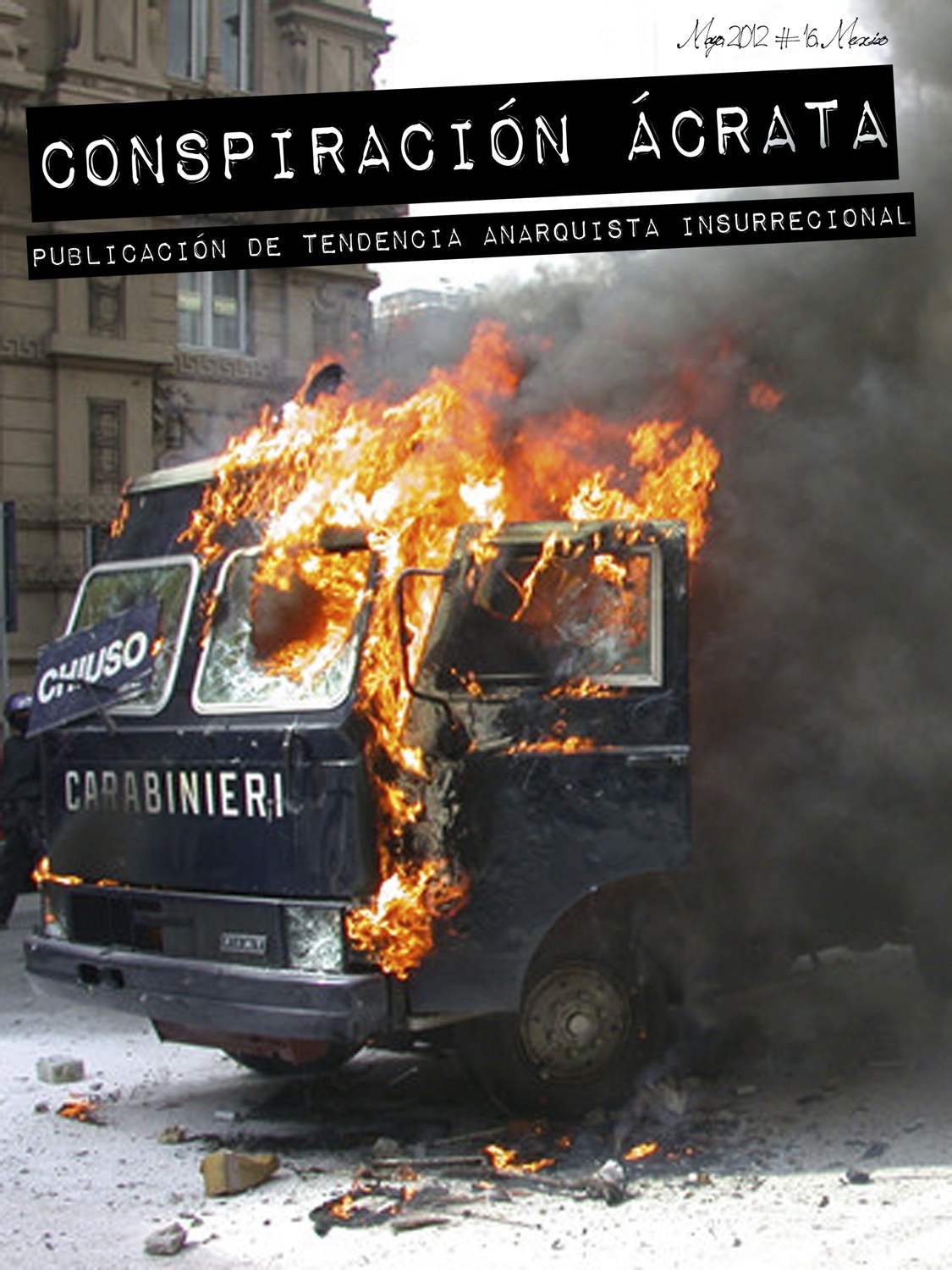
Conspiración ácrata – El antigiuridismo anarchico


El “antigiuridismo anarchico” que traducido al castellano seria “anti-juridicalismo anarquista” es un concepto que a lo largo de la historia del anarquismo se a utilizado para definir la actitud de rechazo radical y total del concepto y de la practica de justicia estatal, ósea el rechazo a los métodos jurídicos del estado incluyendo la defensa mediante un abogado.

Esta actitud o concepto es o debería de ser algo normal dentro del movimiento anarquista pero son poc@s l@s compañer@s quienes lo han puesto en practica por diversas razones o estrategias. El “antigiuridismo anarchico” es el rechazo a declarar en los juicios y contribuir al circo montado por el estado, a menudo las declaraciones de quienes se posicionan en esta actitud van dirigías como un dialogo o explicación a l@s mism@s compañer@s del movimiento. Esta actitud es el rechazo de cualquier recurso legalitario mediante el cual se obtiene la libertad.

Para algunas personas las bases del “antigiuridismo anarchico” podríamos buscarlas en los textos de Max Stirner como “el único y su propiedad” ya que de hecho en el pasado han sido l@s individualistas quienes han utilizado este concepto o método mas que nada quienes han recurrido al uso de explosivos o diversos sabotajes contra el sistema ósea “quienes no tenían nada que perder”. Históricamente en Italia fueron los “antiorganizzatori” cercanos al anarquista Luigi Galleani* quienes utilizaron el “antigiuridismo anarchico” aunque habría que subrayar que no tod@s l@s “antiorganizzatori” fueron individualistas pero si se mantenían en un contraste total con l@s anarco–‐sindicalistas. También sabemos de individu@s anarquistas quienes se han posicionado bajo este concepto sin definirlo como tal, ejemplo son muchos Severino Di Giovanni y Paulino Scarfò en argentina, algunos anarquistas denominad@s como l@s Galeanistas en EUA, anarquistas franceses como Ravachol o Emile Henry, o italianas–‐estadounidenses como Gabriella segata Antonili**

En la actualidad esta el caso de l@s compañer@s de las CCF*** de Grecia quienes han utilizado el “antigiuridismo anarchico” como actitud de ruptura con el sistema jurídico y además con la sociedad de masas negándose a declarar y así colaborar con las investigaciones de la policía. CCF han emitido comunicados respecto a esto pero como una forma de comunicarse con l@s compañer@s solidari@s mas no como explicación o justificación ante el estado. Sin emitir juicio alguno podemos que el “antigiuridismo anarchico” es una actitud tomada individualmente (o colectiva en el caso de CCF) que parte de dos vertientes. Una es la convicción individual en no mantener en lo máximo diálogos ni compromisos con el estado/capital o la línea de políticas a seguir que cada individuo, grupo o célula mantiene en contraste a la realidad actual. Por otra parte puede ser debido a un movimiento consistente y fuerte capaz de reivindicar a sus pres@s y no dejarles sol@s y que es capaz de interrumpir fisicamente el desarrollo de la represión como ejemplo podemos citar el primer juicio contra gente de las Brigate Rosse**** de Italia en que la misma organización ajusticio a jueces, abogados, fiscales, etc.

También sin emitir juicio alguno hay compañer@s que en contraste con esta actitud de ruptura deciden analizar sus posibilidades y tomar “ventaja” o tomar lo legal como “estrategia” para salir de la prisión y afuera continuar la guerra, siempre cuestionando al poderío y sus leyes y tomando a estas mismas o a estos recursos legales como medios que pueden ser utilizados para evadir la cárcel y utilizarlo en la medida de lo posible contra el mismo sistema judicial, teniendo en claro que esto funciona como una estrategia mas no como un dialogo con el poder.

Much@s compañer@s quienes han tomado recursos legales como estrategias han demostrado que una vez en la calle continúan su guerra y se mantienen en conflicto. Desgraciadamente hay “compañer@s” quienes justifican los medios de readaptación social del estado para contradecir a nuestr@s compañer@s en guerra realizando afirmaciones como: “a ti la cárcel no te ha hecho entender”. De cualquier modo las dos actitudes son sumamente valorables pero a lo largo de este articulo se ha intentado dar a conocer el concepto que define esta actitud.

Hay algunos estudios de filosofos del derecho sobre el “antigiuridismo anarchico” de Max Stirner***** pero generalmente son escritos académicos que valoran a un Stirner nihilista y existencialista.

Breves notas.

*Luigi galleani fue un anarquista italiano radicado en estados unidos quien editaba el periódico Cronaca sovversiva que fue editado por primera ves el 6 de junio de 1903. Una característica de Cronaca Sovversiva era la lista de direcciones y vinculaciones de empresarios, “espías capitalistas”, rompehuelgas y todos aquellos considerados “enemigos del pueblo”. Luigi galleani además edito un librillo sobre como hacer bombas y que titulo “la salud esta en usted” y que fue traducido a diferentes idiomas del cual se presume Emma Goldman colaboro. El circulo de anarquistas alrededor de Cronaca Sovversiva fue llamado “l@s galeanistas” y en su auge realizaron numerosos ataques con bombas contra instituciones del estado/capital, resalta el atentado en Wall Street efectuado por Mario Buda y que fue el primer coche bomba de la historia, también enviaron gran cantidad de paquetes bomba contra personalidades de la iglesia, estado y capital y expropiaciones a negocios capitalistas. Luigi también publico varios articulos el mas destacado fue publicado en 1914 titulado “Faccia a faccia col nemico” y que Severino Di Giovanni utilizaría mas adelante en culmine y tomaría como actitud de vida. El periódico Cronaca salio durante 15 años hasta que fue prohibido por la ley de sedición, cave destacar que los anarquistas Sacco y Vanzetti eran cercanos a su circulo.

** Gabriella segata antonili fue una anarquista italiana que a sus 19 años fue arrestada el 17 de enero de 1918 por transportar dinamita en una cartera. Cuando la interrogaron dio un nombre falso y rehusó cooperar con las autoridades o brindarles alguna información; fue enviada a prisión durante 14 meses. Mientras permaneció en prisión Antolini conoció a la notoria anarquista Emma Goldman con quien trabó amistad. Gabriella era del grupo de l@s galenaistas de Cronaca sovversiva.

*** CCF es el grupo de guerrilla urbana anarquista–‐nihilista de Grecia “Conspiración de las células del fuego” quienes han realizado acciones directas que van desde incendios hasta ataques explosivos como el perpetrado contra la corte en vísperas del juicio de algunos de sus integrantes. CCF también fue autor de el envió de paquetes bomba a diferentes embajadores y dirigentes del capitalismo mundial incluyendo al Berlusconi. Actualmente integrantes de CCF se encuentran en juicio.

**** Brigate Rosse (brigadas rojas) fue un grupo guerrillero marxista de la década de los setentas que actuó en Italia y ejecuto varias acciones armadas contra gente del poder. Este fueron los años llamados como “los años del plomo” en Italia en los cuales también actuarían much@s anarquistas con acciones directas y el grupo de acción anarquista Acción Revolucionaria.

***** Max Stirner fue un teórico anarco–‐individualista o individualista que nació en 1806 y murió en 1856, su obra mas popular fue “el único y su propiedad” la cual ha causado innumerables discusiones al interior del movimiento anarquista incluido el de acción.

--extraido da Conspiracion Acrata n. 13

L’antigiuridismo anarchico da Conspiracion Acrata


fonte: http://culmine.noblogs.org/post/2011/10/09/conspiracion-acrata-publicacion-anarquista-insurreccional-y-revolucionaria-13/

L’“antigiuridismo anarchico” che in spagnolo dovrebbe tradursi “anti-juridicalismo anarquista” è un concetto che nel corso della storia dell’anarchismo è stato utilizzato per definire l’atteggiamento di rifiuto radicale e totale del concetto e della pratica della giustizia statale, ossia il rifiuto dei metodi giuridici dello stato, inclusa la difesa per mezzo di un avvocato.

Questo atteggiamento o concetto è o dovrebbe essere qualcosa di normale all’interno del movimento anarchico, ma sono pochi i compagni che l’hanno messo in pratica per diverse ragioni o strategie.

L’“antigiuridismo anarchico” è il rifiuto a farsi interrogare nei processi e di contribuire al circo messo su dallo stato. Spesso le dichiarazioni di quelli che si riconoscono in questa pratica sono rivolte ai compagni del movimento come forma di dialogo o di spiegazione. Con questa pratica si rifiuta anche qualsiasi ricorso legalitario attraverso il quale si potrebbe ottenere la liberazione.

Per alcune persone le basi dell’“antigiuridismo anarchico” potrebbero essere cercate nei testi di Max Stirner, come “L’unico e la sua proprietà”, in quanto nel passato sono stati gli individualisti coloro che hanno fatto ricorso a questo concetto o metodo, in particolare coloro che son stati protagonisti di attacchi esplosivi o di azioni di sabotaggio contro il sistema, ovvero “quelli che non avevano nulla da perdere”.

Storicamente, in Italia, sono stati gli “antiorganizzatori” vicini all’anarchico Luigi Galleani* ad utilizzare l’“antigiuridismo anarchico”, anche se bisogna sottolineare che non tutti gli “antiorganizzatori” siano stati degli individualisti, ma certo erano in netto contrasto con gli anarco-sindacalisti.

Ma sappiamo anche che ci sono stati individui anarchici che hanno scelto questa pratica senza definirla come tale. Di esempi ve ne sono tanti: Severino Di Giovanni e Paulino Scarfò in Argentina, alcuni anarchici denominati galleanisti negli USA, anarchici francesi come Ravachol o Emile Henry, o italo-americani come Gabriella Segata Antolini**

Attualmente, c’è il caso dei compagni della CCF*** della Grecia che stanno ricorrendo all’“antigiuridismo anarchico” come atteggiamento di rottura verso il sistema giuridico ed anche verso la società di massa, rifiutando di esser interrogati e di collaborare in tal maniera con le indagini della polizia.

La CCF ha emesso comunicati su questo, ma si tratta di una forma di comunicare con i compagni solidali piuttosto che una spiegazione o giustificazione dinanzi allo stato. Senza emettere alcun giudizio, possiamo dire che l’“antigiuridismo anarchico”è un atteggiamento preso individualmente (o collettivamente, com’è il caso della CCF) che scaturisce da due fronti.

Il primo è il convincimento individuale nel non instaurare in alcuna maniera dialoghi o compromessi con lo stato/capitale o quelle linee politiche che ciascun individuo, gruppo o cellula avversa.

Il secondo può esser dovuto ad un movimento consistente e forte capace di rivendicare i suoi prigionieri ed a non lasciarli soli, al punto di esser capace di impedire fisicamente lo svolgimento della repressione; come esempio possiamo citare il primo processo contro la gente delle Brigate Rosse**** dell’Italia, in cui la stessa organizzazione giustiziò giudici, avvocati e magistrati, ecc.

Senza emettere alcun giudizio, bisogna anche sottolineare che ci sono compagni che in contrasto con questo comportamento di rottura decidono di valutare le proprie possibilità e trarre “vantaggio” o assumere la via legale come una “stratega” per uscire dal carcere e continuare la guerra dall’esterno, mettendo sempre in discussione il potere e le sue leggi. In questo caso si ricorre a leggi o scappatoie legali come mezzi che possono esser utilizzati per eludere il carcere e -nei limiti del possibile- per contrastare lo stesso sistema giudiziario. Ma bisogna sempre ricordare che tutto ciò funziona come una ulteriore strategia, ma non come una forma di dialogo con il potere.

Molti compagni che hanno scelto di ricorrere alle vie legali come strategia hanno dimostrato che una volta liberi continuano la loro guerra e che si mantengono in conflitto.

Purtroppo, ci sono “compagni” che giustificano i mezzi di riadattamento sociale dello stato per contraddire i nostri compagni in guerra, giungendo ad affermazioni quali: “a te il carcere non ha insegnato nulla”.

Ad ogni modo i due comportamenti sono notevolmente apprezzabili, ma con questo articolo s’è cercato di far conoscere il concetto che definisce questo atteggiamento.

Ci sono alcuni studi da parte di filosofi del diritto sull’“antigiuridismo anarchico” di Max Stirner***** , ma in generale sono scritti accademici tesi ad avvalorare uno Stirner nichilista o esistenzialista.


Brevi note.

*Luigi Galleani: anarchico italiano che visse negli USA. Editore del periodico Cronaca sovversiva, che fu pubblicato per la prima volta il 6 giugno 1903. Una caratteristica di Cronaca Sovversiva era l’elenco degli indirizzi e collegamenti di imprenditori, “spie capitaliste”, crumiri e tutti quelli che venivano considerati “nemici del popolo”. Luigi Galleani editò un libro, tra i tanti altri, sul come fabbricare bombe e che intitolò “La salute è in voi!”, tradotto in diverse lingue, ed al quale si presume che collaborò la stessa Emma Goldman. Il circolo di anarchici vicini a Cronaca Sovversiva venne chiamato dei “galleanisti” e nel periodo di auge realizzò numerosi attacchi dinamitardi contro istituzioni dello stato/capitale, tra questi l’attentato contro Wall Street da parte di Mario Buda, da annoverarsi come la prima auto-bomba della storia. Il gruppo inviò anche numerosi pacchi bomba contro personalità della chiesa, dello stato e del capitale, oltre ad aver effettuato numerosi espropri ai danni di attività commerciali capitaliste. Luigi ha pubblicato diversi articoli, tra questi quelli che vanno sotto il nome “Faccia a faccia col nemico” e che Severino Di Giovanni avrebbe utilizzato più tardi su Culmine e che avrebbe preso come comportamento di vita. Il periodico Cronaca sovversiva uscì per 15 anni, fino a che non venne proibito dalla legge di sedizione. Da rimarcare che gli anarchici Sacco e Vanzetti erano vicini al suo circolo.

** Gabriella Segata Antolini: anarchica italiana che a soli 19 anni venne arrestata, il 17 gennaio 1918, perché trasportava dinamite nella sua borsetta. All’interrogatorio fornì un nome falso e si rifiutò di cooperare con le autorità e di fornire ad esse qualsiasi informazione. Venne inviata in carcere dove vi rimase per 14 mesi. In carcere la Antolini conobbe la nota anarchica Emma Goldman, con la quale instaurò un’amicizia. Gabriella apparteneva al gruppi dei galleanisti di Cronaca sovversiva.

*** CCF: gruppo di guerriglia urbana anarco-nichilista della Grecia “Cospirazione delle Cellule di Fuoco” che ha realizzato diverse azioni dirette che vanno da incendi fino ad attacchi esplosivi, come quello effettuato ai danni del tribunale alla vigilia del processo contro alcuni suoi membri. La CCF s’è anche resa responsabile dell’invio di pacchi bomba diretti a diversi ambasciatori e dirigenti del capitalismo mondiale, Berlusconi incluso. Attualmente i membri della CCF si trovano sotto processo.

**** Brigate Rosse: gruppo guerrigliero marxista degli anni ’70 che ha agito in Italia ed ha effettuato diverse azioni armate contro persone del potere. In Italia, quelli furono gli anni chiamati “anni di piombo”, ai quali hanno partecipato anche molti anarchici con azioni dirette ed il gruppo di azione anarchica chiamato Azione Rivoluzionaria.

***** Max Stirner: teorico anarco-individualista o individualista, nato nel 1806 e morto nel 1856. Il suo lavoro più noto è “L’unico e la sua proprietà” che ha provocato innumerevoli discussioni all’interno del movimento anarchico, incluso quello d’azione.

http://culmine.noblogs.org/2011/10/18/conspiracion-acrata-%e2%80%93-lantigiuridismo-anarchico/

lunedì 19 marzo 2012

About ‘’ANTI-JUDICIAL ANARCHISM’’, Max Stirner, Luigi Galleani, CCF & More.


Here i san english translation o fan article fron the journal ‘’Conspiracion Acrata’’ from Mexico, referring to the idea of ‘’Antigiuridismo Anarchico’’

‘’Antigiuridismo Anarchico’’ which translates to ‘’Anti-Judicial Anartchism’’ is a concept which has been used throughout anarchism history to define the attitude of a radical and total rejection of the concept and practice of the ‘’justice’’ of the State, or as otherwise said – the judicial methods of the State including defence through a lawyer. This attitude or concept is or should be something normal within the anarchist movement but there are few companer@s who have put it into practice for diverse reasons or stretegies.
Antigiuridismo Anarchico is the rejection of declaring a position to the State in front of the court or contributing to the circus of the State. Often the declarations of those who position themselves in this attitude are only directed as a dialogue or explanation to the companer@s of their movement. This attitude is the rejection of any legal resources through which one could obtain ‘’freedom’’.
For some, Antigiuridismo Anarchico’s basis can be found in the text of Max Stirner such as ‘’The Ego And Its Own’’ as individualist have used this concept or method in the past, usually those who have used explosives or have been involved in diverse sabotages against the system, in other words those who have ‘’nothing to lose’’.
Historically, in Italy the ‘’Anti-Organizzatori’’ (anti-organisationalists) close to the anarchist Luigi Galleani used the Antigiuridismo Anarchico method, although it’s worth noting that not all of the ‘’antiorganizzatori’’ were individualists, however they did maintain themselves in a total contrast to the anarcho-syndicalists.
We also know of anarchist individuals who have positioned themselves under this method without without defining it as such, examples include Severino Di Giovanni and Paulino Scarfo in Argentina the anarchists known as the Galleanists in the USA, French Anarchists such as Ravachol or Hemile Henry, or Italian-Americans Gabriella Segata Antolini.
At the moment this is the case with companer@s of the Conspiracy of Cells of Fire from Greece who have used Antigiuridismo Anarchico as an attitude of rupture with the judicial system as well as with the society of the masses, refusing to declare and as such collaborate with the police investigations. The Conspiracy of Cells of Fire has put out communiqués referring to their situation, but as a form of communication with the companer@s in solidarity, rather than as an explanation or justification before the State.
We can see that Antigiuridismo Anarchico is a decision taken individually (or collectively as is the case of the CCF) that works as part of two sides. For one part there’s the individual conviction to refuse to take part in any dialogues or compromise with the State/Capital or the line of politics, ensuring that each individual, group or cell maintains itself, in contrast to the current reality. The other part can be owed to a consistent movement and a strong capacity to stand with prisoners and not leave them alone and one that is capable of physically interrupting the development of repression, for example we could cite the first trial against those of the Brigate Rosse in Italy, in which the same organization brought judges, lawyers, prosecutors etc, to justice.
Furthermore, without putting forward any judgement whatsoever, there are other companer@s who, as a contrast to this position of complete rupture, decide to analyse their possibilities and take advantage of legal avenues as a ‘’strategy’’ to get out of prison and continue the war on the outside, always questioning power and its laws and taking these same laws or resources as weapons that can be used to avoid prison based on what’s possible within the judicial system, taking into account that this only works as a strategy and not as a dialogue with power. Many companer@s who have taken use a legal resources as a strategy have demonstrated that once back on the street, they continue the war and maintain themselves in conflict. Unfortunately, there are some ‘’companer@s’’ who justify the State medium of ‘social rehabilitation’, to attempt to contradict our companer@s in war, affirming such things as ‘’you haven’t learnt anything from your time in prison’’.
Whichever way you look at it, two attitude are equally valuable, however during this article we have attempted to lay out the concept defining the particular standpoint of Antigiuridismo Anarchico. There are a few philosophical law studies about Antigiuridismo Anarchico by Max Stirner, but generally they are academic texts which refer to a more nihilist and existentialist Stirner.
Luigi Galleani was an Italian Anarchist who lived in the USA and edited the publication Cronaca Sovversiva which was edited for the first time on the 6th of June, 1903. One of Cronaca Sovversiva’s characteristics was the listing of addresses and location of businessmen, ‘’capitalist spies’’, strike-breakers and all those considered enemies of the people. Luigi Galleani also edited a bomb-making manual called ‘’Health Is In You’’, which was later translated into various different languages by various people supposedly including Emma Goldman. The Anarchist circle that revolved around the Cronaca Sovversiva were called ‘’The Galleanists’’ and in their time carried out numerous bomb attacks against institutions of the Stae and Capital, such as the first car-bomb in history carried out by Mario Buda. They also sent a great number of packet bombs to personalities of the Church, State and Capital and expropriated the businesses of capitalists. Luigi also published various articles, the most well known called ‘’Faccia a Faccia col Nemico’’ in 1914, which Severino Di Giovanni later would use in his publication ‘’Culmine’’, as well as in his way of life.
The newspaper Crocana was published throughout 15 years util it was banned under the Sedition law. It’s worth nothing that the anarchists Sacco and Vanvetti, were close to the publication’s circle.
Gabriella Segata Antolini was an Italian anarchist who was arrested on the 17th of January 1918 at the age of 19 for transporting dynamite in a purse. When she was interrogated she gave a false name and refused to ccoperate with the authorities or give them any informations. She was sento to prison for 14 months. During her time in prison she got to know the notorious anarchist Emma Goldman with whom she formed a friendship. Gabriella was from the Galleanist group from the Cronaca Sovversiva.
The Conspiracy of Cells of Fire is an anarchist nihilist urban guerrilla group from Greece who have carried out direct actions ranging from arson attacks to powerful wxplosive attacks such as that carried out against the Athens Courthouse in solidarity with their imprisoned members. The CCF also sent a number of packet bombs to different abbassadors and world capitalist leaders including Silvio Berlusconi. Currently there are members of the CCF under trial.
The Brigate Rosse (Red Brigades) were Marxist guerrilla group from the 1970s who carried out various armed actions against those power. Those years were called ‘’The years of Lead’’, in Italy, a time in which many anarchists also carried out direct action, and some formed the anarchist action group Azione Rivoluzionaria.
Max Stirner was an anarco-individualist theorist who was born in 1806 and died in 1856, his most popular (after L’Unico, my note) work was ‘’The Ego and Its Own’’ which caused unnumerable discussions within the anarchist movement, including the anarchists of action.

(extract from Dark Nights newsletter) nye 2011-2012.

Edizioni Cerbero – Intro. The Temple of Prophecy


Intro. The Temple of Prophecy

In the second part, on judicial contests, we have described the subject-defendant in a double metaphorical and allusive way.

http://325.nostate.net/?p=4117

The structural method of this double way (which is an indication-way of coming to a joint simplification of the one-subject) makes the trial a process of ambiguous and programmatic explication.

The reduction of the one-subject to a ‘subject’ in an induction by structured form amplifies the terms of derivation in a limited time, where the one-subject is defined in a definite manner as ‘defendant-subject’, which becomes a limited ‘term’.

Clarifying signs of the subject in a definition given in a definite manner expresses their procedural clauses to the subject himself.

The amoral anarchist anti judicial attitude as said in the previous introduction hits the sacred altar of the ‘right law’, where the expression of the clarifying signs imprints the cancellation of any peculiar choice, and completely(not marginally) reshapes the contraposition of an approximate alternative of the use of the form of the law and its counterpart.

The amoral anarchist anti judicial attitude extends its negation to any minimum contact with ‘justice’, searching for experimentation of life at the extremes of this experimentation.

The composite form of a form in line with ‘jurisprudence’ establishes and redeems, by concealing, any choice that belongs to the individual.

In the negation of the ‘right-duty’, in amoral terms, any prophetic prophecy is nullified.

To each one their choice.

‘The Ego without Limits, and so we are originally and so we stay within ourselves, is the non suppressible criminal of the State.’ i


I
General principles

‘Incompatibility of the judge who pronounced the contested sentence to participate in the following grades of the trial, and to participate to the adjournment after reversal or revision of the proceeding (art. 34).’

DECOMPOSABLE COURSE: BREAKING DOWN

The course of ‘elapsing’ of a term that is a limited passing of time is a ‘limited time’ that passes through and incurs in the terms of ‘limited time’.

The elapsed time creates a therapy, which is the cure of the elapsing of a term.

The therapy is a term that establishes the elapsing, which is accomplishment of a composite and theoretical border.

A cure composes a boundary in decompressing an elapsed time and the theory confined between theory and composite.

Article 24 paragraph 1 affirms that “anyone can act in a proceeding for the defence of their legitimate rights and interests.” ii

The means of judicial contest are typical (obligatory nature of the means of judicial contest).
The principle is exposed in art. 568, according to which

The law establishes the cases when a judge’s decision can be contested, and determines the means of this contest (objective obligatory nature)

A judge’s decisions concerning personal freedom and sentences are always subjected to appeal in cassation, where they cannot be otherwise contested.

The right to judicial contest only belongs to those to whom the law expressly confers it (paragraph 3, objective obligatory nature)


FOUNDATION: PRINCIPLE: TRUTH

The boundary between theory and composite is the therapy that retraces the ‘boundary’ in an elapsed time, made by decomposed and accomplishment.

The methodological course accomplishes a theory that estimates the elapsed value between a time in ‘decrease’ and a ‘commencing’ term.

The parameter of value is a value in decomposition that retraces a boundary between therapy and cure, and which puts an end the deprecating decrease in a time with a commencing term.

Typology is the practicability of the elapsed term in a balance given by an indefinite term that has been defined and therefore it is definitely ‘defined’.

To collocate a definite time in a time that has been elapsed and defined in a definition of practicality.

‘I’m this way: as I don’t recognize any duty and therefore I don’t get tied or try to get tied.
If I don’t have any duty I don’t recognize any law.’ iii

The principle of the prohibition of the reformatio in pieus [this is Latin]: the judge of a contested proceeding is forbidden from pronouncing a sentence that is more unfavourable than that of the first judge towards the defendant, when the latter only and not also the public prosecutor has contested the proceeding (art. 597, paragraph 354).


IMMEDIATE SYLLOGISM OF MEDIATION

The definition of ‘trajectory’ cannot be split into a composing fraction in the elapsed time, along a boundary that is composed between an elapsed time and a commencing term in the passage from the limit which gives a boundary to the trajectory.

There is a divergence between the term ‘trajectory’ and the act of going through a limit whose passage is given by a practical decomposition.

The articulation expresses a meditation where the trajectory consists in putting the thinking of a ‘viable’ trajectory into a temporary enacting of a time determined by the thinking.

The thinking flows within the boundaries between an elapsed time and a decreasing term in a decipherable and indivisible composition between therapy and cure.

‘As soon as man conceived the idea that those who violate other’s rights must be punished for this, it was a logic necessity that judgement in an objective sense immediately sprang up, i.e. that an intellectual operation was carried out, with which – once it was ascertained that someone has violated a right – the consequence of the punishment to be inflicted was made clear.’ iv

Convertibility of a contested proceeding.

This complies with three profiles logically connected to each other:

The erroneous qualification given by the party who is contesting the proceeding is not an obstacle to its automatic conversion (ope legis [Latin]) to an appropriate means.

If the contested proceeding has been proposed to an incompetent judge it is considered as formulated in a correct way before a competent judge to whom the documents must be transmitted by the first judge (art. 586, paragraph 5).

A contested proceeding becomes appeal when different means for the contest of the sequence of the grades of judgement prevails (art. 580). However, the conversion of a contested proceeding into appeal is admissible only if the connection as exposed by article 12 of the penal code exists.


REMOVAL AND RESOLUTION

A consequential prologue is the epilogue consequent to consequentiality. It is a prelude to the premise in a prophetic thinking which utters a:’so that’.

Mediated epilogue between meditation and medication.

A claimable ‘epilogue’ is a prologue of an affirmation that serves the consecration of a meditation that adheres to the mediation between prologue and epilogue.

A profane proffering is similar to the mediation between the meditated and medication.

It is consecrated in an identical medication which is similar to the final premise in the prelude shaped according to the medium between the meditated and medication.

The premise between prelude and the final mediated is congruent between meditation and mediation and the identical epilogue of the permitted prologue.

The adjournment relates to a permitted medication of a similar prologue linked to a logic therapy.

A prophetic meditation outlines a consequential being in a similar mediation between therapy and cure.

A mediate prophecy of a profane medication, which is the goal of the congruent temporariness congruent to the mediation between therapy and cure, is assimilated to the anteposition.

This medication consists in the dilatation of a proffering in a similar final premise of a prelude of the consequent ‘assimilated’ limbo.

A stand-inv exposing himself is an imposition on the word ‘defendant’ in a prophetic time.

A mediated recurrence between mediation and medication can be compared to the word ‘defendant’.

The consequential term passes through the border between time limit and limiting time.

A stand-up intervenes in the elapsing of a course between ‘meditated’ mediation and ‘meditated’ medication in a prophetic time.

The word ‘defendant’ penetrates a time limit in the boundaries of the terms of a ‘limited term’.

Rebuilt in a limited time, a stand-up stands inside the hospitalization concerning the mediation between the meditated and medication within a temporary cure.

The therapy is given by a stand-up referring to a hospitalization going through a boundary where the time limit is a time limited between the word ‘defendant’ and the limited term that can be assimilated.

Once it deduces a ‘term’ it identifies it in the rebuilding that has given a form to the mediated structure of a temporary limbo, all within a proffering time that proffers a need of amputation.

‘It is a call for cure.
To be guilty is the being that we call cure.
In this confusion the fact of being is in an original relation with oneself.
The confusion brings the being before an unequivocal nothingness, which is part of its ability to be oneself, for in the being as a cure is the essence of the being. It is from the confusion that the being calls oneself as a derelict oneself and then wakes up to its ability of being oneself. This call is a call backwards by calling forwards.’ vi

Immediate reproducibility in cassation

‘According to the first paragraph of art. 56B, when the concerned party detects law faults in a sentence, it can make appeal to the cassation only as concerns that grade of the appeal (appeal for saltum [Latin]. However it is necessary that all parties who have already manifested the will of making recourse to the appeal adhere to the appeal in cassation, art. 569, paragraph).


SYMPTOM OF A SYMPTOMATIC PROPOSITION

The prognosis of the word ‘defendant’ consists in putting this word into an identity of stand-up following a whole and indivisible line.

The move of a stand-up demands the lining up of the word ‘defendant’.

The identification of the word ‘defendant’ takes place in the premised ‘premise’ of a mediation between mediated and medication.

Its form is a whole and indivisible one because it is formed by a time limit and a limiting term.

A stand-up rebuilds a whole and indivisible form, which is inseparable from a structural integrity confined in a time limit inside a prophetic temporality determined by a ‘term’.

The course of a resolution of a ‘time limit’ determines a ‘term’, which runs along the boundary between meditation and medication of a temporal limbo.

This term is the deduction of the meditation in its approaching the medication.

Once the ‘passage’ is passed through, the lining up of the structure of the mediation exacerbates the behaviour of the word ‘defendant, while the prognosis deducts the course as the approaching of the epilogue premised by a prologue in a distinctive sign deduced by the recurring being: the amputation.

Cohesion is given by the analogy between the deduction of the course of the boundary of a time limit and a limiting term.

A stand-up expresses the need of a boundary between a time and a limit in a term.

The boundary is given by the word ‘defendant’, which now – having passed through the course – expresses clear signs of identification of structure and form in a word that is ‘mediated’.

Cohesive between identification, structure and form, the stand-up – which is ‘structural form’ – expresses the docile deduction of a meaning which runs parallel along a boundary between time and limit.

‘The Labyrinth of the guilt is a labyrinth of words. It is in the speeches of this “not guilty” that an attempt is being expressed not so much at carrying out a given defensive strategy as at removing the guilt from one’s conscience. At this point the theme of judgement and that of the guilt result inextricably intertwined, especially as the former cannot be comprehended independently from the latter. The one finds its speculating reflex into the other.’

Renunciation of a contest

‘In a trial it is natural that the concerned parties can renounce the imposed burden. In that case the public prosecutor by the judge ad quem [Latin], if he cannot substitute the prosecutor below him, he can nevertheless renounce the imposed burden put in action by the previous prosecutor as soon as the trial is carried out (art. 589). In this case the contest is declared inadmissible (art. 591).’


DECOMPOSED AXIOM

The above mentioned paragraph expresses a declaration similar to the parameter of the word ‘defendant’.

This declaration declaims and refers to the structure of the identifying form.

A digression is the boundary triggering the search for a structural form which becomes and extends its bases between a time limit and a limiting term of a limbo in a prophesized temporality.

The connexion between an identifying structure and a structural form unravels itself in a parallel whose measure is the threshold in which the term is defined in the ‘stand-up’.

The structure of the identifying form intervenes in the time limit under the form of a proposition of prophylaxis.

The mediation between mediated and medication defines the structural form since its bases and leads it to a conclusion in a prelude that runs in the time limit and that searches for a prophesised limiting term in a consecrated limbo.

A stand-up defines the definition ‘structural formation’.

The therapy is a mediation of the cure in the course which is the prelude of an epilogue.

The reflex of an identifying structure becomes a synthetic form of the temporary limbo in a prophetic time and in a temporal consecration.

A summary scheme is a simulacrum of an invocation which becomes composition of the medication, in the decomposition of the prophecy into prophylaxis.

A proposed measure is the lining up of the crossing of a boundary, where the course is limit subjected to an indivisible procedure of a scheme similar to the preceding one, which is premised to the final end by an invocation in a limbo where the ceremony is prophesised in an amputation.

‘The people who are absolutely necessary to the penal judgement are three: prosecutor, defendant and judge.’ vii

Those entitled to power of contest

In theory those entitled to the right of contest are the parties, i.e. the defendant (art.571), PM (art. 570) and the plaintiff (art. 572). Nevertheless the right to contest also pertains to subjects who are not parties, for example:

Kinsmen of the defendant (or heirs in case of death) are entitled to the right of contest.

The plaintiff condemned to repaying expenses or damages is entitled to the right of appeal and cassation appeal.

The defender, parents for children subjected to their guardianship and the guardian for the people subjected to his tutelage are also entitled to the right of contest. Even if the defender is contumacious his defender is entitled to contesting the sentence (art. 571, paragraph 3).

ANITNOMY AT THE PEAK OF COLLISION

The course ‘premises’ the epilogue of an amputation in an indivisible structure.

The consecration is the derivation of the stand-up, whose sign is the ideogram which runs along the boundary between a time limit and a limiting term in the Temple of prophecy.

A disruptive incepts reduces the sign of a symbolic representation, between a temporal limbo and a temporary prophesised ceremony.

The imaginative symbol crosses the boundaries between time and limit in search of the amputation.

The examined form becomes again a mediation between mediated and medication.

The stand-up urges to the reflux through the definite prophetic consecration in an adjoining limbo.
The word ‘defendant’ transmits the allocution of ‘although’ to the ‘at least’.

The intercalating of the consecration defining the ‘at least’ deducted by the ‘although’ is complementary to the identifying structure.

As it is deducted by the ‘although’, the ‘at least’ exteriorizes the meaning of the intrinsic sign inside the word ‘defendant’.

The representation of a symbolic representation is the ‘although’ deducted by the ‘at least’.

The hospitalization has an effect of speculating affection when it deduces that the ‘at least’ is on the line of representation of an allocution in the ‘although’.

The course is the imaginative symbol that crosses the boundaries in a search between time and limit and exploration of the amputation, and it finds its stand-up in a prophetic time.

The flowing is the deduction that consecration gives a clear sign to the word ‘defendant’, a sign that pushes to the structured form of the stand-up in prophesising a temporal consecration.

The representation of a symbolic representation attains the word ‘defendant’ while showing the sign as the stand-up of a sign decomposed in the temporal depiction of an amputation.

The line of transmission between a word and a sign is the identification in the prophetic celebration, which becomes again a representation of the symbolic representation of the proffered hospitalization, in the prominence of a sign composed in the decomposition of the deduction of a prophetic profile.

The flowing is the amputation consecrated in a limbo of the Temple of prophecy.

Law

1 Adj ‘That goes along, that is done following an axis, without bending on either side’.

2 Noun ‘Of a thing with two faces, a faces that shows itself because it is more beautiful or somehow more meaningful.’

3 Adv ‘Following a straight line’.viii

Contest by the contumacious

‘The recent law number 60, in implementation of community instructions, has widened the guarantees to allow contest of contumacious sentences. By modifying article 175 of the penal code, it has been established that on request of the contumacious defendant the latter can contest the trial, unless it is proved that he has received actual knowledge of the trial or of the measure (…) The new aspect is in the fact that the defendant is no longer obliged to demonstrate that the lack of trial was not due to his fault’.

CORRELATION BETWEEN ACKNOWLEDGEMENT AND RECURRENCE

The bases of a structural formation that are collocated between a time and a limit have a definite but elusive principle, where the base is the ‘being collocated’ in a temporal limbo.

A synthetic levelling poses the material for the symptomatic bases in the essence of the ‘elusive’ but with a ‘definite’ principle.

The rebuilding of a base of an ‘elusive definite’ is a principle of the essence which stays in the cause searched between a time and a limit intrinsic to the temporary consecration in the Temple of prophecy.

To erect the foundations of a structural formation results in the collocation of the essence in a principle through the consecrated amputation.

The manifestation of the word ‘defendant’ contains the same base as can be found in the essence of the stand-up.

The limit of the principle is a passage between a mediation and a medication, which become the essence of a consecration proffered and composed in a decomposition decomposed in a decomposing structure.

Coherent in its acknowledgment of the consecration, the stand-up goes through the flow of a structure systematic to the fathoming of the principle and its essence, but it does not recognize the values in the reconsideration of the principle intrinsic to the value itself.

The reflux is a value in its principle and substance, from a value to the essence of an amputation consecrated with a decomposed and recurring form.

By isolating the principle of the essence of a ‘systematic structure’ on one side and the essence of the principle ‘consecration’, the collocation of the stand-up is defined.

The essence in the principle of individuation in an affirmable profiling.

The centre of the base unravels in a constant flux that flows again in the rivulets of its essence in search of a temporal limbo in the Temple of prophecy.

The rivulets flow and flow back again systematically inside and outside, outside and inside, in a continuous circle in a constant search of a determined need of an interlacement between a principle having is essence in a ‘goal’ and the essence of the principle ‘means’.

The goal of the principle goes through the means of its essence.

Amputation consecrated in a decomposing flux of a decomposed ceremony.

‘It must be properly understood so as not to generate misunderstandings. When we say that prosecution and defence are on the same level in the new trial (even as concerns the distribution of the places in the courtroom, see art. 146) we mean that with reference to the running of the trial, when the confrontation between public prosecutor and defendant takes place before a judge.’ix

Contest not permissible (terms of contest)

‘If request for contest is presented when the date has expired, such contest is not permissible. In particular a contest is not permissible when:

A) There are no legal assumptions or interests.

B) The proceeding cannot be contested (obligatory nature)

C) Terms and conditions for the contest have not been complied with (art 581, 582, 583, 585, 586).

D) A renouncement is presented according to article 589.

INVOCATIVE

To invoke a principle and its essence in a fatal ceremony is to express oneself through an emphatic dogma in a structural form between limbo and the decomposition going through the compression of the devotion deduced by the course of the invocation.

The ramification is a balanced imprinting of the formal structure in a synthesis during the course that widens the terms of behaviour with clear signs of a fatal ceremony, which collocate the word ‘defendant’ at the centre of a representation of a symbolic representation.

The expression of the clarifying signs brings an amorphous form of the stand-up out of the word ‘defendant’. This is a temporal limbo composed by a form decomposed between ‘composing’ and ‘decomposition’.

The essence of the nucleus of the form imprints a sign that progresses and intensifies at the approaching of the beginning of the fatal ceremony in the Temple of prophecy.

The completion of the ceremony is a shapeless and amorphous beginning of the clarifying sign, which is the focus essence of the nucleus of the form structured in the stand-up, composed, decomposed and formed in a prophesised temporal limbo.

The nucleus grows and ends up in glimmers of resolution of formative contact and in occlusions of undefined and not viable ravines.

Inserted in a prelude at the principle of individuation.

Composed in the course of a temporal ceremony proffered in a profanation.

The more the sign grows and intensifies the less the word ‘defendant’ determines the prophetic signs composed in a meaningfulness of junctions intervened between decomposition and composition of guide lines of the prophecy between a therapy and a cure.

The nucleus of the identifying structure emerges, erects the accomplishment of its power and limits the spaces. It then takes the essence and principles of these spaces. The principle establishes the ‘definite character’ of the shapeless and amorphous material in the resolution of a consecrated and prophetic amputation.

‘What that no longer has a pure “let live” form but makes recourse to something different, in order to show something, and in so doing it lets something else be seen in the form of something, assumes the possibility of a covering through this synthetic structure.
The truth of “judgement”, however, is not the opposite of this covering, i.e. a phenomenon of the truth having a base derived from more aspects. Realism and idealism fail in the same way.’x

The C.D. Incidental Appeal

‘A special mention must be reserved to the c.d. incidental appeal (article 595), which can be proposed every time that a party that did not make recourse to a contest, according to his or her will, finds himself or herself facing an appeal trial proposed by the other party in the terms that nonetheless keep their precise peculiarities, namely that the party authorized to make recourse to the incidental appeal and therefore acting following the contest of the other party, remains somehow linked to the outcome of such appeal.’

THE FLOW OF AN INVOCATIVE CULT IN AN ANESTHETIZED SUFFIX

The nucleus of the identifying structure measures the principle and essence of the clarifying signs and it calls them and pushes them to a favourable as well as ominous prophetic event.

At the centre of the fatal ceremony, the representation of the symbolic representation induces in the flux of ‘concentric circles’ in attraction. These ‘concentric circles’ encircle the identifying structure in which glimmers feed the material of the base of the structure itself.

The essence of the principle of the glimmers presents countless cracks from where one gets out by getting into a limb composed in a decomposed preaching and in a ‘preached’ limbo.

The structured form of the stand-up examines and catches a glimpse of the glimmers but it only identifies the principle and not the essence, which is a temporary vision where the influx is a formative occluding of the time-space-limit.

The nucleus of the identifying structure absorbs the influxes of the stand-up and expresses an invocation expressed in a prefix: the amputation.

The reciprocity between form and structure inhibits the identifying principles even if the clarifying signs express the being ‘essence’ of the substrate of the word ‘defendant’.

The marginal deductibility, which is significant, ascends the reflux on the border between time and term; both of them are lined up and induced by the limiting, and are composed in the decomposed affirmation of a formative occlusion of the proceeding in the Temple of prophecy.

At the ‘centre’ of the ceremony of the prophetic consecration, the stand-up expresses the principles and the essence of the consecration to the essence itself of the stand-up: the word ‘defendant’.

The knotting of the clarifying signs gives the comparison with its principle to the identifying structure: structured form.

The absent being is a manifestation with a code and an access.

As it ascends a border between time and term, the word ‘defendant’ finds its structural bases in a ‘limiting’ limit, composed in the course of a temporal form decomposed in current transfiguration.

The code is transported around the boundary of the structure and in its countless holes.

The word ‘defendant’ searches its code of access in the principle of the essence of the stand-up and in the Temple of prophecy, in an immanent ceremony.

The beings which is absent in the word ‘defendant’ differs when converging with a code of access in a coexistence between a time and a term, in a limbo run through by the composed form of the decomposed effect.

The effects are adumbrated and eluded by the ‘concentric circles’, which are the boundaries of countless representations of symbolic representations that impress and extend the meaning of the fatal ceremony where the essence of the stand-up is the principle of the word ‘defendant’.

The essence of the word ‘defendant’ is the essence of the principle of a stand-up, which is the limbo that runs through a temporal trajectory in search of the transportation of the ongoing ceremony in the Temple of prophecy.

‘First look for the kingdom of God and his justice, and all these things will be given to you as an extra. Therefore don’t get sunk for tomorrow, because tomorrow already has its worries. Each day has enough sorrow.’ xi

Closed hearing and ‘settlement’ in appeal

The need to simplify and therefore accelerate the course of the judgment of a contest is reflected in the possibility of closed hearing along with that of a trial. A closed hearing is easier and more agile, and it also offers more guarantees to the defendant. In fact the cross examination is merely possible. The recourse to a closed hearing rather than a trial is imposed by the law if the object of the appeal is exclusively centred on the kind or measure of the sentence, or the applicability of bail conditions or of other alternative measures.

METAMORPHOSIS

The approaching of the celebratory function gives the word ‘defendant’ a possible but questionable vision of the structural form collocated on a border where the limit is the time of a limiting time because it is a border where an identifying structure is collocated.

The form is where the principle is essence and ‘time’, and the essence of the principle is the ‘limit’: limb run by a temporary form in a time with a term.

The search of a code of access gives the word ‘defendant’ back to the principle of a stand-up. Its essence is a ‘limbo’ in the running of the decomposition.

The arrangement of a series of procedural rules induces and reduces, hides and manipulates the structural form and widens its ‘hypothesises’, which express the parabola required in a prophetic imminence.

While proposing a principle and an essence in search of a code of access, the ceremony and the function find the consequence of the structural form in the hypothesises.

In an awkward situation, in an unforeseen ‘manner’, the principle of the essence of the word ‘defendant’ emerges.

The stand-up poses questions (?) in a myriad of interpretable allusions, while it suggests a hypothesis between an imperfect ‘imperative’ and a determined composted.

‘Interpreter’ is the fatal ceremony where the nucleus is the representation of the symbolic representation, composed in the decomposed form between essences in search of the fatal form. All this in the proffering of a term evoked between therapy and cure.

The trajectory run through reduces itself to simple premises in an organic disposition of the proposed questions.

The epilogue is a premised prologue.

As the stand-up is the essence of the principle of individuation of the word ‘defendant’, it asks questions (?) by resurfacing in the transpositions of the structural form.

The pathogen induces transmitting links while it conceals the multitude of hypothesises.
The stand-up withdraws itself and exposes and ‘expresses’ (in an expressive term) the principle of its essence.

Some limiting hypothesises impressed in a catalyst lead to the essence of the ‘hypothesis’ in the limbo of a temporal form between decomposition and transposition.

Sometimes it emerges (structure and Hypothesis? Structure is hypothesis), some other times it withdraws, but it is still the principle of the individuation of the word ‘defendant’.

It exposes, imposes and impresses marginal lines of its principle of individuation of the word ‘defendant’ as essence (hypothesis and structure? Hypothesis is ‘structure’).

The celebratory function extends the trajectory in an assignment of devotion, in search of the border between time and term, where the identifying structure has its composed and decomposed bases in a decomposing form.

‘A penal proceeding is nothing more than the exercise of activities that belongs to the law for its assertions, and by law these activities must last until they attain their goal.’xii

‘If the appellant is only the defendant and not also the prosecutor, the judge cannot apply the reformatio in pejus [Latin] so that as concerns a guilty verdict or other sanctions he can only operate in favour of the defendant when making a decision. Therefore, if the prosecutor has not presented request for appeal the judge cannot increase the sentence or decide for new and more serious measures, acquit the defendant through a less favourable formula or revoke benefits.’

STRUCTURAL ELEMENT IN PLANITUDE

The intercalating in a fatal ceremony retraces the clarifying signs in a programmatic manner, through a wide interpenetration in the proffering of a prelude of the prologue of the consecration.

The word ‘defendant’ poses itself in the fatal ceremony in the immanence of the consecration.

The representation of the symbolic representation stands at the centre (being and essence). This representation expresses the message of the principle of the essence of the stand-up.

The ‘concentric circles’ strengthen the borders in an intuition of movements, while approaching the prelude of the epilogue. All this happens in a similar complement of similarity between prologue and epilogue, between temporal limbo and decomposed allusion of the celebratory function in the temple of prophecy.

The word ‘defendant’ is in touch with the essence of the principle of a stand-up in a transposition placed to the reversible prelude.

The stand-up is the essence itself of the principle and essence of the word ‘defendant’.

A parallel trajectory where the transfiguration of the essence confounds itself with, diverges and inhibits the word and the stand-up, adding to an assimilating force where the one is the alter ego of the other one.

The stand-up impresses the clarifying signs in the word ‘defendant’ with a code of access by paraphrasing the meaning in the limbo of the composed form of a prophecy.

Sometimes the identifying structure is placed at the ‘centre’ of a fatal ceremony, some other times it visible in a perceptive way. It expresses the clarifying signs of the essence of the representation of a symbolic representation in the immanence of the approaching of the prophecy.

The stand-up stretches out (or pretend to?) towards the codes, and it expresses them in a marginal but complex procedure in the principle of individuation of the word ‘defendant’.

In the access the two parties split and melt in a continuous circle where the stand-up is the alter ego of the word ‘defendant’.

The structure is identified.
The prelude of the prologue begins, composed in a decomposition of the decomposed limbo.

The ceremony is mediated in a meditation and a medication.
The nucleus is the representation of a symbolic representation that comes along and melts the principle and essence between the word and the stand-up.

The hospitalization advances the allusion: amputation.

‘And remember that you must recognize that the origin of a penal judgement does not stay in the necessity of defending society but in the necessity of defending the law.’xiii

Sentence

Non permissible

A) ‘It is generally pronounced in closed session on request of the attorney general of the same court. It constitutes a sanction determined by the violation of procedural rules (obviously unfounded motives, failure, and forms of contest), i.e. of the inexistence of subjective or objective assumptions (fault in the contest, renunciation of the contest, non application of the proceeding, article 591.606, paragraph 3.615, paragraph 2).

RECONDITE IN A PARABOLA

B) Rejection

‘This occurs when the appeal is unfounded, in the sense that the deduced reasons, even if they do not appear openly inconsistent, reveals themselves as such after the assessment of the judge.’

CALCULABLE IN AN AFFIRMATION

C) Rectification

‘It responds to an existence of conservation of the contested decision, and it occurs every time that errors in the law when indicating texts of reference affect the decision but not its accuracy (errors of denomination, calculation of the sentence, etc, which can be eliminated without requiring discretionary evaluations of the judge in charge).’

REIFICATION

D) Cancellation without postponement

‘Cancellation without postponement consists in the cassation of the sentence in its integrity (in some parts with definition of the trial). In case of partial cancellation, the non announced party becomes definitive (article 624). It clearly implies the superfluity of the postponement because it exhausts the Thema decidendum [Latin] of the same court.’

-

i. Second part The Ego’ in The Ego and its Own, Max Stirner.

ii. The Right to Juridical Defence – Criminal Procedure

iii. Second part The Ego’ in The Ego and its Own, Max Stirner.

iv. Historical Origin of the Penal Code

v. A person taking on the role of an actor in particularly dangerous shots or when specific skills are required. A person who looks very much like another person.

vi. ‘Understanding of call and guilt’, Being and Time, Heidegger

vii. ‘Essential conditions of the penal judgement’

viii. Dictionary of the Italian language, Anonymous (‘Final orifice of the rectum from where faeces are expelled’).

ix. Principle of equality between prosecution and defence, ‘Procedural criminal law’.

x. ‘The concept of logos’, Being and Time, Hiedegger.

xi. Matthew (6.33-34).

xii. ‘Pamphlets of criminal law’

xiii. ‘Philosophical origin of the penal law’

http://325.nostate.net/?p=4584#more-4584